
 United Arab Emirates
 Qatar
 Kuwait
 Bahrain
 Oman
 Iraq
 Turkey
 Lebanon
 Syria
 Jordan
 Egypt
 Morocco
 Tunisia
 Algeria
 Libya
 Sudan

Looking for the Best Home Removals Company from Jeddah to Oman? Al Rahwan moves whole homes out of Jeddah to one standard at every stage: a free survey before any price, packing that survives coastal humidity and then desert heat, kitchens and wardrobes taken apart by carpenters, and a closed truck that travels coast to coast across Saudi Arabia, leaves at the Empty Quarter crossing (Al Rub’ Al Khali) and is let into Oman at Ramlat Khaylah. Your things are in Muscat, Sohar or another northern town 5–7 days after loading, and Al Rahwan’s own crew sets them up in the new home. Expect a starting price from SAR 1,100 when it is one room, from SAR 1,850 when it is a flat of three bedrooms with whatever is plugged in, and from SAR 4,150 when it is a villa. To book a survey, call 0568829975.
🧭 In this guide64 sectionsShowHide
The best removal firm is not the one with the lowest number over the phone; it is the one that leaves you with the fewest surprises. Families who moved out of Jeddah badly tell the same stories: a sofa that arrived smelling of mould, a kitchen with chipped cabinet edges, lost screw bags that left the beds in pieces for a week, a truck held at the border because the inventory was thin, and a crew in Oman with no idea where anything goes. Every one of those stories has a known cause, and each is prevented by a specific step taken before the truck leaves Jeddah, not after it arrives.
- Stated transit: 5–7 days for Muscat, Sohar and the northern belt; Salalah and Al Wusta take a further day or two.
- Itemised pricing: a villa from SAR 4,150, three bedrooms with appliances from SAR 1,850, one room from SAR 1,100.
- Packing for two climates: 3 layers on fabric sofas: cloth or paper, a blanket, then loose plastic.
- The kitchen: dismantled, numbered and sketched, with the stone worktop in a wooden crate.
- Your car: sharing a transporter, a sedan starts from SAR 1,680, while an SUV is from SAR 2,780.
- Assembly: a crew that unloads, assembles and arranges in Sohar, Muscat and the rest of Oman’s 11 governorates.
Standard one: a survey that sees the home before a price is set
A firm that prices a whole villa from a single phone call is betting you will only find the gap on loading day. A free survey puts everything on the table before you agree: how many wardrobes and how big, the kitchen and how it is fixed, the appliances and ACs, the chandeliers and antiques, which floor you live on, the lift situation, and a waiting spot for the truck. The visit ends in an itemised price, a line for each thing, so every riyal is accounted for and anything still outside the price is visible.
If you are travelling before the survey date, or want a rough idea before you fix one, send photos of the rooms on WhatsApp, one shot of each wall, plus the kitchen, the ACs and the stairs or lift. Those photos give an initial estimate to plan around, but a villa or large home still needs a visit in person before the final number, because a photo does not show how deep a wardrobe is, how heavy a worktop is, or what is behind the store room door.
What to ask the surveyor in your home
- Does my load need a dedicated truck, or will a shared one do?
- How many days of packing come before loading?
- Who takes down the kitchen and the ACs, and is reassembly in Oman in the price?
- Will the sofa fit the tower’s lift, or does it need a hoist?
- Which things must not go on the truck?
- Which papers should I have ready before loading day?
What a home removal from Jeddah to Oman costs, line by line
How much will it cost to take a Jeddah household to Oman? The cheapest starting point is SAR 1,100, for a single room; next comes SAR 1,850 for a three-bedroom flat and everything plugged in it; then SAR 4,150 for a villa or full house. Each of those numbers carries the whole job, from the first screw undone in Jeddah to the last piece set up in Oman. Salalah and the remoter governorates simply cost more in proportion to their longer road.
| Item | Starting from |
|---|---|
| One room’s furniture | SAR 1,100 |
| Flat up to 3 bedrooms with appliances | SAR 1,850 |
| Villa or whole house | SAR 4,150 |
| Small office | SAR 1,020 |
| Part load on a shared truck | SAR 410 |
| Dedicated closed truck (transport only) | SAR 4,200 |
| Sedan on a shared carrier | SAR 1,680 |
| SUV on a shared carrier | SAR 2,780 |
| Car on its own carrier | SAR 2,400 |
| Luxury car in a closed carrier | SAR 4,150 |
| Carton or suitcase up to 30 kg | SAR 110 |
| Urgent air parcel up to 5 kg | SAR 110 |
Items such as ACs and their refitting, wooden crates for valuable pieces, storage, insurance, a hoist, and shuttling furniture out of narrow lanes in a small vehicle are priced after the free survey. When you fix the date, ask what the current offer is; Al Rahwan seldom goes long without one.
Sums from real Jeddah homes
- A three-bedroom flat in Al Hamra with the owner’s small home office: SAR 1,850 + SAR 1,020 = SAR 2,870 to start.
- An employee’s room in Al Naeem with his sedan on a shared carrier and a carton of personal things: SAR 1,100 + SAR 1,680 + SAR 110 = SAR 2,890 to start.
- A villa in South Obhur with an SUV and an air parcel of school papers: SAR 4,150 + SAR 2,780 + SAR 110 = SAR 7,040 to start.
- A small office in Al Zahra with an air parcel of backup drives: SAR 1,020 + SAR 110 = SAR 1,130 to start.
Standard two: one packing method for two opposite climates
The problem with a Jeddah household is that it meets two climates on one trip. It is wrapped in salty, moisture-heavy air, then spends a full day in a closed truck crossing the Empty Quarter sands, where the air heats up by day and cools at night. When the air trapped under plastic cools, the moisture in it condenses into droplets on fabric and wood, and then it heats up again. That cycle is what causes mould, swelling and stains. So Al Rahwan never relies on a single layer of plastic; it follows a fixed method for each piece.

| Material | Why it is used |
|---|---|
| Clean unprinted paper | First layer on wood and leather; absorbs moisture and transfers no ink |
| Cloth or a thick blanket | Absorbs knocks and lets air move |
| Corrugated card | Corners of tables and wardrobes, and glass surfaces |
| Moisture-absorbing sachets | Inside cartons of clothes, books and small electronics |
| Loose plastic | Final layer; keeps dust out without trapping vapour |
| Wooden crates | Marble, chandeliers and valuable pieces |
Fabric sofas never change sequence: a sheet of cloth or paper against the upholstery, a blanket over that, and outermost a slack plastic skin that presses on nothing. Before any of that, pieces that stood in a damp room or near an AC are left in the air for an hour to dry, and nothing wet is ever wrapped. Rugs are rolled only when fully dry, and mattresses go into thick bags with a small vent.
What is kept off the truck
Heat ruins candles, perfumes, cosmetics and medicines and makes aerosol cans dangerous, so none of them go in the cartons. Gas and fuel are banned outright. Carry these in your bag or clear them out before the move.
Standard three: a kitchen taken apart and rebuilt without damage
After the appliances, the kitchen is the most valuable thing in the home, and the thing most likely to be damaged when someone untrained takes it apart. Jeddah kitchens are usually one of two kinds: aluminium fixed to the wall, or wood with wall and base units and a marble or granite worktop. The Al Rahwan carpenter starts by disconnecting the sink and mixer once the water is off, then removes the built-in oven and the hood if there are any, then the wall units before the base units, coding each unit and drawing a simple plan of where it sat.

The worktop is never carried as it is. It travels in a wooden crate that supports its full length, because stone snaps at its weakest point when lifted by the ends. Hinges and handles are bagged with the same codes as their units. In Oman the carpenter reads the plan and rebuilds; if the new kitchen is narrower or wider, he suggests a different layout before fixing anything.
Kitchenware and small appliances
Each plate is wrapped on its own and packed upright like books in a divided carton, cups are stuffed with paper, and large pots carry light items inside them. Small appliances, such as a blender or iron, go back in their own boxes if you kept them.
The rest of the home, piece by piece
Bedrooms and chipboard furniture
Beds are dismantled and their panels numbered, mirrors are taken off and wrapped separately, wardrobes are emptied and their doors and drawers removed, and hanging clothes travel in cartons with rails. Screw bags are taped to their panels. Jeddah wardrobes are often made of chipboard, the material that suffers most from damp: once it soaks up water its edges swell and screws no longer hold. So its panels are wrapped in paper and a blanket only once they are dry, and no panel sits directly on the truck floor; it is raised on cartons or timber. Children’s rooms, with their small beds, toys and desks, have their cartons grouped and marked with one clear word, so they are set up first in the new home and the little ones get back to their routine quickly.
Floor majlis sets and corner sofas
Floor majlis sets with their cushions and mattresses go into bags, sofas follow the layer method, and tents and traditional desert shelters are folded only when completely dry, with the poles bundled together. Large corner sofas are split into their sections where they are designed for it, which makes each part easier on the lift and stairs and less likely to twist in the truck. Side and coffee tables have their legs removed where possible and their tops wrapped in corrugated card. The majlis rug comes up last, after the heavy pieces have gone, so nothing is dragged across it and torn.
Fridge, washer and screens
Switch the fridge off a day ahead so it dries; it rides standing. The washer drum gets locked, and screens sit in rigid boxes with foam at each corner. New appliances stay in their factory packaging and are listed in the inventory. The fridge is dried early because water left in its bottom tray leaks into neighbouring cartons and then evaporates in the road heat, raising the humidity of the whole truck. After arrival the fridge should stand upright for some hours before it is switched on, so the compressor oil settles; the technician reminds the family of this during setup.
The ACs in a Jeddah home
The technician pumps the gas into the outdoor unit before dismantling, caps the pipe ends and wraps both units. They are priced after the survey according to number and type. Jeddah homes tend to have many ACs because of the heat and humidity through most of the year, and a mid-size flat can easily have five or more. So the surveyor asks about each one: is it moving or staying with the landlord, and will it be fitted in Oman or stored? The answer changes how many technicians are needed and how long the job takes.
Oil paintings and antiques
Acid-free paper, then card corners, then a carton cut to the size of the painting. Valuable antiques go into wooden crates, with their declared value recorded for anyone who takes insurance. Oil paintings in particular react to damp followed by sudden dryness, and the paint layer can crack if it is trapped in moist plastic. So plastic never touches the face of a painting, and it travels standing on its edge between soft items, never flat under the cartons.
Glass tops and dismantled chandeliers
Glass tops travel upright between two sheets of stiff card. Chandeliers lose their arms and crystals for the journey and travel in a wooden crate.
Curtains, linens and what stays in your hands
Linens and curtains go into cloth bags, suitcases are filled with clothes, and rugs are rolled dry and wrapped on the outside. Gold, passports and certificates stay with you, not in the cartons.
Standard four: reaching every door in Jeddah
Jeddah homes are not all reached the same way, and a good firm knows that before loading day, not after.
Al Balad and its lanes
Historic Jeddah and the older districts around it have streets the big truck cannot enter and old buildings with narrow stairs and no lift. Here a small vehicle, a dyna or a pickup, ferries the furniture out of the lane to where the closed truck is parked on the first road wide enough to take it. That local shuttle is priced after the survey, and the dyna or pickup never crosses the border; only the closed truck does. Narrow stairs mean more pieces taken apart, and thicker padding on corners that rub against the walls.
By the sea: Corniche towers and Obhur villas
In the Corniche towers the service-lift slot is agreed with the building management before loading day, and pieces on the upper sea-facing floors are given longer to dry before wrapping, because the air up there is damper than anywhere else in the city.
Villas in North and South Obhur are large, with majlis rooms, halls, an annex and sometimes a basement or store room, and being close to the sea they hold more moisture than homes in the city centre. A villa here usually takes two days of packing and two carpenters working on the kitchen and wardrobes together; a dedicated truck is only suggested if its volume fills one or the owner asks for a departure date of their own.
Sea-front villas also hold things city flats do not: aluminium or synthetic-rattan garden sets, swings, parasols and barbecues, and sometimes fishing gear in the store room. These pieces have lived in salty air, so the crew wipes them down and lets them dry before wrapping, since salt left on metal rusts faster in the heat of the road. The barbecue is cleaned of ash and grease and its gas bottle removed, because gas bottles do not travel at all. Parasols and swings are broken down into their poles and tied in numbered bundles, with the fixings in a bag carrying the same number, so they go back up in the Omani garden exactly as before.
Loading day in Jeddah, as it really runs
The crew turns up in the morning, and before anything is touched the supervisor tours the home with you, agreeing what travels and what remains, and the remaining pieces get a strip of coloured tape so no one loads them by accident. Then the work splits: the carpenter starts on the kitchen because it takes longest, the AC technician recovers the gas and takes the units down, and the packers begin in the rooms furthest from the door and work towards it, keeping the way out clear until the very end.
By midday the cartons are full, each marked with its number and room, and the carry-down to the truck begins in the order the supervisor sets. In towers the service lift is used in the slot the management has given; if the slot runs out before the work does, it continues in the next one. At the end of the day the supervisor walks the home room by room, the homeowner signs the inventory, and the doors are closed.
Standard five: a supervisor and an inventory that close the truck doors
On every Jeddah move an Al Rahwan supervisor stays with the job from start to finish. He assigns the crew to rooms, checks the packing before each piece leaves its room, and writes every carton number into the inventory with a description of what is inside. The inventory is bilingual since both border posts will read it, and every valuable item is photographed before it is wrapped.
Before the truck doors close, the supervisor runs through a short checklist: are all rooms empty, including the roof, store and annex? Are all the straps tight? Is the first-night box at the back of the truck? Has the homeowner signed the inventory and kept a copy? Only then are the doors shut and your loading notice sent.
Which pieces go in first?
Weight decides the order: the heaviest items stand on the floor, heavy boxes follow, light boxes go above, and sofas and mattresses line the walls, every row belted to the side of the truck.
When is a shared load enough?
One room or a stack of boxes can share a truck with other households from SAR 410, with the drawback that it only sets off once the truck is full. A flat or villa has a starting price that covers the whole move, and the dedicated-truck line only enters the sum if the household fills a truck by itself or you ask for a date tied to nobody else; its haulage then starts from SAR 4,200 and the truck makes no stop before your house.
Route and transit from Jeddah to Oman
Leaving Jeddah the truck aims east, and once the Kingdom is crossed it picks up the Empty Quarter road where it leaves the Al Batha junction. After roughly 564 km of sand it reaches the Empty Quarter crossing, Saudi Arabia’s one overland gateway to Oman and part of the Eastern Province. Ramlat Khaylah, on the Omani side, comes next, and Ibri, chief town of Al Dhahirah, is about 161 km beyond, which makes roughly 725 km from junction to Ibri. Commercial trucks have their own yard at the Saudi post. Because Jeddah sits on the west coast, most of the trip happens before the desert, which is why the time is 5–7 days rather than 3–5.
| Destination | Time from Jeddah after loading |
|---|---|
| Muscat and the northern towns | 5–7 days |
| Sohar and Shinas | 5–7 days |
| Nizwa, Ibri and Rustaq | 5–7 days |
| Salalah and Al Wusta | one to two days more |
| A car on a carrier | about the same as the household |
| Air parcels | 24–48 hours |
Sohar and the route through the UAE
For Sohar and Shinas in North Al Batinah, for Al Buraimi, and for Musandam, going through the UAE can be the better choice: Al Batha into the UAE, then the Khatmat Malaha crossing towards Shinas and Sohar, the Al Buraimi crossings, or Hatta to Al Wajajah towards Muscat. Musandam has no road access except through Emirati territory. On every move Al Rahwan weighs your destination town and the nature of the load before choosing between the desert crossing and the Emirates, and you know the answer ahead of loading.
Customs and clearance at both border posts
It starts in the Kingdom with an e-authorisation you give the broker, who uses it to lodge your export declaration through Fasah (the platform belongs to the Zakat, Tax and Customs Authority); at the Saudi border post an officer may ask for a few boxes to be opened. Then Oman takes over: clearance is finished on Bayan by the customs arm of the Royal Oman Police, its Directorate General of Customs, where the receiver can only be registered with an Omani phone number. Whether second-hand household goods and vehicles attract anything is Oman’s decision under the rules applying when you ship, which is why Al Rahwan reviews your papers and situation before booking.
The broker’s electronic authorisation is a small step that settles a lot: without it he cannot prepare the declaration in your name, and the truck does not leave Jeddah until the declaration is ready. On the Omani side the consignee also has to authorise the broker there, and their Omani number must be active to receive Bayan messages. If you will reach Oman after your household, choose a consignee who lives there and can answer the phone on crossing day.
What holds a truck up?
- A general inventory with no description of each item.
- A name that differs between the passport and the inventory.
- A consignee with no Omani number or no authorisation for the broker.
- Restricted items that were not declared.
- A car with belongings inside.
Documents for a Jeddah move
| Shipment type | Documents |
|---|---|
| Household | Your passport copy, your ID or iqama copy, an inventory written line by line in Arabic and English, and your Fasah authorisation for the broker; from the Omani receiver, a name, local phone, full address (governorate, wilayat, area, floor, lift), a card copy and their authorisation |
| Car | An istimara still in date, the traffic department’s export certificate and export plates, a copy of whoever owns it, a bank letter while instalments remain, no unpaid fines, and an authorisation if someone else sends it |
| Office or showroom | The business’s commercial registration and commercial invoice, a list of what each package holds, the Omani importer’s details, and an origin certificate where requested |
| Government property | Letter from the organisation and its asset list kept separate from the employee’s belongings |
The family car on a transporter from Jeddah
Your car takes a deck on a long transporter, under its cover and held by its straps, keeping roughly to the removal truck’s timetable. What you pay depends on the car and how it rides: from SAR 1,680 for a sedan alongside other cars, from SAR 2,780 for an SUV the same way, from SAR 2,400 for any car given a whole transporter, and a prestige car in a sealed one from SAR 4,150.

Nothing rides inside the car. Its file opens with an unexpired istimara, followed by the export certificate and plates from the traffic department; that certificate is one Oman specifically requires from the car’s country of registration. Behind it go the owner’s ID copy, the bank’s letter for a financed car, proof that it carries no fines, and an authorisation if it is sent by someone other than its owner. On the Omani side the car is checked first and only then entered on the Royal Oman Police register, and before you book Al Rahwan matches your car against Oman’s import requirements.
Air freight: when is it worth it from Jeddah?
Air does not suit a whole home, but it earns its cost in three cases: papers you need on your first day at work or school, work equipment you cannot go a week without, and small valuable pieces you would rather not put on the truck. They go through the cargo terminal at King Abdulaziz International Airport and are collected at Muscat International Airport or in Salalah 24–48 hours later. The first 5 kg of an urgent parcel start at SAR 110; heavier parcels get a quote on their chargeable weight.
By air a parcel has two weights, the one on the scales and the one implied by its size, and you pay on whichever is bigger. Work the size figure out as length × width × height (all in cm) ÷ 6000, so a 50-by-40-by-30 box comes out at 10 kg, so putting only 4 kg in it still costs you 10. That is why a small, tightly packed box is the right choice for air.
Comparing the ways to move from Jeddah
| Mode | For whom? | Time |
|---|---|---|
| Road in a closed truck | Whole homes and cars | 5–7 days to Muscat |
| Air | Papers, devices and urgent items | 24–48 hours |
| Sea | Commercial containers only, from Jeddah Islamic Port to Sohar, Salalah or Duqm | Longer than road |
Sea is not for households; the road reaches your door directly and with fewer steps. Traders who ship goods will find a twenty-foot container priced from SAR 5,200.
Cartons and suitcases
If it is only boxes or cases you need to send, each costs from SAR 110 up to 30 kg, and a small parcel of 5 kg or under goes by road from SAR 32; all of them ride a shared truck running to Jeddah’s timetable. Mark every box with who receives it, their Omani mobile and wilayat, and put a contents list inside.
Offices, showrooms and government property
Moving a small office from Jeddah starts from SAR 1,020, with its desks, chairs and cabinets. Office equipment moves in set steps: back up the data before disconnecting, label the cables and photograph them connected, pack each device in a stiff carton, then strap servers and large printers in place. Showroom furniture, display units and warehouse racking are taken apart, numbered and rebuilt in Oman.
Government bodies, embassies and consulates get their own arrangement: assets belonging to the institution are listed apart from the transferred employee’s household, the two having different papers and different receivers, which stops a hold-up on one side from stalling the other.
What cannot go on the truck
Customs settles what is banned, though the usual refusals are no secret: drugs, firearms and their rounds, things that explode, things that catch fire easily, fuel, gas bottles, fakes and dangerous chemicals. A second group passes only with a declaration or permission: medicine in bulk, drones, two-way radios, oversized batteries, food and anything living such as plants.
Insurance, claims, tracking messages and storage
Insurance is yours to choose when booking; it is calculated on your declared value and supported by the photographed inventory. Tracking is four messages by phone and WhatsApp: once the truck is shut, when it gets to the Saudi border post, when it crosses into Oman and when it is handed over. Storage covers any gap between leaving the Jeddah home and the Omani one being ready, in either direction, and is priced after the survey.
If you find damage when unloading, note it on the delivery record before you sign, photograph the piece where it stands, and compare it with its photo in the inventory. Those three steps are what any insurance settlement is built on.
Standard six: an assembly crew in Sohar and every governorate
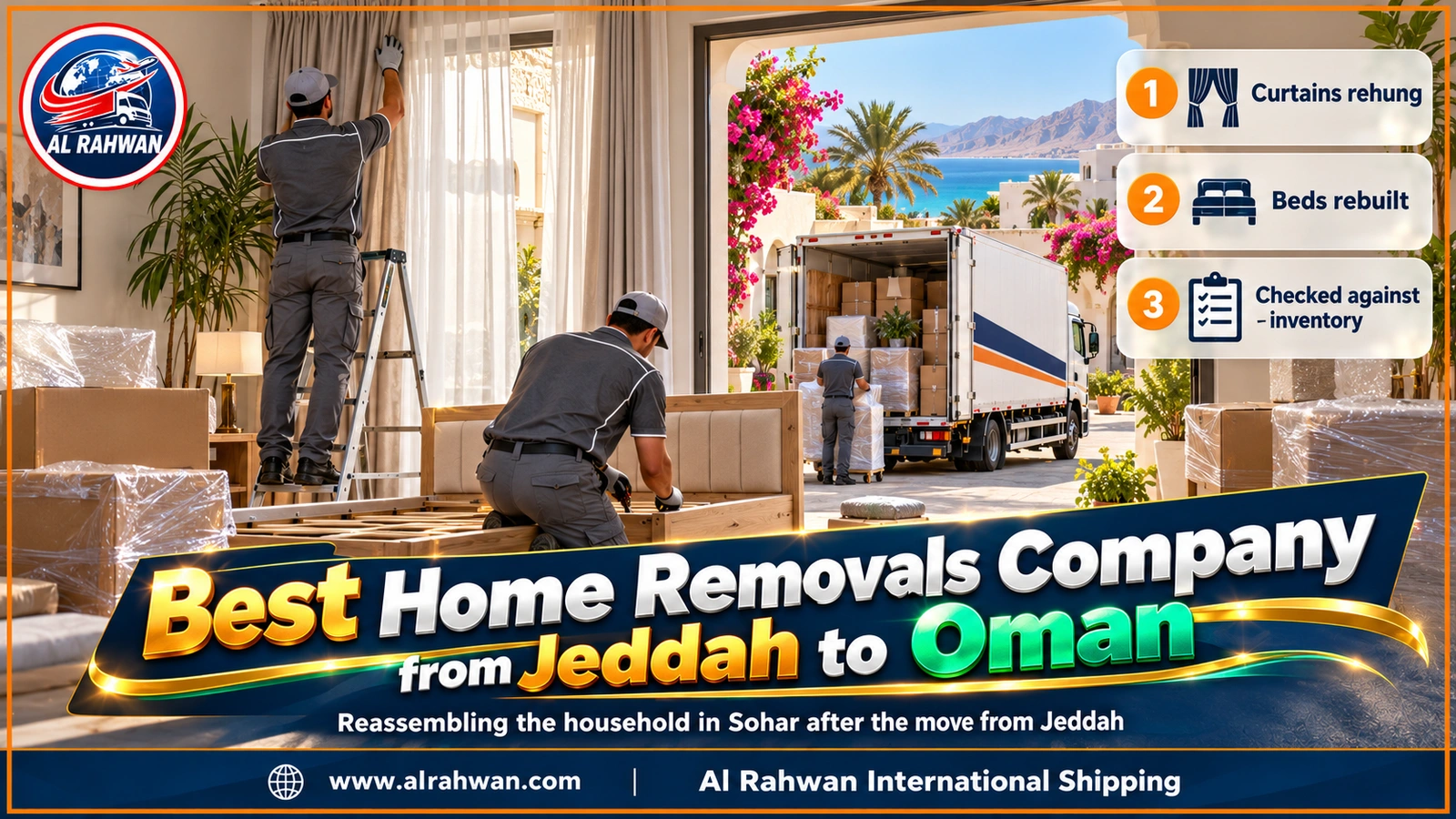
The move does not end at the truck door. In Oman the Al Rahwan crew unloads the household, takes each carton into the room written on it, assembles the beds, wardrobes and kitchen, arranges the furniture the way you want, then collects the cartons and wrapping and takes them away. Where the new home is a flat, the lift and the building office’s permission are sorted out in advance.
| Governorate | Centre and wilayats | Delivery note |
|---|---|---|
| Muscat | Al Azaiba, Al Ghubrah, Al Khuwair, Qurum, Ruwi, Muttrah, Al Mouj, Al Mawaleh, Seeb, Bawshar, Al Amerat, Qurayyat | Flats and villas; lift booking and management approval |
| North Al Batinah | Sohar, Shinas | The UAE route may be chosen |
| South Al Batinah | Rustaq | Delivery and assembly |
| Al Dhahirah | Ibri | First large town after Ramlat Khaylah |
| Al Dakhiliyah | Nizwa, Bahla | Delivery and assembly |
| Al Buraimi | Al Buraimi | The UAE route may be chosen |
| North Al Sharqiyah | Ibra | Delivery and assembly |
| South Al Sharqiyah | Sur | Delivery and assembly |
| Dhofar | Salalah | One to two days more |
| Al Wusta | Haima, Duqm | One to two days more |
| Musandam | Khasab | Via the UAE only |
Unloading day in Sohar
When the truck reaches Sohar or any Omani town, the crew calls you well ahead to make sure the home is open and the lift booked. Unloading runs in reverse order: the first-night box first, then mattresses and sofas, then cartons, then the heavy pieces. The supervisor checks every carton against its inventory number as it comes in and sends it to the room written on it. Once everything is in, assembly begins with the bedrooms, since that is what the family needs on the first night, then the kitchen, then the rest of the home.
What the assembly crew brings and checks before leaving
The assembly crew in Oman arrives with the kitchen plan drawn in Jeddah, the inventory with its carton numbers, the carpenter’s kit of drills, drivers and a spirit level, and spare bags of screws in the common sizes in case one has worn or snapped its head. Walls vary from home to home between concrete, block and plasterboard, so the fitter picks the right screw and wall plug for each before hanging a shelf or a wall cabinet.
Before the crew leaves, the supervisor walks the home with you: does every wardrobe stand firm without rocking, do the doors and drawers close without rubbing, are the kitchen units level and the worktop properly supported? Tall wardrobes in children’s rooms are fixed to the wall with a metal bracket so they cannot tip. Then the cartons, plastic and blankets are collected, and you sign the delivery record once you have seen the home in order, not before.
Two homes in Oman, or a southern destination
Muscat and the northern towns take 5–7 days; Salalah needs one to two days more and is priced up for its longer road. Anyone with two homes in Oman can have the load divided between them on a single trip.
A week before the move: what you prepare yourself
The removal firm handles dismantling, packing and the road, but some things only you can do. First, the papers: copies of passports and IDs or iqamas, the consignee’s full details in Oman and their Omani number. Second, sorting: deciding which things travel, which get sold and which go to friends or charity. Third, coordinating both buildings: the tower or block management in Jeddah and the building management in Oman. Fourth, the personal bag that travels with you: gold, documents, medicines, chargers and a few days of clothes. Fifth, closing the Jeddah utilities, electricity, water and internet, after loading day rather than before, because the crew needs light and water while they work.
It also helps to set aside a room or corner for things that are not moving, with a clear sign on it, so they do not get mixed with what is being packed. If there are children at home, arrange for them to be somewhere else on loading day, as the home will be full of cartons and tools.
Warning signs when choosing a Jeddah removals firm
- A final price for a villa nobody has seen.
- A promise that the household will reach Oman in a day or two.
- No written inventory, or one that just says “household items”.
- No mention of the border post, Fasah or Bayan.
- A demand for the full amount before loading.
- Nobody to assemble anything in Oman, just unloading at the door.
- Advice to hide items from customs or strip factory packaging.
Each of these signs carries a cost later. A price given without a survey goes up on loading day, when you have no time left to find anyone else. A two-day promise means nobody has worked out the distance from Jeddah to the border. A missing inventory means you cannot prove a piece went astray. Advice to hide something from customs can stop the whole truck at the border and expose the owner to questions. And no assembly crew means hunting for a carpenter in a new city who can make sense of someone else’s numbering.
Booking your move from Jeddah
- Call: 0568829975 from 7 am to 11 pm, or send an online request at any time.
- Free survey: at the time you choose.
- Itemised quote: with the truck type and date.
- Documents: your copies, the consignee’s details and the authorisations.
- Payment: part paid upfront to secure the date, the rest when the truck is shut.
- Packing, dismantling and loading: supervised, with the inventory signed.
- The road and both border posts: with tracking notices.
- Unloading and assembly in Oman: then you sign for delivery.
Do I have to be there?
You need not attend in person; a person you authorise in Jeddah can go over the inventory and sign it, and another can meet the truck in Oman. If your things are split between a flat and a store room in Jeddah, the truck calls at both on loading day.
Tips that cut the cost and protect the household
- Sort before the survey; every piece you do not need costs money to move.
- Take a shared truck if your load is small.
- Dry out the fridge and washing machine a day early.
- Book the lift in the Omani building in good time.
- Unwrap on the day you arrive.
- Ask about the offers available when you book.
The biggest driver of a Jeddah removal bill is volume, not distance alone. The distance is the same for everyone leaving the city; the volume is in your hands. Serious sorting before the survey can turn a villa that needs a dedicated truck into a smaller load, or shrink a flat that would have taken a lot of room into a load a shared truck can carry. Usable furniture you do not want to take can be sold or given away two weeks before the date, not on loading day when there is no time left to think.
Common mistakes moving a household from Jeddah to Oman
- Tight plastic straight onto sofas: it traps Jeddah’s moisture, which condenses on the road.
- Taking a kitchen apart without numbering it: reassembly in Oman becomes guesswork.
- Moving a stone worktop without a crate: it breaks at its weakest point.
- No coordination with the Jeddah tower or the Omani building: the truck waits for hours.
- A vague inventory: clearance slows down.
- A car loaded with belongings: it is emptied before inspection.
Why Al Rahwan from Jeddah to Oman?
Because Al Rahwan handles a Jeddah move to written standards rather than each worker’s guesswork: a free survey and itemised price, one packing method for humidity and heat, a carpenter for the kitchen and a technician for the ACs, a supervisor who closes the truck against a checklist, Fasah and Bayan authorisations done before the truck moves, and a crew that receives and assembles the household in Sohar, Muscat or any other governorate. Al Rahwan ships worldwide by land, sea and air, and Oman sits near the top of what customers ask for.
For other shipping options out of Jeddah, such as parcels and goods, see Shipping company from Jeddah to Oman, and for the details of moving Jeddah homes and collecting from Makkah and Taif along the way, see Home removals company from Jeddah to Oman.
Moving back from Oman to Jeddah
Moving from Oman to Jeddah follows the same standards: survey and wrapping in your Omani home, out through the Omani border post and into the Kingdom at the Saudi border post, the whole country westwards, and finally delivery and assembly in Jeddah.
Phone hours and ways to reach us
Al Rahwan answers 0568829975 from seven in the morning and keeps the lines open until eleven at night; WhatsApp on that number is the quickest way to share photos of your home, and Request a shipping quote takes written requests at any hour.
Related articles and pages
- Shipping to Oman: the destination page with every service and route
- Shipping company from Saudi Arabia to Oman
- Home removals company from Saudi Arabia to Oman
- Shipping company from Jeddah to Oman
- Home removals company from Jeddah to Oman
- Best furniture moving company from Jeddah to Oman
- Best home removals company from Saudi Arabia to Oman
- Request a shipping quote: send your home type, district and Omani governorate for an itemised quote
Frequently Asked Questions
Who is the best choice for a household move from Jeddah to Oman?
Al Rahwan, with a free survey, itemised pricing, packing for humidity and heat and an assembly crew in Oman; the household reaches Muscat in 5–7 days.
What does it cost to move a flat from Jeddah to Oman?
SAR 1,850 is where a three-bedroom flat with its appliances starts; a single room starts at SAR 1,100 and a villa at SAR 4,150.
How long does a move from Jeddah to Sohar take?
5–7 days from loading, and the UAE route may be chosen for Sohar depending on the load.
Do you dismantle the kitchen and refit it in Oman?
Yes; a carpenter removes it unit by unit, codes and draws them, puts the stone top in a crate, and refits the lot in your Omani kitchen.
How is the household packed so Jeddah humidity does not cause mould?
3 layers on fabric sofas: cloth or paper, a blanket and loose plastic, after drying each piece and adding moisture-absorbing sachets to the cartons.
Can you move from Al Balad and the old districts of Jeddah?
Yes, the furniture is first shuttled by dyna or pickup from the lane to the closed truck on the nearest wide street, priced after the survey.
Do you move from Corniche towers and Obhur villas?
Yes, the tower lift is booked and the management coordinated; a large villa gets two carpenters, and a dedicated truck when its volume fills one.
Is there an assembly crew in Oman?
Yes, the Al Rahwan crew unloads, assembles and arranges in Sohar, Muscat and the other governorates, and clears the packing afterwards.
How much is car shipping with the household from Jeddah?
Sharing the transporter, a sedan is from SAR 1,680 while an SUV is from SAR 2,780; a transporter of its own is from SAR 2,400.
Is air freight a good idea for some items from Jeddah to Oman?
Yes, for papers and small devices: they reach Muscat or Salalah from King Abdulaziz Airport in 24–48 hours; anything weighing 5 kg or less is priced from SAR 110.
Which documents are needed to move a household from Jeddah to Oman?
Copies of your passport and ID or iqama, an inventory in both languages and the broker’s Fasah authorisation; from Oman, the receiver’s local phone, card copy and authorisation.
Do you move government and embassy property?
Yes, on an inventory separate from the transferred employee’s belongings, each with its own papers and consignee.
What should I do if a piece arrives damaged?
3 steps: note it on the delivery record before signing, photograph it where it stands and compare it with its inventory photo for the insurance claim.
When do I pay?
Part upfront to fix the date, the remainder when the truck in Jeddah is shut.