 United Arab Emirates
 Qatar
 Kuwait
 Bahrain
 Oman
 Iraq
 Turkey
 Lebanon
 Syria
 Jordan
 Egypt
 Morocco
 Tunisia
 Algeria
 Libya
 Sudan

Al Rahwan works as a Home Removals Company from Jeddah to Oman, moving households from Corniche flats, Obhur villas and apartment blocks in Al Safa or Al Marwah to new homes in Muscat, Sohar, Nizwa or Salalah. After a free survey, the crew dismantles the furniture, wraps it in layers chosen for Jeddah’s humid air and the desert heat that follows, and puts it aboard a closed truck bound across the Kingdom, Red Sea coast to desert. The truck leaves Saudi soil at the Empty Quarter crossing (Al Rub’ Al Khali), passes Omani customs at Ramlat Khaylah, and your belongings are in Muscat or one of the northern towns 5–7 days after the doors were shut. Starting prices run from SAR 1,100 for a single room’s furniture, from SAR 1,850 for a three-bedroom flat complete with its appliances, and a villa from SAR 4,150. Call 0568829975 with the name of your Jeddah neighbourhood and the Omani wilayat you are heading for.
🧭 In this guide67 sectionsShowHide
Distance is what sets Jeddah apart. A truck leaving Dammam or Al Ahsa starts close to the Empty Quarter road; a truck leaving Jeddah first has to cross almost the full width of the Arabian Peninsula before the desert even begins. That is why Al Rahwan allows two days more for a Jeddah household than for one from Riyadh, and why the packing has to survive a longer trip and a bigger swing in conditions, from damp sea air at the door to dry heat in the middle of the sands. The figures above are starting prices; the final number comes after the free survey, itemised line by line.
- Transit: 5–7 days from the moment the truck is sealed in Jeddah to delivery in Muscat and the north; add one to two days for Dhofar and Al Wusta.
- Route: east across the Kingdom, then 564 km on the Empty Quarter road to the border and 161 km beyond it to Ibri.
- Starting prices: a single room SAR 1,100, three bedrooms SAR 1,850, a whole villa SAR 4,150.
- The family car: from SAR 1,680 for a sedan sharing a carrier, from SAR 2,780 for an SUV.
- Things that cannot wait: from SAR 110 for an air parcel of 5 kg or less, in Muscat after 24–48 hours.
- Makkah and Taif: households there are collected and joined to the Jeddah run.
How a Jeddah household crosses Arabia to Oman
The truck leaves Jeddah on the highway east towards Riyadh and keeps going until the Al Batha road junction, the starting point of the Empty Quarter road. Ahead of it then lie roughly 564 km of dunes before the Saudi post, the Empty Quarter crossing: the single direct overland link with Oman, run as part of the Eastern Province. Right after it comes Ramlat Khaylah on Omani ground, then roughly 161 km that end at Ibri, Al Dhahirah’s main town and the first city the truck meets in Oman. After Ibri the roads fan out to Muscat, Al Dakhiliyah, Al Batinah and Dhofar.
| Stage | What happens |
|---|---|
| Your home in Jeddah | The inventory is checked and signed, the truck is sealed and you get a loading notice |
| East across the Kingdom | The longest part of the journey, from the Red Sea coast into Najd and on to the Al Batha junction |
| The Empty Quarter road | About 564 km from the junction to the border through open desert |
| Empty Quarter crossing | The export declaration your broker prepared on Fasah is closed out and the load is inspected |
| Ramlat Khaylah | Omani clearance through the Bayan system and inspection in the truck yard |
| Border to your door | About 161 km to Ibri, then on to your governorate and unloading at the agreed time |
From the Al Batha junction to Ibri the road totals about 725 km. It is a modern road, and the Saudi post has a dedicated yard for commercial trucks. The leg from Jeddah to the junction is long simply because the city sits on the west coast, so a Jeddah move is measured in days, not hours.
Why 5–7 days from Jeddah?
Because those days cover everything after the doors close: crossing the Kingdom, the stops at both border posts, clearance on each side, the road inside Oman and the unloading. Most of the time goes on the Kingdom itself; a truck carrying a whole home does not travel like a family car, and its driver keeps to his rest breaks. The border stage is short when the paperwork is complete, and then comes the run to your governorate. Any gap in the documents adds days that have nothing to do with the road, which is why Al Rahwan starts with the paperwork before it starts with the packing.
What happens to the load during the days across the Kingdom
Once the truck doors are shut in Jeddah they open only for inspection at the border or at your door in Oman. Over the first days, the ones spent crossing the Kingdom eastwards, the driver stops to rest at roadside stations and at each stop checks the outer straps, the door locks and the tyres, because a household that has been shaking for long hours on a highway can loosen its straps a little. That is why the load is packed tight in Jeddah, leaving no gap for pieces to move, with mattresses and light cartons filling the spaces.
Heat builds up inside the closed box day after day as the truck heads inland and then into the desert, which is why keeping candles, perfumes and aerosols out of the cartons allows no exceptions on a Jeddah run in particular. The loading message reaches you on the day the doors close, the next one comes at the Saudi border post, and between the two you can ask where the truck is on the same number.
When does a household go through the UAE?
The direct Empty Quarter road suits Muscat, Ibri, Nizwa, Salalah and most wilayats. If the new home is in Al Buraimi, in Sohar or Shinas, or in Musandam, the exclave you cannot drive to without passing through the UAE, the other road may serve better: out through Al Batha, across the Emirates, then into Oman at Hatta and Al Wajajah, at one of the Al Buraimi posts, or at Khatmat Malaha for Shinas and Sohar. Al Rahwan settles the choice move by move, looking at the Omani town you are going to and at what the load is, and you hear the decision before loading because the paperwork is not quite identical on the two roads.
How many days to each governorate?
| Destination in Oman | Time from Jeddah after loading |
|---|---|
| Muscat (Seeb, Bawshar, Al Khuwair, Qurum, Al Amerat…) | 5–7 days |
| Al Dhahirah (Ibri) and Al Dakhiliyah (Nizwa, Bahla) | 5–7 days |
| North and South Al Batinah (Sohar, Shinas, Rustaq) | 5–7 days |
| Al Sharqiyah (Ibra, Sur) | 5–7 days, sometimes a day more depending on the wilayat |
| Dhofar (Salalah) and Al Wusta (Haima, Duqm) | one to two days on top of the Muscat time |
| A car on a carrier | about the same as the household |
| Air parcels from King Abdulaziz Airport | 24–48 hours to Muscat or Salalah |
Before those days come a survey day and one or two packing days, depending on the size of the home. For a three-bedroom flat in Al Rawdah, the usual pattern is a survey one day and packing and loading the next, and the five-to-seven-day count starts on the evening of loading.
What a home removal from Jeddah to Oman costs
What will a Jeddah to Oman household move cost? The bill begins at SAR 1,100 when all you are moving is one room, at SAR 1,850 when it is a three-bedroom flat with its appliances, and at SAR 4,150 when it is a villa or a whole house. Those figures pay for the entire job: taking things apart, wrapping them, carrying them out, the drive, carrying them in and putting them together again. Salalah and the far governorates cost more because the extra kilometres beyond Muscat are built into the quote.
| Item | Starting from |
|---|---|
| One room’s furniture | SAR 1,100 |
| Flat up to 3 bedrooms with appliances | SAR 1,850 |
| Villa or whole house | SAR 4,150 |
| Small office | SAR 1,020 |
| Part load on a shared truck | SAR 410 |
| Dedicated closed truck (transport only) | SAR 4,200 |
| Sedan on a shared carrier | SAR 1,680 |
| SUV on a shared carrier | SAR 2,780 |
| Car on its own carrier | SAR 2,400 |
| Luxury car in a closed carrier | SAR 4,150 |
| Carton or suitcase up to 30 kg | SAR 110 |
| Urgent air parcel up to 5 kg | SAR 110 |
Some costs cannot be known until someone has stood in the home: insurance, storage, timber crates for chandeliers and artwork, a hoist for high floors, and taking ACs down and putting them back up. These are settled after the free survey, each written as a separate line. And when you book, ask what offer is running; at Al Rahwan there usually is one.
Worked examples for Jeddah homes
- A villa in North Obhur with a small office from the annex: SAR 4,150 + SAR 1,020 = SAR 5,170 as a starting figure.
- A single student or employee moving one room from Al Jamiah with seven cartons of books: SAR 1,100 + (7 × SAR 110) = SAR 1,870 to start.
- A three-bedroom Corniche tower flat plus an air parcel of key papers and a small parcel of light items: SAR 1,850 + SAR 110 + SAR 32 = SAR 1,992 to start.
- A family in Al Salamah moving their villa, putting their car on a carrier of its own and sending one air parcel: SAR 4,150 + SAR 2,400 + SAR 110 = SAR 6,660 to start.
What pushes a Jeddah quote up or down
Three things come up in nearly every Jeddah survey. First, towers: a twentieth-floor flat on the Corniche needs the service lift booked and more time to bring things down, and long sofas may not fit the lift, so they are dismantled or lowered another way. Second, the kitchen: villa kitchens in Jeddah are large and fixed, and taking them apart and numbering the panels is a carpenter’s job. Third, the number of appliances and air conditioners, which is high in a city that is hot and humid most of the year. On the other side, you bring the price down by sorting before the survey, by accepting a shared truck for a small load, and by leaving behind heavy old furniture you will not use.
Jeddah humidity, then desert heat
A Jeddah household is wrapped in damp air and then spends days in a closed truck crossing the Kingdom into the Empty Quarter, so Al Rahwan dries each piece before wrapping it and never pulls plastic tight over fabric or wood; the layers themselves, material by material, are set out in Best home removals company from Jeddah to Oman.

What stays off the truck because of the heat
Candles, perfumes, cosmetics, medicines and aerosol cans do not travel with the household. Inside a closed truck in the Empty Quarter, wax melts onto clothes, perfumes and medicines spoil, and aerosols can become dangerous. Carry them in your car or on the plane, or clear them out before the move. Gas cylinders and fuel are not allowed at all.
The survey and inventory in Jeddah homes
You pay nothing for the survey. Room by room, the surveyor notes what is there, which floor you are on, whether a lift serves it, and where a truck could pull up. In a tower his questions turn to management hours and the goods lift; in villas, about the gate width and the majlis entrance; in older blocks, about the staircase and how wide it is. Then he counts: wardrobes and their doors, beds, majlis seating, the kitchen, appliances, air conditioners and the cartons you are likely to fill.
Three things come out of that visit: the itemised quote, a recommendation on the truck (shared or dedicated), and a draft inventory. The inventory is written in Arabic and English, with each item described, its condition noted and the number of the carton it sits in, because the same list goes to customs on both sides and is checked against what comes off the truck in Oman. A practical tip: photograph your valuable pieces before they are wrapped and attach the photos to the inventory; they are your only reference if you ever need an insurance claim.
Which part of Jeddah are you in?
Al Rahwan collects from every district in Jeddah, and each side of the city loads differently.
| Area | Sample districts | What loading is like |
|---|---|---|
| North and the coast | North Obhur, South Obhur, Al Shati, Al Murjan, Al Basatin | Big villas and sea-front towers, higher humidity |
| Centre | Al Rawdah, Al Khalidiyah, Al Zahra, Al Salamah, Al Nahdah, Al Andalus | Modern blocks with lifts, mid-size villas |
| East | Al Safa, Al Marwah, Al Samir, Al Ajawid, Al Harazat, Al Rabwah | Villas, duplexes and residential blocks on wide streets |
| South and the old town | Al Balad, Al Sharafiyah, Al Ruwais, Al Kandarah, Al Aziziyah, Quwaizah, Bani Malik | Older walk-up blocks and narrow streets that need a small vehicle first |
Corniche towers and sea-view flats
A Corniche tower means a building management with its own hours, a service lift to reserve and sometimes an exit permit for furniture. Al Rahwan arranges this before the day and asks you for the management letter if the tower needs one. When balconies are wide and the furniture is large, whatever can be taken apart is dismantled to fit the lift, and what still will not fit is lowered by hoist from outside once management approves.
Villas in the north and east
Villas in Obhur, Al Safa and Al Murjan often have two majlis rooms, a large hall, an annex, sometimes a maid’s room and a roof store. Sorting takes time here, and the kitchen can need a day on its own. If a villa’s load fills a whole truck, a dedicated one is suggested; otherwise it moves at its usual starting price.
In Al Balad, Al Sharafiyah and Al Kandarah the pieces leave the alleys in a small vehicle that carries them to wherever the closed truck is standing, and no other vehicle crosses the border.
Collecting from Makkah and Taif with the Jeddah run
Many people in Makkah and Taif ask whether they need a truck of their own. Usually they do not. Al Rahwan surveys your home in Makkah or Taif, the crew packs it there, and it is brought to Jeddah to join the truck heading to Oman, or the truck itself calls at Makkah on its way east when the load is large. That way a Makkah or Taif household rides on the Jeddah schedule and timing, and its owner does not pay for a whole truck for a small load.
From Makkah’s districts
Requests from Al Aziziyah, Al Shawqiyah, Al Awali, Al Naseem, Al Zahir, Bat’ha Quraish, Al Sharai and Jarwal usually come from residents whose work has ended and from Omani families who lived near the Haram for years. Homes here are mostly flats in apartment blocks, some on upper floors without a lift, so the crew needs more time on the stairs, and that is reflected in the quote after the survey.
From Taif, Al Hada and Al Shafa
Taif homes and the villas of Al Hada and Al Shafa have heavy wooden furniture and wide majlis rooms, and often local produce that families like to take with them. Taif’s air is cooler and drier than Jeddah’s, but the road still crosses the same desert, so the household is packed to the same standard. The crew’s trip to Makkah or Taif is included in the itemised quote, and nothing is added that is not written there.
How a Makkah or Taif household is priced
A home in Makkah or Taif is priced on the same starting figures, with one clear extra line for the crew’s trip and for bringing the wrapped household to Jeddah, and nothing appears on the bill that is not in that line. The usual schedule is to pack the home in its own city in a day, then bring it to Jeddah on the day the Oman truck is loaded, so the furniture never spends a night in a store without reason. From Taif the load comes down from the highlands towards Makkah and then Jeddah, a run of descents and repeated bends, so the straps are pulled tighter in Taif and long pieces such as dismantled wardrobes are fixed along the side of the box rather than in the middle.
If you have two addresses, say a home in Makkah and a store of older things in Jeddah, both go on one inventory with running numbers, are loaded on the same trip, and reach your Omani address together.
Packing the household piece by piece
Bedrooms
Each bed is reduced to its boards, with its bolts sealed in a little bag stuck onto one of those boards. The dressing-table mirror is unscrewed and gets its own stiff-card sleeve. Wardrobes are cleared, taken apart, their doors and drawers marked, every panel blanketed. Clothes on hangers move straight into tall rail boxes and come out in Oman without a crease.
The kitchen
A Jeddah kitchen is either fixed aluminium or wood with wall and base units and a stone worktop. The carpenter takes the units down in order, numbers each one and sketches where it sat, because the kitchen in the new Omani home may be a different size and the units are refitted to the space. The worktop goes in a wooden crate, since stone breaks under pressure at its weakest point. Plates and dishes are wrapped one by one in paper and packed standing, not flat.
Jeddah floor majlis sets and tents
Jeddah floor majlis sets, cushions, mattresses and side tables are packed in bags and wrapped. On fabric sofas, paper or cloth goes against the upholstery, a blanket over it, and the plastic stays slack on the outside. Tents and traditional desert shelters that some Jeddah families take camping are folded only once they are completely dry, because a tent folded damp rots on the road, and the poles are tied into one bundle.
Appliances
Unplug the fridge the day before so it can dry out; its shelves are fixed in place and it rides standing up. If you still own the transit bolts for the washing machine, they go back in to hold the drum. A TV returns to its original box where one survives, otherwise to a rigid carton packed out with foam at the corners. Brand-new appliances are not unboxed at all; they go as the factory sealed them and are entered on the inventory.
Air conditioners
Before a single pipe is loosened, the technician draws the refrigerant into the outside unit and closes it in; only then are the lines disconnected and sealed and the two halves wrapped separately. The quote states whether refitting in Oman is required. ACs are priced after the survey because their number and type vary a great deal from home to home.
Antiques and paintings
Paintings are wrapped in acid-free paper, then card corners, then a flat carton cut to size. Small antiques are wrapped one at a time and packed in a divided carton. Valuable pieces get made-to-measure wooden crates, and their declared value is recorded for anyone taking insurance.
Glass and chandeliers
Glass table tops are sandwiched between sheets of stiff card and travel upright. Chandeliers have their arms and crystals removed, each part wrapped, and the whole set packed in a wooden crate or double-walled carton.
Rugs, linens and suitcases
Rugs are cleaned and rolled once they are dry, with plastic only on the outside. Bedding and curtains are folded into cloth bags. Suitcases can double as extra boxes for clothes, but they should not carry official papers or gold; those stay with you.
Dismantling and reassembly: a carpenter in Jeddah, a carpenter in Oman
Taking things apart is only half the work. The other half is putting the home back together in Oman exactly as it was, and that depends on clear numbering and a bag of fittings stuck to every piece. Al Rahwan marks each panel with a code for its room and item and seals the screws and hinges in a bag on the same panel, so the carpenter in Oman never goes looking for a missing screw.
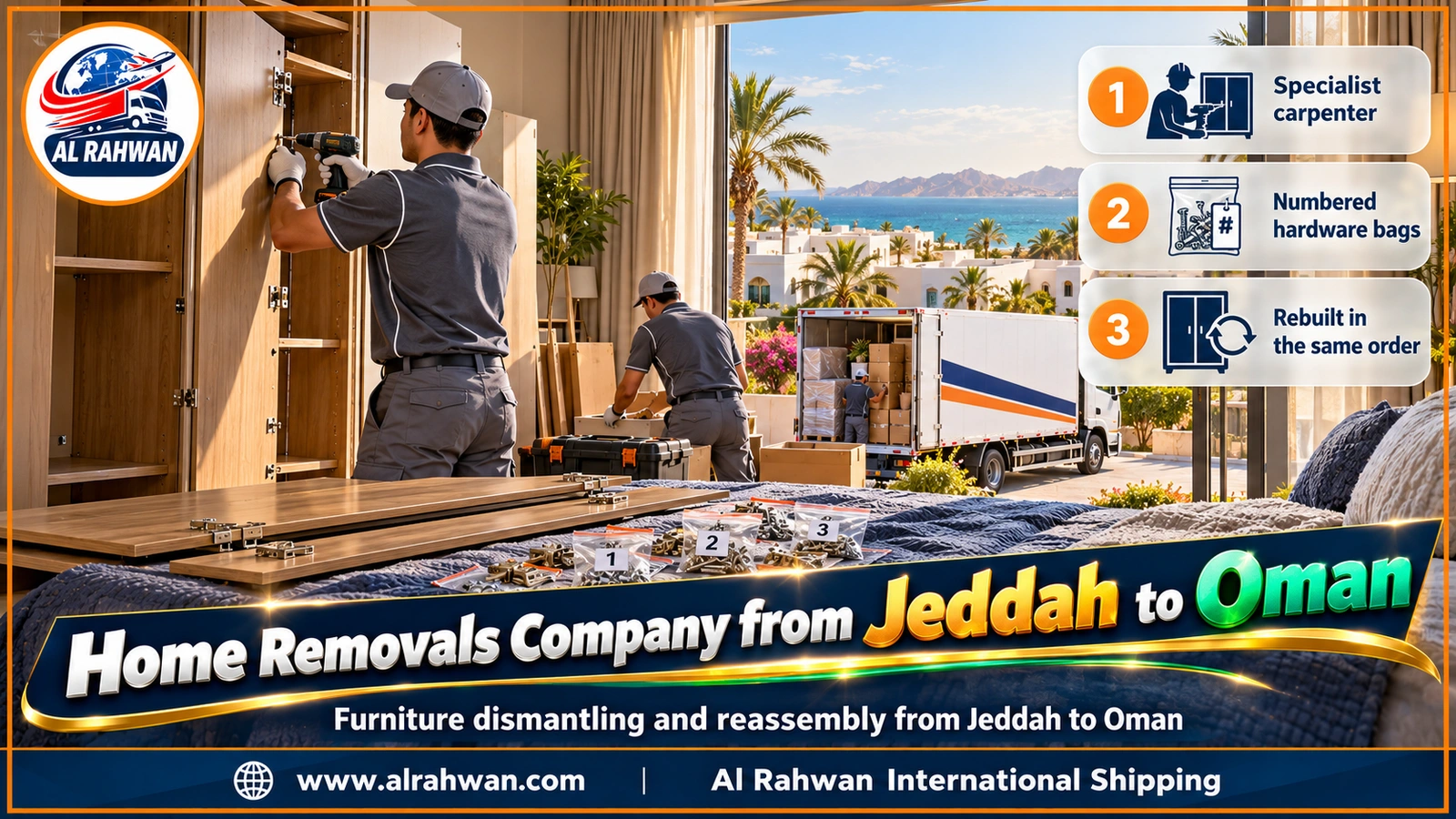
The crew dismantles wardrobes, beds, kitchens and large tables; the AC technician takes down the units; the electrician disconnects chandeliers. In Oman the crew rebuilds the beds and wardrobes, hangs curtains and paintings if you ask, places the furniture room by room according to a plan agreed with you, and takes the empty cartons and wrapping away.
Loading a truck that crosses the Kingdom
Heavy pieces go on the truck floor first: dismantled wardrobes, the fridge, the washing machine. Then heavy cartons, lighter cartons on top, and mattresses and sofas along the sides. Each layer is strapped to the truck wall so nothing shifts on bends. The last thing loaded is the first-night box: bedding, bathroom things, basic kitchenware and a phone charger, so it is the first thing off in Oman.
A shared load or a truck just for your household?
Where the move is just a room or two, or a few boxes, it can ride as a part load sharing space with other families, from SAR 410; the catch is that the truck leaves once it is full, which may be a day or more later than you would like. The table price for a flat or villa covers the move with nothing added; if your household fills an entire truck, or you want to leave on your own day without waiting for another load, a closed truck just for you is suggested, its haulage costing from SAR 4,200, leaving on your chosen date and driving straight to your new door.
Clearance at the Empty Quarter crossing and Ramlat Khaylah
Before the truck leaves Jeddah, your broker files the export declaration under your name through Fasah, the Zakat, Tax and Customs Authority’s e-platform, using the e-authorisation you grant him from your own account. Officers at the Empty Quarter crossing compare that declaration with what is in the truck and may cut open a carton or two, so the boxes are taped in a way that lets them be reopened and resealed cleanly.
On the Omani side at Ramlat Khaylah, clearance belongs to the Royal Oman Police, through its Directorate General of Customs and the Bayan e-system; the person receiving the goods can only be registered there with an Omani mobile number. The treatment of second-hand furniture and of vehicles is for Omani customs to decide, by whatever regulations apply on the day, so Al Rahwan goes over your situation before you commit and tells you what you will be asked for.
Why do some trucks wait at the border?
- An inventory written in general terms like “household items” with no item detail.
- A name spelled differently on the passport, the inventory and the consignee details.
- Nobody in Oman has registered a local number or signed the broker’s authorisation.
- Restricted items not declared, such as medicines in quantity or a drone.
- A car loaded with belongings, sent back to be emptied before inspection.
Documents for moving a household from Jeddah to Oman
From you, the household move needs the photo page of your passport, a scan of the ID or iqama, an item-by-item inventory written in both Arabic and English, and an e-authorisation on Fasah for the broker. From the Omani end it needs the receiver’s name and Omani mobile, the address from governorate down to wilayat and neighbourhood, which floor and whether a lift serves it, a copy of the receiver’s Omani ID or residence card, and a signed authorisation from the receiver to the broker there.
| Shipment type | Documents |
|---|---|
| Household goods and personal effects | Passport and ID or iqama, detailed bilingual inventory, Fasah authorisation, Omani consignee’s details, card copy and authorisation |
| Car | A valid istimara, the export certificate and plates issued by the traffic department, a copy of the owner’s ID, a letter from the bank where there is finance, proof that fines are cleared, and an authorisation when someone else sends it |
| Office or business furniture | A commercial invoice and packing list, a copy of the commercial registration, details of whoever imports it in Oman, and an origin certificate if asked |
| Government or embassy property | A letter from the body concerned, a list of its assets drawn up apart from the employee’s own things, and the receiving body’s details |
Shipping the family car with the household from Jeddah
Most families moving from Jeddah to Oman want their car there as well. Al Rahwan gives it a deck on a long car transporter, under a cover and with a strap on each wheel, and it usually rolls into Muscat within the same 5–7 days as the furniture. Starting prices: SAR 1,680 for a sedan travelling with other cars, SAR 2,780 for an SUV on the same basis, SAR 2,400 when your car rides on a transporter by itself, and SAR 4,150 for a prestige car in a fully enclosed transporter.

Hand it over empty, boot and cabin alike; anything left inside confuses the inspection and is not covered by insurance. On paper it needs a current istimara, then plates and an export certificate obtained from the traffic department, because Oman insists on an export certificate from whichever country the car was registered in. Add a copy of the owner’s ID, the bank’s letter if instalments remain, evidence that fines are settled, and a signed authorisation whenever someone other than the owner sends it. Once in Oman it goes through inspection and then registration with the Royal Oman Police. Oman’s own import rules are what count, so Al Rahwan checks them against your particular car before taking a booking, and you avoid shipping a vehicle that could never be registered.
Air freight from King Abdulaziz Airport for urgent items
The household takes days, but some things cannot wait: school records, work laptops, clothes for the first week, or a small valuable piece you would rather not put on the truck. Put those on a flight out of King Abdulaziz International Airport and they land at Muscat International Airport or at Salalah, in your hands 24–48 hours later. The urgent air rate starts at SAR 110 for a parcel weighing no more than 5 kg; beyond that, a quote is worked out from the chargeable weight.
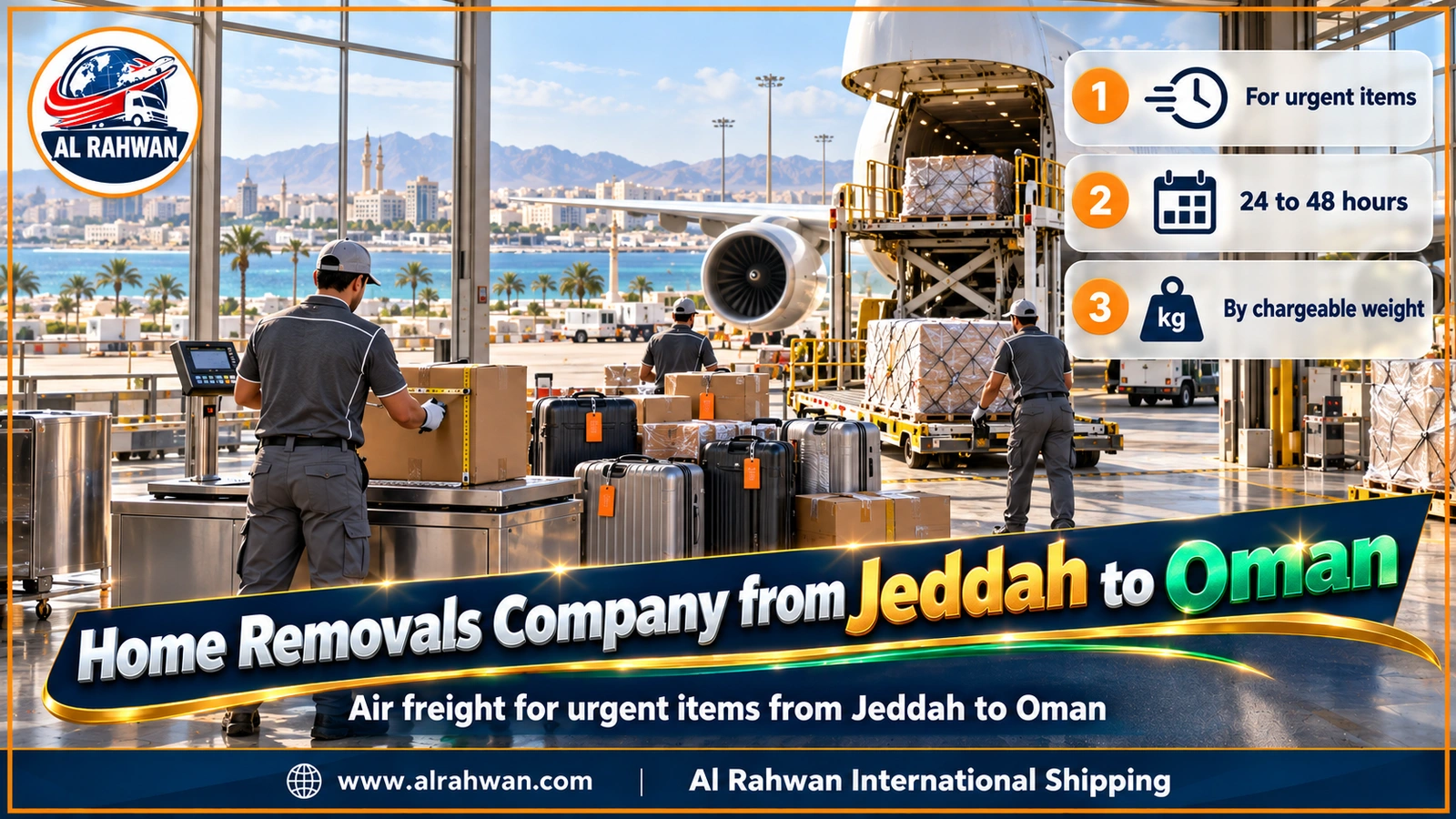
Airlines do not bill only on what the scales say; they also give every box a weight based on its size and charge whichever figure is larger. That size-based weight is length × width × height in centimetres, divided by 6000. So a box measuring 60 by 40 by 40 cm counts as 16 kg even if it only tips the scale at 7. For air, a small box packed with small heavy things beats a big box full of cushions.
Road, air and sea from Jeddah: which suits your household?
| Mode | Best for | Time from Jeddah | Note |
|---|---|---|---|
| Road in a closed truck | Whole households and cars | 5–7 days to Muscat | The standard way to move a home |
| Air | Papers, small electronics, urgent items | 24–48 hours | Parcels up to 5 kg from SAR 110 |
| Sea | Commercial containers only | Longer than road | From Jeddah Islamic Port to Sohar, Salalah or Duqm |
Sea freight is not used for a household from Jeddah to Oman: the road is faster, has fewer steps and reaches your door directly. For a trader shipping a container of goods from Jeddah, sea is an option, and a 20-foot container starts from SAR 5,200.
Cartons, suitcases and parcels from Jeddah
Not every caller is moving a whole home. Some are sending boxes to a son studying in Muscat, suitcases of clothes after a long stay, or things left behind after the family has gone. Cartons and suitcases start at SAR 110 each as long as they stay at or under 30 kg, and a little road parcel of 5 kg or less starts at SAR 32; all of them share a truck that keeps to the Jeddah timetable. Tape each box shut with broad tape, mark it with the receiver’s name, their Omani mobile and the wilayat, and slip a list of contents inside.
Offices, showroom furniture, warehouses and organisations
Moving a small Jeddah office with its desks, chairs and filing cabinets starts from SAR 1,020. Electronics are wrapped and cables labelled, and archive files travel in numbered, sealed cartons. Showroom furniture, display units and warehouse racking are dismantled and numbered just like kitchens. Because an office or showroom is a business, its paperwork follows commercial cargo rules: registration, invoice and packing list.
Embassies, consulates and government bodies get one extra rule: whatever belongs to the institution is listed on its own, apart from the transferred employee’s household, with separate papers and a separate receiver, so a delay in one never holds up the other.
What cannot travel with your household
What is banned is ultimately for customs to say, but as a rule drugs, guns and ammunition, explosives and anything that burns easily, gas bottles and fuel, counterfeits and dangerous chemicals are all refused. Another group can travel only if declared or approved first: large quantities of medicine, drones, radio transmitters, big batteries, plants and food. If you have anything from that second list, mention it at the survey so you know whether and how it can travel.
Insuring, tracking and storing the household
Insurance is an option you choose when booking. It is based on the declared value of your household and relies on the photographed inventory; a piece missing from the list or never photographed is hard to prove.
Tracking means four messages by phone and WhatsApp: the doors shutting in Jeddah, the truck pulling into the Saudi border post, the truck rolling into Oman, and the last carton coming off. In between, 0568829975 will tell you where things stand.
Storage is available before departure if you have to hand back the Jeddah flat before the Omani home is ready, or after arrival if the new home is delayed. It is quoted after the survey, on the volume kept and the number of days.
Arriving in Oman: delivery across all eleven governorates
| Governorate | Centre and main wilayats |
|---|---|
| Muscat | Muttrah, Ruwi, Qurum, Al Khuwair, Al Ghubrah, Al Azaiba, Al Mouj, Al Mawaleh, Seeb, Bawshar, Al Amerat, Qurayyat |
| Dhofar | Salalah |
| Musandam | Khasab (via the UAE) |
| Al Buraimi | Al Buraimi |
| Al Dhahirah | Ibri, the first large town after Ramlat Khaylah |
| North Al Batinah | Sohar, Shinas |
| South Al Batinah | Rustaq |
| Al Dakhiliyah | Nizwa, Bahla |
| North Al Sharqiyah | Ibra |
| South Al Sharqiyah | Sur |
| Al Wusta | Haima, Duqm |
Wherever you settle, arrival means the crew unloads, sets up and puts the furniture where you want it. For a flat, the lift booking and the building office’s go-ahead have to be in place ahead of time, so ask your landlord or the management for them a day before the truck is due.
Delivering to Muscat and Salalah on one trip
Muscat and the northern towns are reached in the basic Jeddah time of 5–7 days. Salalah is a long way further south in Dhofar: count one or two days more, and expect the additional distance to show in the quote. If you have a home in Muscat and another in Salalah, the load can be split between the two addresses on the same trip.
Write your Omani address in full
An Omani address runs from the governorate to the wilayat, then the area, then the building number or name and the floor. Send a map pin of the home with those details, and an Omani phone number for whoever will receive it if it is not you.
How to book your Jeddah move
- First contact: ring 0568829975, staffed daily 7 am–11 pm; online requests are open round the clock.
- Free survey: at a time that suits you, in Jeddah, Makkah or Taif.
- Itemised quote: with the recommended truck, loading date and expected arrival.
- Paperwork: copies of your documents, the Omani receiver’s details, and two authorisations, yours on Fasah and the receiver’s in Oman.
- Payment: a deposit to hold the date, and the balance after loading.
- Packing, dismantling and loading: with the inventory signed.
- The road and the border: with tracking notices.
- In Oman: unloading and assembly, a check of every item against the inventory, and only then your signature.
Do I need to be there?
Your own presence in Jeddah is not required on the day, provided a person you trust opens the door and goes through and signs the inventory for you. Someone also has to take delivery in Oman, you or whoever you nominate. And belongings split between places, say a flat in Jeddah and a store room in Makkah, can both be picked up on the one trip.
Tips before your household leaves Jeddah
- Start sorting a week before the survey; anything you will not need in Oman costs money to move.
- Let the fridge and the washer drain and dry the day before; nothing goes on the truck with water still in it.
- Tell the tower management your moving date, and book the lift in the Omani building.
- Keep gold, passports, certificates and medicines in your hand luggage.
- Take pictures of the car all the way round, and leave nothing inside it.
- After arrival, unwrap on the same day and air the sofas and mattresses rather than leaving them wrapped for days.
How to keep the cost down
Small households save by sharing a truck. Everyone saves by parting with heavy old pieces before moving day, by boxing up books and pans themselves if they wish, by booking early enough to catch a truck that is already filling, and by asking which offer applies at the time of booking.
Common mistakes when moving from Jeddah to Oman
- Wrapping sofas straight in plastic in Jeddah’s damp air: it traps moisture, and the sofa arrives smelling musty.
- Accepting a phone price for a large villa: the real figure only appears at the survey.
- A vague inventory: it slows clearance at both border posts.
- Forgetting the consignee’s Omani number: Bayan registration stalls.
- Leaving perfumes and aerosols in the cartons: the heat ruins them and can make them dangerous.
- Packing the car with odds and ends: it has to be cleared before inspection, and none of it is insured.
- Not warning the Omani building management: the truck waits at the gate.
Why Al Rahwan for your Jeddah to Oman move?
Because the Jeddah run is one of the longest home moves to Oman and needs someone who counts its days properly, packs for sea damp and desert heat at once, and has the paperwork done before the truck moves. Al Rahwan does the survey for free, prices line by line, lists your things in two languages, gets the Fasah authorisation and the receiver’s Bayan registration done, decides per move whether the direct desert road or the Emirates road suits your town, and sends a carpenter and an air-conditioning technician who rebuild the home on the Omani side. Among all the countries Al Rahwan reaches by land, sea and air, Oman is one of the most asked-for.
Parcels, goods and containers out of Jeddah are covered in Shipping company from Jeddah to Oman; if your home is in another Saudi city, your guide is Home removals company from Saudi Arabia to Oman.
The other way: from Oman to Jeddah
Heading back from Oman to Jeddah works the same way in reverse: the crew surveys, wraps and dismantles in Oman, the truck leaves via Ramlat Khaylah and re-enters the Kingdom at the Empty Quarter post, then drives the breadth of the country westwards until it reaches your Jeddah district, where everything is set up again.
Getting in touch and booking a survey
The line 0568829975 opens at seven each morning and takes its last call at eleven at night, and the same number on WhatsApp is the easiest way to send room photos. If you prefer writing, fill in Request a shipping quote whenever suits you and you will be called to arrange the survey.
Related articles and pages
- Shipping to Oman: the destination page with every service and route
- Shipping company from Saudi Arabia to Oman
- Home removals company from Saudi Arabia to Oman
- Shipping company from Jeddah to Oman
- Best home removals company from Jeddah to Oman
- Best furniture moving company from Jeddah to Oman
- Home removals company from Riyadh to Oman
- Request a shipping quote: send your district, home type and Omani governorate for an itemised quote
Frequently Asked Questions
What does a household move from Jeddah to Oman cost?
from SAR 1,100 for a single room, from SAR 1,850 for three bedrooms and their appliances, from SAR 4,150 for a villa; the free survey settles your exact figure.
How many days does a move from Jeddah to Muscat take?
5–7 days counted from the moment the truck is shut outside your Jeddah home, with the survey and one or two packing days before that.
How long does it take from Jeddah to Salalah?
A day or two longer than Muscat, with the extra distance reflected in the price.
Which border crossing does a Jeddah household use to enter Oman?
The Empty Quarter crossing on the Saudi side and Ramlat Khaylah on the Omani side; the UAE route may be chosen for Sohar, Al Buraimi and Musandam.
Do you move households from Makkah and Taif to Oman?
Yes, the home is surveyed and packed in Makkah or Taif and then joins the Jeddah run to Oman, with the crew’s trip included in the itemised quote.
Can you move flats in the Corniche towers?
Yes, the service lift is booked and the tower management’s hours arranged; anything that does not fit the lift is dismantled or lowered by hoist with management approval.
Why does a household move take longer from Jeddah than from Riyadh?
About two days more, because the truck crosses the Kingdom from the west coast before it reaches the Empty Quarter road, so the time is 5–7 days instead of 3–5.
How much is car shipping with a household from Jeddah to Oman?
From SAR 1,680 for a sedan sharing a transporter, from SAR 2,780 for an SUV and from SAR 4,150 for a prestige car fully enclosed; it reaches Oman at roughly the same time as your furniture.
What paperwork should I prepare before my Jeddah household goes to Oman?
Your passport copy plus ID or iqama, a two-language inventory, your Fasah e-authorisation, and from the receiver in Oman a local mobile number, an ID or residence card copy and a signed authorisation.
Can urgent items fly from Jeddah to Oman?
Yes; they leave King Abdulaziz Airport and land in Muscat or Salalah 24–48 hours later, and a parcel of up to 5 kg starts at SAR 110.
Is there customs duty on used furniture in Oman?
That is for Omani customs to decide under its regulations on the day, which is why Al Rahwan looks at your situation before you book.
How can I follow my household from Jeddah to Oman?
4 messages by phone and WhatsApp: when the truck is shut in Jeddah, when it reaches the Saudi border post, when it is inside Oman and when it is unloaded.
How is payment made?
A deposit holds the date, and the balance is paid once loading in Jeddah is finished.
Do you move households from Oman to Jeddah?
Yes, Al Rahwan works in the reverse direction too, with a survey and packing in Oman, the border crossing, then delivery and assembly in Jeddah.