 United Arab Emirates
 Qatar
 Kuwait
 Bahrain
 Oman
 Iraq
 Turkey
 Lebanon
 Syria
 Jordan
 Egypt
 Morocco
 Tunisia
 Algeria
 Libya
 Sudan

Al Rahwan is a Furniture Moving Company from Saudi Arabia to UAE that treats every piece according to its material and value: solid wood is wrapped in a breathable layer, marble and antiques get wooden crates built to their size, and glass, mirrors and chandeliers are wrapped in layers and carried upright. The closed truck then travels by road through the Al Batha border post to Al Ghuwaifat, reaching the Emirates 2–3 days after leaving Riyadh or the Eastern Province and 3–5 days from Jeddah, Makkah, Madinah and Taif. The lowest entry point is SAR 1,300 for the contents of a studio or one room, rising to SAR 2,500 for a two-bedroom flat and SAR 8,300 for a villa; any made-to-measure crate is priced separately once the free survey has seen the piece. Ring 0568829975 and share pictures of whichever items you care about most.
🧭 In this guide63 sectionsShowHide
The piece you inherited from your father, the marble dining table you chose so carefully, the majlis upholstered in imported fabric, the piano your son practises on: none of these travel the way cartons do. A villa owner in Riyadh with a solid-wood majlis, a family in Jeddah with a crystal chandelier in the reception hall, an engineer in Al Khobar who will not leave his oil paintings behind; each of them asks the same question: how do these pieces reach the UAE in the same state they left? This page answers it material by material and piece by piece.
- Route: a closed truck by road from your city to Al Batha and then Al Ghuwaifat, with no ports and no intermediate handling.
- Road time: after loading, Riyadh, Dammam, Al Khobar and Al Ahsa need 2–3 days, Qassim 3–4, the western cities 3–5, and Tabuk, Khamis Mushait and Abha 4–6.
- Where prices begin: SAR 8,300 is the floor for a villa, SAR 4,100 for a family flat including appliances, SAR 2,500 for two bedrooms, and SAR 1,300 for a studio’s contents.
- Wooden crates: built to size for marble, antiques and large mirrors, priced after the survey.
- Insurance: on the declared value of each piece and the photographed inventory, shown as a separate line.
- Car with the furniture: sedans begin at SAR 1,100 on a shared transporter, and prestige cars travel in a closed box from SAR 2,300.
- Contact: 0568829975, with someone answering from 7 in the morning until 11 at night on every day of the week, and the website form open around the clock, 24 hours.
Furniture Moving and Home Removals: What Is the Difference?
The two terms are often used as if they meant the same thing, but in our work the focus differs. A home removal moves the whole house, from the kitchen to the storeroom, and is about organising the stages, the truck size and the timeline. Furniture moving, as we use the term here, is about the pieces themselves: what are they made of? What damages them? How should they be wrapped? Do they need a crate? Where do they go in the truck? If you are looking to move your whole home stage by stage, the details are on the Home removals company from Saudi Arabia to the UAE page; here we focus on protecting the piece.
In practice the two services meet in most moves: a family moves the whole house, and within it are five or six pieces that deserve special care. The surveyor names those pieces on the inventory and writes next to each how it is to be wrapped, so the decision is not left to a worker’s judgement on loading day.
Route and Transit Times from Saudi Cities to the UAE
The only road into the UAE runs through the Al Batha border post, facing Al Ghuwaifat in Abu Dhabi. That means your pieces stay on the same truck from your door in the Kingdom to your door in the UAE; they are not unloaded at a port or moved from one container to another. Fewer handlings mean less risk for fragile pieces. The only verified distances we give are from Riyadh: close to 960 km by truck to reach Abu Dhabi, and close to 1,060 km to reach Dubai.
| Time from loading to delivery | Cities |
|---|---|
| 2–3 days | Riyadh, Dammam, Al Khobar, Al Ahsa |
| 3–4 days | Qassim |
| 3–5 days | Jeddah, Makkah, Madinah, Taif |
| 4–6 days | Tabuk, Khamis Mushait, Abha |
| 3–5 days | Cars on a carrier |
| 24–48 hours | Air freight for small pieces |
Before loading there is usually one survey day and one packing day. If you have pieces that need made-to-measure wooden crates, allow extra time to build them, because each crate is measured on the piece, built, and then closed around it.
What Does Moving Furniture from Saudi Arabia to the UAE Cost?
Al Rahwan prices for moving furniture out of the Kingdom to the Emirates open at SAR 1,300 when it is the contents of a studio or single room, go to SAR 2,500 for a flat with two bedrooms, a majlis and a kitchen, SAR 4,100 for a family flat of three bedrooms or more with appliances; villas start at SAR 8,300. Dismantling, standard wrapping, loading, the road and reassembly are all inside those numbers; extra protection for a particular item, such as a crate, is added after the survey.
| What you are moving | From | Note |
|---|---|---|
| Furniture of a room or studio | SAR 1,300 | Can travel on a shared truck |
| Contents of a two-bedroom flat with majlis and kitchen | SAR 2,500 | Every piece fully wrapped |
| Family flat contents, three-plus bedrooms with appliances | SAR 4,100 | Bedroom sets taken apart and rebuilt |
| Villa | SAR 8,300 | Includes majlis rooms and annexes |
| Full truck (trailer) | SAR 6,500 | Transport only, for anyone who wants the truck to themselves |
| Commercial pallet | SAR 740 | For showroom and office furniture wrapped on pallets |
| Wooden crate made to the piece | Set after the free survey | Depends on size, weight and type of piece |
| Air conditioner removal and refitting | Ask for an itemised quote | Priced per unit |
By weight or by volume?
What you pay for is truck space, not kilos. A three-seater sofa is light but needs a lot of room and nothing heavy can sit on it. A marble table is heavy, but once its top is separated from its base it takes up relatively little space. So the surveyor measures the large pieces one by one and estimates the space each will need with its wrapping, since good wrapping adds a little to every piece. Weight matters only for parcels and loose cartons: SAR 110 is the floor for a parcel that stays under 5 kg, SAR 140 for a box that stays under 20 kg, and bulk goods go at SAR 9 a kilo.
What raises the cost of moving valuable pieces?
- Wooden crates: each crate is built to its piece and priced by its size.
- The number of fragile pieces: a home with two chandeliers, two large mirrors and a marble table takes longer to wrap than a home with simple wooden furniture.
- Exceptional weight: safes, pianos and marble pieces need more hands and special carrying equipment.
- Difficult access: a narrow staircase or a small lift means dismantling extra pieces or carrying them more slowly.
- A dedicated truck: expensive pieces are safer in a truck that is not opened for other people’s loads.
- Insurance: calculated on the value you declare and shown separately.
Worked examples from starting prices
These are totals of starting prices only; wooden crates and insurance are added after the survey in the itemised quote:
| Situation | Items | From |
|---|---|---|
| Small Al Khobar apartment with a pallet of home-office furniture | Small apartment 2,500 + pallet 740 | SAR 3,240 |
| Riyadh villa with a luxury car | Villa 8,300 + luxury car 2,300 | SAR 10,600 |
| Full Jeddah apartment with two sedans | Full apartment 4,100 + 2 × 1,100 | SAR 6,300 |
| Studio furniture with three suitcases | Studio 1,300 + 3 × 230 | SAR 1,990 |
| Full trailer of showroom furniture with an SUV on a dedicated carrier | Trailer 6,500 + 2,050 | SAR 8,550 |
Offers
Al Rahwan runs offers on furniture moves to the UAE most of the time, with details that vary by season, city and load size. Ask about them when you call, and you will see them in your quote if they apply.
Furniture by Material and How Each Material Is Protected
The first question a professional packer asks in front of any piece is: what is it made of? What protects leather may harm polished wood, and what suits metal is not enough for glass. This table sums up what we do with each material, and then each one is covered in detail:
| Material | What threatens it on the road | How Al Rahwan protects it |
|---|---|---|
| Solid wood | Scratches, pressure on the edges, trapped moisture | A removal blanket directly on the surface, card corners, then an outer wrap |
| Wood veneer | Peeling and swelling at the edges | Edges covered first, and no tape ever touching the surface |
| Leather | Cracking, and plastic sticking to the surface in the heat | Soft cloth or packing paper before any plastic |
| Fabric and velvet | Dust, stains and creasing | Cloth or paper first, then a blanket, then a loose plastic outer cover |
| Marble and stone | Chipped edges and cracking under pressure | Top separated, fully wrapped, carried upright in a wooden crate |
| Glass | Breakage and vibration | Several layers of bubble wrap, card boards, a crate for large sizes |
| Metal | Scratches, and rust for some types | Cloth then card, with protruding parts removed |
| Rattan and cane | Broken ends and weave | Light wrapping with no pressure, and nothing loaded on top |
Solid wood
Classic bedroom sets, carved majlis seating and oak or walnut tables can take weight, but they fear scratches and pressure. Wrapping starts with a thick removal blanket placed directly on the wood, because sticky plastic touching a polished surface in the heat of the road can mark the finish. Card corners go on the edges, and then an outer wrap holds the layers together. Drawers are emptied and secured so they cannot slide out, and keys go into a bag with the screws.
Wood veneer
A great deal of modern furniture is made of pressed board covered with a thin layer of natural wood. That veneer is strong on its face and weak at its edges: if an edge hits something hard it peels, and if it meets moisture it swells. So the edges are covered first with a card strip, and adhesive tape never touches the veneer itself, because pulling it off can lift the veneer with it.
Leather
A leather sofa copes with daily use, but on the move it needs to breathe. Leather is never wrapped straight in plastic, because the heat inside the truck can make the plastic stick to it or trap moisture and leave marks. The first layer is soft cloth or clean packing paper, then a blanket, then the outer wrap. Nothing heavy is placed on a leather sofa, so the cushions do not come out with pressure marks.
Fabric and velvet
Upholstered majlis seating and velvet chairs have dust and stains as their main enemies. They are covered first with clean cloth or paper, with a padded blanket over that, and an unstretched plastic sleeve outermost, so the plastic never touches the fabric or traps moisture in the padding. Velvet in particular creases if pressed for long, so it is placed in the truck where it carries no weight.
Marble and stone
Marble dining tables, console tops and stone side tables are the pieces we most often see broken by people moving without experience. The reason is that marble is heavy and brittle at the same time, and carrying it flat exposes it to cracking across the middle. So the top is always separated from the base, fully wrapped, and carried standing on its long edge inside a wooden crate or between fixed boards, never lying flat under other pieces.
Glass
Glass tabletops, glass cabinet doors and shelves: each panel is removed from its place and wrapped in layers of bubble wrap, then placed between two sheets of heavy card and marked “glass” with an arrow showing which way up it travels. A large panel goes into a thin wooden crate built to its size.
Metal
Metal beds, metal chairs and shelving units are strong, but they scratch what is around them and can be scratched themselves. They are wrapped in cloth and then card, and protruding parts such as legs and handles are removed where possible. Metal garden furniture is cleaned of sand before wrapping so the sand does not rub against the paint the whole way.
Rattan and cane
Rattan chairs and outdoor lounge furniture are light, but their weave breaks if it bears weight. They are wrapped loosely without pressure, placed at the top of the load, and nothing goes on them. If they are old and dry, it is best not to pull straps tight directly across the weave.
Layers of Wrapping: From the Surface to the Outer Cover
Good wrapping is not a quantity of plastic; it is an order of layers, each with a job. This is the order used for valuable pieces:
- Contact layer: soft cloth or ink-free packing paper that protects the surface from friction and leaves no mark.
- Cushioning layer: a thick removal blanket or bubble wrap that absorbs shocks and vibration.
- Edge layer: corrugated card corners and strips on every edge and protruding corner.
- Holding layer: a clear outer wrap that holds everything underneath without touching the surface.
- Label: a sticker with the piece number, the room name and which way up, plus “fragile” where needed.
The number of layers varies by piece. An ordinary wooden chair may need two; a glass display cabinet with a carved wooden frame goes through all five and may then go into a crate. The test Al Rahwan’s packers work by: if the piece tipped gently onto its side inside the truck, would it survive? If the answer is no, it needs another layer.
Protecting Corners, Legs and Surfaces
Corners are the first thing to take a knock in any movement, whether passing through a door, turning on the stairs or being stacked in the truck. So every corner gets a corrugated card corner, taped to the wrapping rather than to the wood. Thin legs on tables and chairs are removed if they detach, wrapped one by one and tied to their piece. Large surfaces such as desk tops and wooden dining tables get a full sheet of card before the blanket, so the blanket’s texture does not print onto the finish.
Something we see a lot with people who move their own furniture: they wrap the whole piece in plastic and leave the corners unprotected, so the piece arrives clean but chipped at the corners. Plastic protects against dust only; it does nothing against impact.
Made-to-Measure Wooden Crates for Valuable Pieces
Some pieces are not safe in any wrapping, however careful, because they are fragile, heavy or too valuable to risk. For these a wooden crate is built to their size: the length, width and height of the piece are measured after its first wrapping, a crate of timber boards is made slightly larger, the gap between the piece and the crate walls is filled with cushioning, and the crate is fastened shut with screws, never nails, so that opening it needs a screwdriver instead of a hammer.
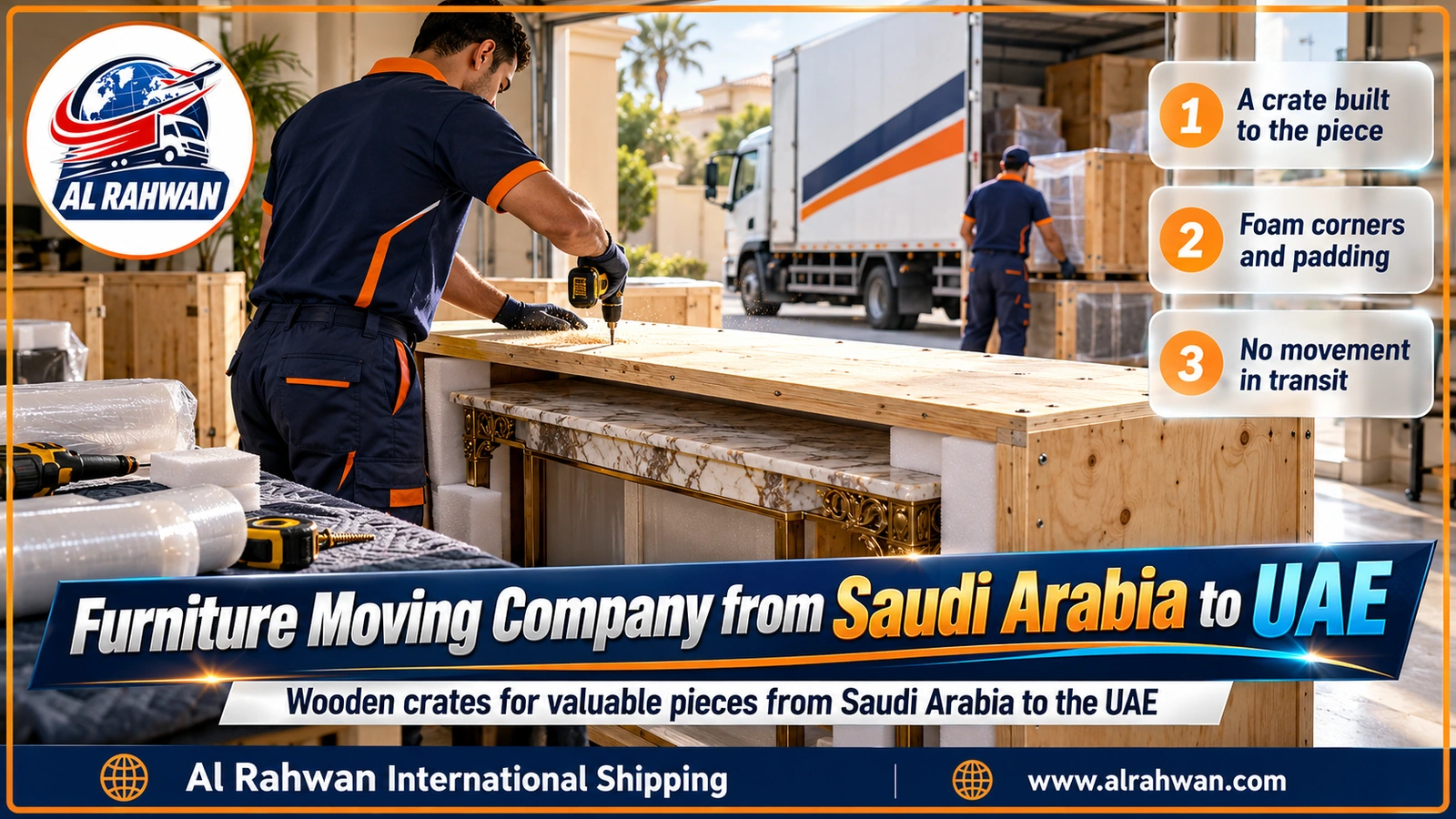
When do you need a wooden crate?
- Marble and granite tops: dining tables, consoles and side tables.
- Large mirrors: especially those with gilded or carved frames.
- Original artworks: oils and watercolours of value.
- Antiques: large vases, statues and ceramic pieces.
- Crystal chandeliers: after they have been taken apart.
- Grandfather clocks: after the pendulum and weights are secured.
The price of a crate is set after the free survey because it depends on the size and weight of the piece. A crate does not only protect the piece from knocks; it also lets other items be stacked next to it safely and makes handling easier at the border and at unloading.
Packing Glass, Mirrors and Chandeliers
Glass is the material that never gives you a second chance. A wooden piece can be repaired if scratched; a broken mirror cannot. That is why glass takes up more packing time at Al Rahwan than its size would suggest.

Mirrors
A mirror first gets tape in a star or X across its face, not to stop it breaking but to hold the shards together if it does, so they do not scratch the frame. It is then wrapped in bubble wrap, placed between two sheets of card or inside a thin crate made to its size, and always carried standing on its edge, never flat.
Chandeliers
A chandelier does not travel hanging as it is. It is taken apart into its frame, arms and hanging crystals. Each crystal is wrapped on its own in soft paper and arranged in small divided boxes, and the arrangement is photographed before dismantling so it can be put back exactly as it was. The frame is wrapped and fixed inside a box so its arms do not bend. At the new home the technician reassembles and hangs it after checking the ceiling fixing point.
Glass tables and display cabinets
A glass tabletop is separated from its base and travels as a separate panel. A display cabinet is emptied completely, its glass shelves removed and wrapped one by one, then its glass door is taped shut from the outside and wrapped. The items displayed in it, from china sets to small ornaments, are wrapped individually and packed in divided cartons.
Antiques, Paintings and Clocks
Every home has a piece whose value is not measured in money: a painting by a friend, a vase that was a gift, an old wall clock. These are recorded on the inventory by name, description and photograph, not under “assorted ornaments”.
- Paintings: the face is protected with acid-free paper or a non-stick cover, card corners go on the frame, and then a crate built to size if the painting is valuable or the frame is gilded.
- Statues and vases: wrapped in layers and secured inside a crate whose gaps are filled with cushioning so they cannot move.
- Grandfather clocks: the pendulum and weights are removed and wrapped separately, the movement is secured, and the clock travels upright.
- Valuable hand-made rugs: rolled on a tube, never folded, and wrapped in a breathable cover.
- Small ceramics and crystal: each piece wrapped alone, packed in divided cartons, with the contents written on the carton.
Upright Pianos and Heavy Pieces
An upright piano is heavy and delicate at the same time. The keyboard lid is closed and secured, the whole piano is wrapped in thick blankets, it is always carried upright and never on its back, and it is strapped against the wall of the truck. Nothing is placed on top of it. After a long trip a piano usually needs tuning by a specialist in the UAE once it has settled in place for a few days; that is normal and not a sign of damage.
Other heavy pieces include steel safes, full marble tables and massive solid-wood wardrobes. These are checked at the survey along with the route they will take: the width of the door, the turn of the staircase, and the size and load limit of the lift. Anything that will not pass is dismantled where possible, or a different way of bringing it down is planned before loading day, not on the day itself.
Hand-Made Rugs and Fitted Carpet
Hand-made rugs, whether Persian, Turkish or Afghan, are among the most valuable things in many homes. They are cleaned of dust before packing, then rolled face-in into a cylinder, because folding breaks the knots and leaves lines. They are wrapped in a breathable cloth or paper cover rather than airtight plastic alone, and carried flat in the truck. Fitted carpet is rarely worth moving, as room sizes in the new home will differ.
Appliances, Air Conditioners and Kitchens
These are not furniture in the strict sense, but they move with it and need technical care. Before a split AC leaves the wall, the technician pulls its refrigerant back into the outside unit and seals it, then separates the copper lines; in the Emirates he puts it back up and tests it. The fridge is emptied and switched off a day ahead and carried upright. Large televisions travel in their original boxes if you still have them, otherwise in padded cartons made to size. A wooden or aluminium kitchen is taken apart into numbered units if you decide to move it, after checking the size of the new kitchen first.
IKEA and Flat-Pack Furniture
Furniture that arrives in flat boxes and is assembled with screws, such as IKEA and similar brands, has its own character. Most of it is made of pressed board that does not tolerate being taken apart and reassembled many times, because the screw holes widen each time. The decision is made piece by piece:
- Large items such as wardrobes: dismantled carefully, panels numbered, and screws and wooden dowels kept in numbered bags.
- Small sturdy items such as chests of drawers and side tables: moved assembled if their size allows, to avoid weakening them.
- Cheap, worn-out pieces: buying a replacement in the UAE may cost less than moving them, and we will tell you so plainly at the survey.
The key with this kind of furniture is never to force it apart. A carpenter who knows it dismantles in the reverse order of assembly and keeps every small metal fitting, because losing one can hold up the whole reassembly.
Road Heat and Dust: What Happens to Furniture on a Desert Trip
The road to Al Batha crosses desert stretches. A closed truck protects against direct sun and dust, but the temperature inside the box rises during the day. What is affected?
- Plastic touching surfaces: it can stick to paintwork or leather, which is why a layer of cloth or paper goes on first.
- Wax and liquids: they melt or leak, so candles, perfumes and oils are never packed with the furniture.
- Wood: it expands and contracts as the temperature swings, so straps are not tightened to the point of pressure, and it is wrapped in something breathable.
- Old glue: in antique furniture it can weaken in the heat, so antique pieces are braced from the inside before wrapping.
- Dust: it gets in through any opening, so drawers and doors are closed and fabrics are fully covered.
Arranging the Pieces Inside the Truck
How the load is arranged is part of the protection, just as much as the wrapping. A truck stacked without a plan can damage its load even if the wrapping is excellent, because pieces shift and press against each other on bends and bumps.
The rules Al Rahwan’s crew follows when loading:
- Heaviest first and at the bottom: large appliances, cabinets and heavy wooden crates on the floor of the box and towards the front.
- Long pieces upright against the walls: dismantled wardrobe panels, mattresses and mirrors in their crates.
- Marble and glass upright on edge: held between fixed pieces or strapped to the wall, never flat.
- Sofas and majlis seating on top of solid pieces: with no weight placed on them.
- Light and fragile items at the top: rattan, divided cartons and crystal pieces.
- Gaps filled: with blankets and cushions so nothing has room to move.
- Tier-by-tier strapping: each tier is strapped before the next one begins.
Shared or dedicated truck for valuable pieces?
| Comparison | Shared truck | Dedicated truck |
|---|---|---|
| Cost | Lower; you pay for your share of the space | Higher; the truck is yours alone |
| Departure | Once the load is complete | On the agreed day |
| Opening the box en route | May be opened to unload other loads | Opened only on arrival or for customs inspection |
| Best for | A few sturdy pieces | Valuable furniture or a whole home |
Our advice: if you have expensive pieces, a dedicated truck gives you more peace of mind, because every time the box is opened to unload someone else’s goods is another chance for your pieces to shift.
Road or Sea for Valuable Furniture?
People sometimes suggest a sea container for a big load: out of Dammam through King Abdulaziz Port, or out of Jeddah’s Islamic Port, discharging at Jebel Ali. Sea freight does exist, but it is designed for commercial containers, either a full container (FCL) or a shared one (LCL), and moving furniture that way means unloading and loading at two ports plus trucking before and after. Every extra handling of a valuable piece is an extra risk. So Al Rahwan keeps furniture on the road, door to door, and reserves sea boxes for trade cargo, where a twenty-footer begins at SAR 2,300 and a forty-footer at SAR 3,500.
Office, Showroom and Corporate Furniture
Moving office furniture follows a different logic from homes. Large wooden executive desks are treated like valuable furniture, office chairs go into bags with protection for the castors and armrests, large meeting tables have their tops removed, and steel cabinets and archives are emptied or locked and secured. Every piece is numbered by its position in the new office so it can be set up in the UAE as it was or according to the new layout.
Showroom and exhibition furniture, often brand new, needs wrapping that keeps it exactly as it left the factory, because any mark lowers its sale value. It often travels on wrapped pallets from SAR 740 per pallet, or in a full trailer from SAR 6,500. The paperwork differs because the shipment is commercial: commercial registration, invoice, packing list and certificate of origin. Al Rahwan moves the furniture of companies, institutions and administrative bodies with the same level of care.
Moving Cars Together with Furniture to the UAE
People moving valuable furniture usually have a car they want to follow them. The car travels on a multi-deck car carrier, covered and strapped down, and arrives within 3–5 days. Luxury and classic cars travel inside a fully enclosed carrier that protects them from dust and sun, which suits anyone who cares about the condition of their car as much as their furniture.

| Option | From | Suits |
|---|---|---|
| Sedan in a slot on a group transporter | SAR 1,100 | The everyday runabout |
| Sedan on an open transporter booked for you | SAR 1,650 | When you need a fixed arrival date |
| Family 4×4 in a slot on a group transporter | SAR 1,400 | Big family vehicles |
| 4×4 on an open transporter booked just for it | SAR 2,050 | A 4×4 on its own timetable |
| Prestige or classic car in a closed box transporter | SAR 2,300 | Valuable and rare cars |
Paperwork for the car: the istimara with both plates, a certificate permitting its export, a copy of the owner’s identity, written approval from the lender if instalments remain, and a mandate if someone else hands it over. Before handover, photograph it all round and take your belongings out.
Air Freight for Small, Valuable Pieces
Some pieces are small in size but high in value, and their owners would rather they did not spend days on the road: a small painting, a collection of watches, silverware or crystal sets. These can fly and be collected within 24–48 hours: they leave from the airports of Riyadh, Jeddah or Dammam and are picked up at Dubai, Abu Dhabi or Sharjah.
On a plane you pay for chargeable weight, meaning whichever is bigger out of what the box weighs and what its size implies; the size figure comes from multiplying the three sides in centimetres and dividing the result by 6000. Because valuable pieces travel in padded boxes, volumetric weight usually decides the charge. For example, a painting box measuring 100 × 80 × 15 cm gives 120,000, and divided by 6000 its volumetric weight is 20 kg, even if it actually weighs no more than 8 kg. There is no fixed price per air kilo; you receive an itemised quote based on the chargeable weight of each box.
Documents Required to Move Furniture to the UAE
Anyone exporting used furniture from the Kingdom provides four things: a copy of their ID or iqama, a list of the pieces travelling, a mandate for the clearing agent on the Fasah platform, and the name, mobile and address of the person receiving in the Emirates. At Al Ghuwaifat the recipient may be asked for whatever the personal-effects rules of the day require; in summary:
| Load type | Prepare before leaving the Kingdom | Possibly asked for at Al Ghuwaifat |
|---|---|---|
| Used household furniture | ID or iqama, piece-by-piece inventory, Fasah mandate, recipient address with floor, lift and loading access | Recipient’s or owner’s passport; their UAE residency, Emirates ID or work visa; a bilingual inventory that labels each piece as used; a mandate for the agent |
| Valuable pieces | Listed by name, description and photo on the inventory, with their declared value if insurance is requested | Within the same packing list |
| Office and showroom furniture | Commercial registration, invoice, packing list, certificate of origin | According to the nature of the goods |
| Car | Istimara and plates, export certificate, owner’s ID copy, bank consent where financed, mandate for anyone delivering it | Whatever the rules on the shipping date require |
Why does a detailed inventory matter for valuable pieces?
Because it does three jobs at once: the customs inspector knows what is in each crate without opening the whole load, insurance relies on it if anything is damaged, and you check your pieces against it at delivery. A piece listed just as “table” helps nobody; “white marble dining table with wooden base, top separate in crate no. 4” helps with everything.
Customs and the Question of Duty on Used Furniture
In the Kingdom, the paperwork runs through an electronic mandate you give the agent on Fasah, the ZATCA platform. On the far side, Abu Dhabi Customs finish things at Al Ghuwaifat, and where the final address is in Dubai the agent also lodges the shipment on Mirsal, which belongs to Dubai Customs. The inspector may ask for a crate or carton to be opened for inspection.
This is where crates closed with screws pay off: they can be opened for inspection and closed again without breaking. An Al Rahwan representative attends the inspection to make sure anything opened is repacked.
On the question of duty for second-hand furniture, our answer never changes: only customs decide how used belongings are handled, shipment by shipment, under the rules that apply on the day. Nobody who knows the business will give you a figure in advance; what is in your hands is an accurate packing list stating that the items are used, and the recipient’s UAE residency documents ready to go.
What Cannot Travel with Your Furniture
Along with valuable pieces, people sometimes pack things that are not allowed, and the crossing gets delayed because of them. Banned outright: narcotics, weapons and their ammunition, explosives, flammable materials, gas cylinders, fuel, counterfeit goods and hazardous chemicals. Needing prior approval or declaration: medicines in large quantities, drones, wireless devices, large batteries, plants and refrigerated food. The customs authority has the final say on all of these.
Examples that come up again and again with furniture: tins of varnish and wood-polishing oils, cleaning sprays, and heater lighters. These stay out of the load.
Insurance on the Declared Value
For valuable pieces, insurance matters more than for ordinary furniture. With Al Rahwan it is optional and added at booking if you want it; it rests on the sum you put on each piece and on the photo inventory made on packing day, and it shows in the quote as its own priced line.
How to prepare for it:
- Photograph every valuable piece before wrapping: from more than one angle, including any existing marks.
- Set a reasonable value: the declared value is the basis for any compensation, so neither inflate nor understate it.
- Keep purchase receipts if you have them: especially for expensive pieces.
- Check the pieces at delivery: before signing, and note anything on the inventory with the crew present.
Tracking the Shipment Until Delivery
You receive a notification at loading once the truck is closed, another when it crosses Al Batha, a third when it reaches the city where the furniture will be delivered, and a fourth at delivery. In between, call or WhatsApp 0568829975 whenever you need to, from seven in the morning until eleven at night.
Storage Before You Leave or After You Arrive
Sometimes the new home in the UAE is still being finished, or has not been handed over yet, and you do not want to leave valuable pieces in an empty house. Wrapped pieces can then be kept in storage on the Saudi side until your flight, or on the Emirati side once they land, for as long as the house needs. What storage costs is set by how much space and how many weeks, and it is written into the quote if you request it. Our advice: do not open the wooden crates during storage; they are the best protection for the piece until it reaches its final place.
Building Permits in Dubai and Abu Dhabi, and Door and Lift Sizes
Furniture reaching the building entrance does not mean it reaches the inside of the apartment. Dubai residential blocks are mostly managed by facilities firms that want a moving permit issued and the goods lift reserved ahead of the date, and plenty of Abu Dhabi towers and compounds do the same. The permit usually needs the tenancy contract and the resident’s ID, so start early.
What matters most for large pieces is measurements. Before the move, ask the new building’s management for the internal size of the service lift (width, depth and height) and the width of the apartment door, and send them to the Al Rahwan team. A long sofa, an assembled wardrobe or a marble table may get into your home in the Kingdom and still not fit a tower lift in Dubai. If we know early, we dismantle what needs dismantling in the Kingdom and protect its parts, instead of discovering the problem in front of the lift.
Furniture Delivery and Reassembly in the UAE
Furniture is delivered to all seven emirates, and the Al Rahwan crew handles unloading, uncrating, reassembly and arrangement.

- Abu Dhabi: the capital plus Al Ain and the Al Dhafra region, reached first after Al Ghuwaifat.
- Dubai: all areas, with details registered on Mirsal and building permits arranged.
- Sharjah: the city, inland Al Dhaid, and Khor Fakkan and Kalba facing the Gulf of Oman.
- Ajman and Umm Al Quwain: close to Sharjah.
- Ras Al Khaimah: in the north.
- Fujairah: on the east coast.
At delivery things happen in order: pieces are brought down and carried to their rooms by number, wooden crates are opened by removing the screws, beds, wardrobes and tables are reassembled, chandeliers and large mirrors are hung if the fixing points are ready, and the wrapping is cleared away. Then the valuable pieces are checked against the inventory one by one before you sign.
Steps to Move Your Furniture with Al Rahwan
- Get in touch on 0568829975 or through Request a shipping quote, and send photos of the valuable pieces.
- Free survey: the surveyor identifies each piece’s material, what needs a crate and what gets dismantled.
- Itemised quote: transport, crates, insurance and storage if requested, each as a separate line.
- Preparation: you send the documents, book the lift in the new building and send its measurements.
- Crate building and wrapping: one day or more depending on the number of special pieces.
- Loading and inventory: you check the photographed list and sign it.
- Road and border: notifications at each stage.
- Delivery and reassembly: uncrating, reassembly, checking, then signing.
Common Mistakes When Moving Valuable Pieces
- Wrapping polished wood and leather straight in plastic: in road heat it can stick and leave marks.
- Moving marble flat: the right way is upright on its edge inside a crate.
- Folding a hand-made rug: it breaks the knots; it should be rolled into a cylinder.
- Leaving the chandelier assembled: it should be taken apart, with the crystals in divided boxes.
- Ignoring lift sizes in the UAE: the piece arrives and cannot get in.
- A vague inventory with no descriptions: it weakens your insurance position and lengthens customs inspection.
- Packing polish and varnish with the furniture: flammable materials are banned.
- Choosing a shared truck for expensive pieces: a small saving in exchange for the box being opened several times on the way.
Why Al Rahwan for Moving Your Furniture to the UAE?
- Wrapping by material: wood, veneer, leather, fabric, marble, glass, metal and rattan each have their method.
- Made-to-measure wooden crates: for pieces that wrapping alone cannot protect.
- Carpenters and technicians: to dismantle and reassemble bedrooms, wardrobes and chandeliers, and air-conditioning technicians who recover the gas before removal.
- A photographed inventory by name and description: serving customs, insurance and delivery.
- Closed trucks and planned loading: protection from dust, heat and vibration.
- Reassembly across all seven emirates: your furniture is never left at the door.
- Far beyond the UAE: Al Rahwan ships to any country by road, sea or air, and the Emirates sit near the top of what its customers ask for.
- Punctuality and clear contact: phones answered every day 7 am to 11 pm, and a website form that never closes.
Send photos of your valuable pieces to 0568829975 by phone or WhatsApp, and the survey team will tell you how each piece will be protected and what it will cost. Sending general goods or parcels instead? The Shipping company from Saudi Arabia to the UAE guide covers them, and the Shipping to the UAE hub gathers every route in one place for quick reference.
Related Articles and Pages
- Shipping to the UAE: routes, transit and services on the country page
- Shipping company from Saudi Arabia to the UAE: freight, parcels and vehicles
- Home removals company from Saudi Arabia to the UAE: every stage of a whole-house move
- Furniture moving company from Riyadh to the UAE: majlis seating and heavy pieces from capital homes
- Best furniture moving company from Jeddah to the UAE: wood, leather and coastal humidity
- Best home removals company from Saudi Arabia to the UAE: what to ask before you sign
- Request a shipping quote: describe your pieces and get an itemised price
Frequently Asked Questions
What is the lowest price for moving furniture from Saudi Arabia to the UAE?
Prices open at SAR 1,300 for one room’s furniture, SAR 2,500 for a two-bed flat, SAR 4,100 for a three-bedroom family home and SAR 8,300 for a villa, with crates and insurance added after the free survey if you need them.
How many days is furniture on the road to the Emirates?
After loading: 2 to 3 days out of Riyadh and the east, 3 to 5 days out of Jeddah, Makkah, Madinah and Taif, and 4 to 6 days out of Tabuk, Khamis Mushait and Abha.
Is furniture moving charged by weight or by volume?
By the volume the pieces take up in the truck with their wrapping, while parcels go by weight from SAR 9 per kg and air freight by chargeable weight.
When does a piece need a wooden crate?
For marble tops, large mirrors, original paintings, antiques, dismantled chandeliers and grandfather clocks, with each crate built to the piece and priced after the survey.
How is a marble table moved without breaking?
The top is separated from the base, fully wrapped and carried standing on its edge inside a wooden crate, never lying flat under other pieces.
How is a crystal chandelier packed for the move to the UAE?
It is taken apart into frame, arms and crystals, each crystal is wrapped alone and arranged in divided boxes after photographing the layout, and a technician reassembles it in the UAE.
Will a leather sofa be damaged by the heat on the road?
Not if it is wrapped in cloth or paper before plastic, because plastic touching leather in the heat is what causes sticking and marks.
Does second-hand furniture attract fees at the UAE border?
That is a customs decision: they set how used belongings are treated in each shipment under the rules applying on the shipping date, and your part is an accurate packing list showing the pieces are used.
Which papers does my furniture need to reach the Emirates?
In the Kingdom: an ID or iqama copy, a list of the pieces, the clearing agent’s mandate on Fasah and the recipient’s address; in the UAE a passport copy, UAE residency and a bilingual packing list may be asked for.
Is valuable furniture insured during the move?
Yes, choose it at booking; it is built on the value you give each piece plus the photo inventory, and the premium is itemised on its own.
Can small valuable pieces be sent by air?
Yes, they land within 24–48 hours and are billed on the bigger of real and size-based weight, so a 100 × 80 × 15 cm painting box counts as 20 kg.
How does the car travel with the furniture, and at what price?
On a covered, strapped car transporter: sedans from SAR 1,100 on a group transporter, 4x4s from SAR 1,400, prestige cars from SAR 2,300 in a closed box, all within 3 to 5 days.
Do you dismantle and reassemble IKEA furniture?
Yes, large items are dismantled in reverse order of assembly with numbered panels and bagged screws, while small sturdy items travel assembled to avoid weakening them.
What if a piece is larger than the building lift in Dubai?
Send the lift and apartment door measurements before the move so the crew can dismantle what is needed in the Kingdom, and arrange the move-in permit and service lift booking with the building management.