 United Arab Emirates
 Qatar
 Kuwait
 Bahrain
 Oman
 Iraq
 Turkey
 Lebanon
 Syria
 Jordan
 Egypt
 Morocco
 Tunisia
 Algeria
 Libya
 Sudan

Al Rahwan, the Best Furniture Moving Company from Jeddah to Kuwait for owners of pieces they worry about, handles each item according to what it is made of: natural wood is wrapped in materials that breathe, leather never touches plastic, and antiques and paintings go into padded wooden crates. The closed truck then travels by way of Riyadh or Qassim and on to Hafar Al Batin, then crosses at Al Ruqai and enters Kuwait at the Al Salmi post, delivering within 3 to 5 days of loading. One room’s worth of furniture moves from SAR 1,350; a flat of three bedrooms, appliances included, from SAR 2,300; and a closed truck reserved for your pieces alone from SAR 2,300 for the haulage. Call 0568829975 and send photos of your valuable pieces so the right packing can be assessed for each one.
🧭 In this guide52 sectionsShowHide
For us there is a clear line between a home removal and a furniture move. The first is moving an entire household with its cartons and appliances; the second is care for the pieces that carry real financial or sentimental value: a walnut bedroom set, a genuine leather sofa, a dining table with a marble top, an inherited painting, a brass antique, or wedding furniture used for only a few months. This page is written for the owner of such pieces, and specifically for someone living in Jeddah, where humidity is a bigger threat to furniture than the road itself.
- The road: a closed truck from Jeddah via Riyadh or Qassim to Hafar Al Batin, then the Al Ruqai crossing and Al Salmi, with Jahra the first Kuwaiti governorate it reaches.
- Arrival time: furniture lands 3 to 5 days after loading; a car needs 2 to 4 days on its transporter; small pieces flown arrive in 24 to 48 hours.
- Starting prices: one room SAR 1,350, a small flat SAR 1,390, a villa SAR 3,700, and a part load on a shared truck SAR 1,290.
- Wood and leather protection: paper or cotton cloth against the surface, a blanket over it, loose outer plastic, and silica sachets inside drawers.
- Antiques and paintings: a made-to-measure wooden crate lined with foam, priced after the free survey.
- On arrival: wraps removed at once, assembly and placement in all six governorates, and optional insurance on the declared value.
Why does Jeddah furniture need different treatment on its way to Kuwait?
Furniture in Jeddah spends years in moisture-laden air and adapts to it: natural wood swells slightly and holds water in its fibres, fabric slowly absorbs humidity, and leather stays supple. Then that furniture is suddenly moved into a truck crossing the dry centre of the Kingdom, and arrives in Kuwait, where for most of the year the air is drier than on the west coast and the air conditioning in the new home runs for long hours.
That rapid change causes most of the damage people see and blame on rough handling: fine cracks across a wooden table top, joints opening between wardrobe panels, veneer lifting at an edge, a white haze on a glossy finish, small mildew spots on the back of a fabric sofa, or leather cracking because it dried out quickly after being trapped under plastic. The difference between the two climates cannot be avoided, but its effect can be greatly reduced by how the pieces are packed and how they are unpacked on arrival.
Route and arrival time: Jeddah to Al Ruqai, then Al Salmi
A furniture truck from Jeddah does not head for the east coast; the Al Khafji and Al Nuwaiseeb crossing serves loads leaving Dammam, Al Khobar and Al Ahsa. Your pieces travel east to Riyadh or north-east to Qassim, then to Hafar Al Batin, and from there to the Saudi Al Ruqai crossing, which faces Kuwait’s Al Salmi post. From Al Salmi, Jahra is the nearest governorate, after which loads are distributed across the rest of Kuwait.
| Service | Time from loading to delivery | Note |
|---|---|---|
| Furniture in a dedicated closed truck | 3 to 5 days | Leaves as soon as loading is complete |
| Furniture pieces on a shared truck | 3 to 5 days | Departure may wait until the load is full |
| Car on a transporter | 2 to 4 days | Counted from when the car is loaded |
| Small valuable pieces by plane | 24 to 48 hours | From King Abdulaziz Airport in Jeddah |
Wooden crates take time before loading, because each one is built to the size of its piece. So if you have paintings, antiques or large mirrors, tell us about them on the first call so the building day is included in the schedule.
Furniture moving prices from Jeddah to Kuwait
Moving furniture from Jeddah to Kuwait is priced from SAR 1,350 when it is a single room, from SAR 2,300 when it is three bedrooms plus appliances, and from SAR 3,700 when it is a villa. If you want a closed truck shared with no one, which suits anyone with many valuable pieces, the transport alone starts from SAR 2,300.
| Item | Price starts from |
|---|---|
| Furniture of one room (bedroom, majlis or dining) | SAR 1,350 |
| Small flat: two bedrooms, majlis and kitchen | SAR 1,390 |
| Three-bedroom flat with appliances | SAR 2,300 |
| Villa or whole house | SAR 3,700 |
| Part load of selected pieces on a shared truck | SAR 1,290 |
| Dedicated closed truck (transport only) | SAR 2,300 |
| Wrapped pallet for many small pieces | SAR 550 |
| Wooden crate for an antique, painting or marble top | Ask for an itemised quote |
| Insurance on the declared value | Set after the free survey |
What do the numbers look like in practice?
A newly married couple in Al Hamra moving only their new bedroom set to their home in Jahra: one room from SAR 1,350. A family in Al Rawdah with a three-bedroom flat, including a leather sofa and a marble dining table, taking a sedan along: SAR 2,300 + SAR 920 = SAR 3,220 to start, plus the table’s crate after the survey. A villa owner in Al Shati with a collection of paintings and antiques who wants a dedicated closed truck and is shipping an SUV: SAR 2,300 + SAR 1,100 = SAR 3,400 to start for the transport and the car, with crates and packing added according to the number of pieces.
Al Rahwan runs offers most of the time, applied according to the date and the size of the load. But with valuable furniture we never advise saving on packing; a wooden crate costs far less than repairing a painting or replacing a marble top.
Six questions to ask before handing your pieces to any company
Anyone looking for the best in moving valuable furniture needs more than “we take care of your things”. Put these questions to any company, listen to the detail in the answer, and compare:
- How will you wrap the leather sofa? If the answer is “with stretch film”, that tells you enough.
- Who builds the wooden crate for the painting, and is it made to measure? A loose, ready-made crate lets the piece move around inside.
- Which crossing will the truck use? For a Jeddah load, the correct pair is Al Ruqai leaving Saudi Arabia and Al Salmi entering Kuwait.
- Is the truck closed, and will it be shared with other loads? Sharing saves money, but it means loading and unloading for others along the way.
- Do you photograph pieces before packing and write a detailed inventory? With no photos and no inventory, nothing can be proved.
- Who unwraps and assembles in Kuwait? If the answer is “we unload at the door only”, look elsewhere.
At Al Rahwan we answer these same questions before you ask them, in the itemised quote.
The survey and a condition report for each piece
When valuable furniture is involved, the survey is more thorough than for an ordinary house move. Counting rooms is not enough; the surveyor needs to see every valuable piece and record its material, size and condition. So the Al Rahwan team prepares what could be called a condition report: photos of every valuable item from more than one angle, a note of any scratch, crack or discolouration present before the move, and exact measurements for everything that will go into a wooden crate.
That report protects you and us. If a piece arrives with something that worries you, its state is compared with the photos and it becomes clear whether the flaw is old or from the journey. It is also the basis for the declared value in the insurance. If you are short of time you can send a video of the pieces and close-up photos, and the rest is completed on packing day before anything is wrapped.
The crew that handles your pieces
Valuable furniture is not handed to porters alone. On an Al Rahwan move the work is split among people who each know their part: a carpenter who dismantles and reassembles bedrooms, wardrobes and tables; a technician for air conditioners, chandeliers and fittings; a packing team trained in layers and crates; a supervisor who holds the condition report and inventory and stands at the truck; and a driver who takes the closed truck to the crossing and follows the formalities with the customs broker. Demand for moves out of Jeddah rises in the wedding season and at the end of the school year, so booking early secures the same crew in Jeddah and in Kuwait.
Sort your pieces before packing: each material has its risk and its protection
The first thing the Al Rahwan team does at the survey is sort the home’s pieces by material, not by room. One living room may hold a leather sofa, a glass table, a handmade rug and a brass ornament, and each needs a different method. This table sums up what we use for Jeddah furniture:
| Material | What threatens it on the trip | How it is protected |
|---|---|---|
| Solid wood (walnut, oak, beech, mahogany) | Cracking from fast drying, and scratches | Paper or cloth, then a blanket, then loose plastic, with cardboard corners |
| Pressed wood with veneer or lacquer | Edges swelling from moisture, veneer lifting | Dried before wrapping, a breathable layer, and panels carried standing on edge once dismantled |
| Genuine leather | Sweating under plastic then cracking, and rope marks | Cotton cover, then a blanket, no plastic against it, and nothing heavy on top |
| Fabric and velvet | Mildew and odour, and soiling | Cloth or paper, then a blanket, then loose plastic |
| Rattan and bamboo | Broken ends and drying out | Bubble wrap round the ends, cardboard, and no stacking |
| Glass and mirrors | Breakage from pressure and vibration | Heavy cardboard on both faces, carried upright, or a wooden crate |
| Marble and granite | Snapping under its own weight if carried flat | Carried on edge in two blankets, or in a wooden crate |
| Metal and brass | Rust and spots from salty air | Cleaned and dried, acid-free paper, and a carton |
| Paintings and antiques | Breakage, and moisture on the canvas | Foam-lined wooden crate, with no plastic touching the face of a painting |
Solid wood, veneer and lacquer
Solid wood moves with humidity; that is its nature, not a defect. So the Al Rahwan crew does not try to seal it off from the air completely, but slows down the change in moisture around it. A table or wardrobe is wrapped first in soft packing paper or cotton cloth touching the wood, then in a thick moving blanket, and the plastic goes on the outside without tension that presses on the edges. Corners get cardboard guards, and carved legs are wrapped one by one.
Furniture made of pressed wood with a wood veneer or glossy lacquer, common in modern bedroom sets, carries a different risk: its edges absorb water and swell, and the veneer lifts if moisture is trapped beneath it. Here drying before wrapping matters more than anything else. We ask owners of sea-facing homes to run the air conditioning in the rooms for a few hours before packing day where possible.

Drawers and doors
Drawers are emptied, one or two moisture sachets go into each large drawer, and they are then held shut with paper tape that leaves no mark, not strong adhesive tape that peels the finish. Glass doors on wardrobes and sideboards are removed if they can be, and wrapped on their own.
Genuine leather: no plastic against it
The most common mistake we see with leather sofas is wrapping them straight in plastic. Genuine leather breathes, and when it is trapped under plastic in Jeddah’s humidity and then the heat of the road, it sweats and develops a haze or spots, and the folds of the plastic can imprint on it. Then, if it is unwrapped in an air-conditioned Kuwaiti home and dries quickly, it starts to crack along the creases.
So a leather sofa is covered first with a clean cotton cover or soft paper, then a blanket, and either left at that or given a loose outer plastic layer that does not touch the leather. Rope is never tied directly over the leather, and nothing is placed on top of the sofa in the truck. We advise anyone with fine leather to clean and condition it with a suitable product a few days before the move, not on packing day, so it is completely dry.
Faux leather
Faux leather is less sensitive to humidity but cracks faster from heat and pressure. It is wrapped the same way and kept away from rubbing against metal pieces in the truck.
Fabric sofas, curtains and rugs
Fabric sofas get three layers: cloth or paper against the upholstery, a blanket over it, and an outer sheet of plastic left loose. Loose cushions are removed and placed in cloth bags, because a cushion squeezed between pieces loses its shape. Velvet and plush need extra care, since rope pressure leaves marks on them that last for days.
Heavy curtains are folded clean and dry into large cartons with moisture sachets, labelled with the room and the window. Handmade rugs are rolled face-in around a tube or into a cylinder, never folded, wrapped in paper or cloth and then outer plastic, and carried flat on top of the stable pieces. Silk rugs are treated as antiques.
Rattan, bamboo and outdoor seating
Obhur and Al Shati villas often have rattan and bamboo seating in gardens and on terraces. These pieces are light but their ends are fragile and they break if stacked. The ends are wrapped in bubble wrap, and chairs are placed facing each other so none presses on another. Metal outdoor furniture is washed free of salt from the air and dried completely before wrapping, or it will arrive with rust spots. Garden parasols are taken down and their fabric is rolled up dry.
Antiques, paintings, mirrors and chandeliers
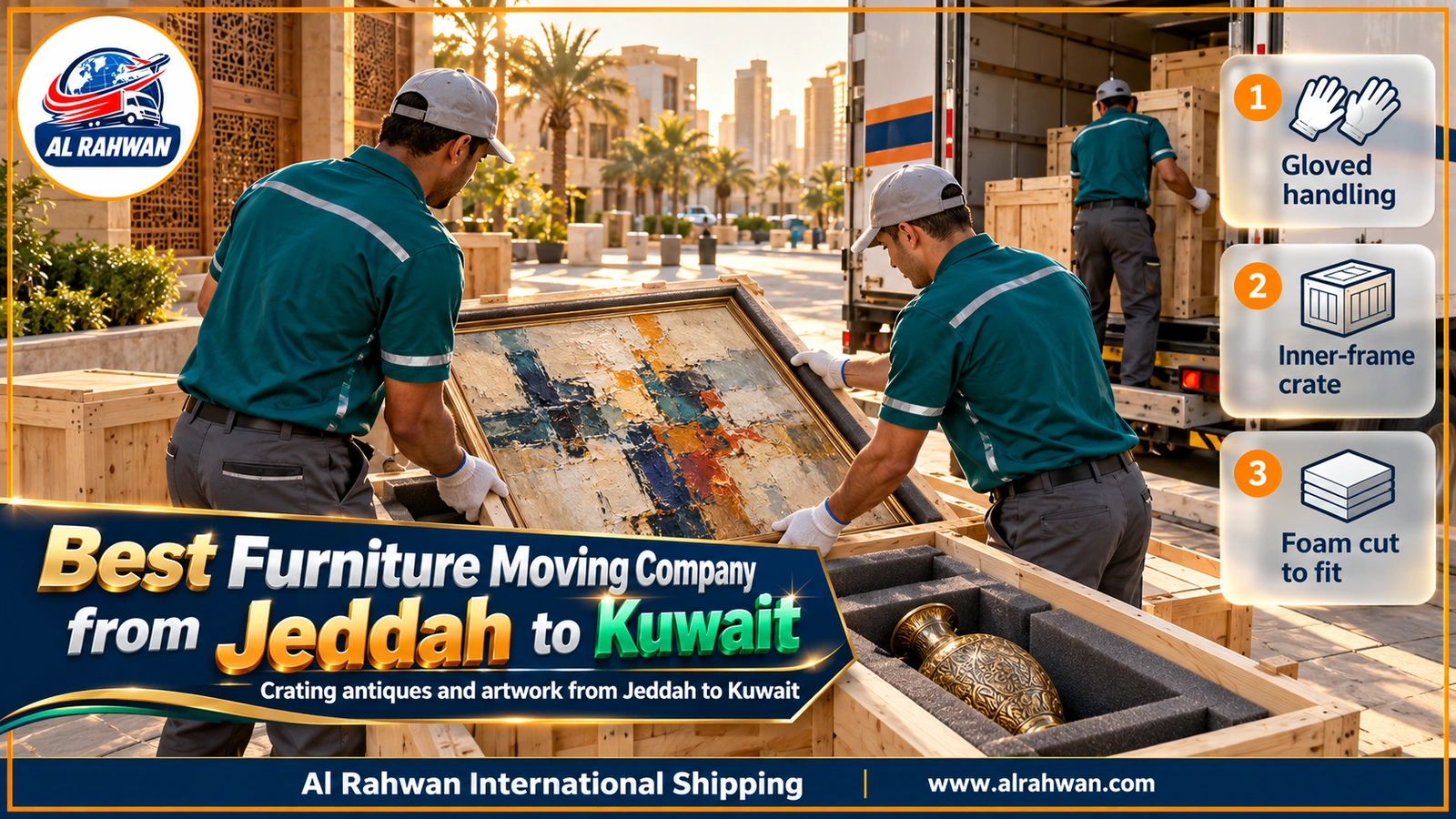
This is where the real difference lies between a removals firm and a furniture moving company. An oil painting is never wrapped in bubble wrap straight against its face, because the bubbles leave their pattern on the paint. It is covered first with acid-free paper, then placed in a wooden crate with an inner frame that holds it by the edges, lined with foam so that nothing touches its face. The crate is marked “this side up” and “fragile” and travels upright.
Brass, ceramic and glass antiques
Vases, brass ewers, old coffee pots and ceramic plates are wrapped one by one in soft paper, then set in a foam cradle inside a heavy carton or small box. Art glass has its inner hollows filled with crumpled paper so vibration does not crack it. No carton holds more than one valuable piece without a divider.
Large mirrors
A mirror is protected with heavy cardboard on both faces, has tape applied across the glass in an X to hold the fragments if it breaks, and travels standing on its edge. A mirror much over a metre and a half tall, or one with a carved gilt frame, goes into a wooden crate.
Chandeliers
A chandelier is taken down by a technician, who unhooks the crystal drops one by one; every drop gets its own twist of tissue and a slot in a partitioned box. The frame is wrapped separately. We photograph the chandelier from every side before dismantling it so it can be reassembled in Kuwait in the same arrangement.
Heritage furniture and old pieces
In Jeddah homes, especially those of families who once lived in Al Balad, there are heritage pieces passed down through generations: a brass-inlaid wooden chest that once held a bride’s trousseau, a carved door removed when a house was restored, an old wooden chair, or a heavy wooden bookcase. Their wood is dry and tired after many years, their nails are old, and they cannot take being dismantled.
So they travel as they are, and no one tries to take them apart. The wood is checked first for loose parts, which are held temporarily with paper tape, then the piece is wrapped in cotton cloth and two blankets, and goes into a wooden crate if it is small or fragile. Pieces inlaid with brass or mother-of-pearl have their raised parts wrapped in foam so they do not come away. Anything loose or cracked before the move is noted in the condition report.
Expensive electronics
Large screens, sound systems and specialist equipment are handled as valuable pieces. The best cover for a screen is its original box and foam; failing that, a case of heavy cardboard and foam is made to protect the panel from pressure, and it travels upright, not flat. Cables are disconnected and collected in a bag labelled with the device’s name, and the wiring at the back is photographed before unplugging. Moisture sachets go into each device’s carton, because moisture is a greater danger to electronics than vibration.
Bridal sets, showroom furniture and imported pieces
Many people moving furniture from Jeddah to Kuwait are not moving old furniture at all. Some are brides who bought their bedroom set in Jeddah showrooms to live in Kuwait, some are families who bought a new majlis before the move, and some imported pieces from abroad that arrived in Jeddah. These pieces get special handling.
- Collection straight from the showroom: Al Rahwan can collect the pieces from the showroom in Jeddah if you wish, so they are not taken home and then dismantled a second time.
- Original packaging: if the piece is still in its factory carton, extra outer packing is added and the carton is left closed. If it has been opened, it is replaced with full packing.
- The invoice: keep the purchase invoice; it can help at customs inspection, and it is the basis for the declared value for insurance.
- Assembly: new bedroom sets are assembled by the Al Rahwan carpenter in Kuwait using the maker’s booklet if there is one, checking that the wardrobe sits level on the new floor.
- Luxury imported pieces: those inlaid with mother-of-pearl or hand-gilded are treated as antiques and usually need a crate.
Packing that breathes, and moisture-absorbing sachets
The idea of packing that breathes is simple: the layer touching the piece is made of something that lets air through and absorbs moisture, such as cotton cloth or packing paper, and only the outer layer is there to keep off dust. Between the two sits a blanket to take the knocks. This is the opposite of what some crews do when they wrap a piece straight in stretch film and then put cardboard over it.
Moisture-absorbing sachets, silica gel and similar, go wherever air is trapped: inside drawers, in cartons of clothes and bedding, in antique crates, and next to electronics. The number of sachets rises with the size of the space. If the furniture is stored for a long period before or after arrival, the sachets are checked and replaced.
How Al Rahwan packs a valuable piece
- Photograph the piece from every side and record any existing flaw.
- Light cleaning and drying, leaving the piece in an air-conditioned room where possible.
- A layer of soft paper or cotton cloth against the surface.
- Protection for corners, legs and edges.
- A thick moving blanket.
- An outer plastic layer without tension, or a wooden crate for fragile pieces.
- A number, an orientation label and “fragile” where needed.
Dismantling and assembly: beds, wardrobes, tables and air conditioners
Large pieces are dismantled for two reasons: so they pass through doors and lifts, and so their joints are not twisted on the road. The Al Rahwan carpenter dismantles bedrooms, wardrobes and dining tables with removable legs, keeping screws and hinges in numbered bags taped to the piece itself.
- Dining table with a marble or glass top: the top is lifted off, wrapped on its own and carried on edge, with the base wrapped separately.
- Large wardrobes: doors come off first, then shelves, then the carcass is dismantled if it is designed to be.
- Sideboards and consoles: emptied, with their upper mirrors removed.
- Split air conditioners: the technician pumps the refrigerant into the outdoor unit, then the pipes are disconnected and capped, and both units are wrapped.
- The kitchen: if it is part of the move, it is dismantled in order and numbered, with plumbing and gas agreed at the survey.
In Kuwait the same crew assembles what it took apart, places each piece according to a layout agreed with you, and checks that doors hang straight and legs are firm.
What furniture faces on the road: heat and vibration
After humidity comes the road itself. The truck spends days between Jeddah and Al Ruqai, and in summer the temperature inside the closed box climbs sharply around midday and falls again at night. These cycles affect wax, glue and sensitive finishes, as well as candles and perfumes left in drawers. So nothing that can melt is left inside furniture, and pieces with delicate finishes are kept away from the truck wall exposed to the sun.
Constant vibration on long roads loosens screws and shifts anything not well secured. That is why weak joints are taken apart rather than left to take the movement, gaps between pieces are filled with blankets or light cartons so nothing slides, and straps are tightened over blankets rather than across the surface of a piece. In winter the northern stretch of the road is colder, so no water is left in any appliance or vase.
How pieces are arranged inside the closed truck
Valuable furniture is not loaded the way cartons are. In an Al Rahwan closed truck, heavy stable pieces go at the bottom and against the walls, strapped to the tie-down rings. Nothing is put on leather or fabric pieces. Crates holding antiques and paintings are secured upright where porters will not walk past them while unloading. Mirrors and stone tops stand on their edges against the side wall, with blankets between them.
That is why we recommend a dedicated truck to anyone with many valuable pieces: its doors are opened only at the crossing if customs ask, no other customer’s load is added on the way, and nothing is rearranged. It is photographed inside before it is closed.
Customs and paperwork on both sides of the border
Before the truck sets off, the broker logs on to the Fasah system of Saudi customs (the Zakat, Tax and Customs Authority) using an electronic authorisation you grant. The file is then completed at Al Salmi by Kuwait’s General Administration of Customs. The officer may want a crate or carton opened to check it; for that reason each crate carries its own number and a note of what is inside, so only what is necessary is opened and then carefully closed again. Used household goods and cars are dealt with by Kuwaiti customs under whatever rules apply on the day of shipping.
| What you are moving | Papers to prepare |
|---|---|
| Used household furniture | Your iqama or ID copy, an inventory describing each piece, the broker’s consent on Fasah, and from the Kuwait end the receiver’s name and phone with governorate, area, block number, street, house and floor; their civil ID copy is sometimes requested |
| New furniture from a showroom | The same papers plus the purchase invoice |
| A car travelling with the furniture | Proof of the owner’s identity with the car’s registration, plates and export certificate; the bank’s letter if the car is mortgaged; a signed authorisation if someone else is sending it; and the Kuwaiti receiver’s civil ID copy |
| Office or showroom furniture | The firm’s or showroom’s registration, its commercial invoice, a list of everything packed, the Kuwaiti importer’s identity, and an origin certificate where asked for |
Delivery and assembly in Jahra and the other governorates
The first job on arrival is to take off the outer plastic wraps without delay, so no moisture stays trapped. Wooden and leather pieces are then left to settle into the home’s climate, ideally without the air conditioning blowing straight at them for the first few days. After that the furniture is assembled and arranged.

Jahra is the governorate closest to the Al Salmi crossing, so it is often the first delivery on the truck’s run, whether in Jahra city itself, Saad Al Abdullah or Abdali. From there loads go out to the Capital, in areas such as Shuwaikh and Kaifan; to Hawalli, in areas such as Salmiya and Mishref; to Farwaniya and Khaitan; to Mubarak Al Kabeer in Adan and Qurain; and to Ahmadi in Mangaf and Fahaheel.
Flats in Kuwaiti blocks need the service lift reserved and the building office’s consent arranged ahead of the date; for houses it is enough that the way to the door is open to the truck or close to it. We ask for the doors and passages of the Kuwaiti home to be measured before the move where possible, so we know which pieces must stay dismantled to get in.
Moving the car with the furniture from Jeddah to Kuwait
Someone moving valuable furniture rarely leaves the car behind. Al Rahwan ships the car on a multi-deck transporter, covered and strapped down, arriving within 2 to 4 days of loading. Luxury cars travel inside an enclosed transporter, away from dust and sun.
- Sedan on a shared transporter: from SAR 920.
- SUV on a shared transporter: from SAR 1,100.
- A transporter dedicated to your car: from SAR 1,390.
- Luxury car in an enclosed transporter: from SAR 4,150.

Al Rahwan confirms Kuwait’s import requirements for your specific car ahead of booking. Keep the car’s registration, number plates and export certificate to hand, and the lender’s letter if it is financed. Do not put furniture or small antiques inside the car; their place is in their numbered crates on the furniture truck.
Accompanying cartons, office furniture and showrooms
Moving valuable furniture rarely comes on its own; cartons of books, bedding and kitchenware come along too. If you are not moving the whole home, starting prices run as follows: SAR 140 for any carton or case weighing 20 kg or less, SAR 110 for parcels to 10 kg, SAR 37 for light parcels to 2 kg, and SAR 6.5 per kilo by road once quantities grow. Several small pieces, such as a set of chairs or living-room accessories, can be combined on a wrapped pallet from SAR 550.
Al Rahwan also moves fine office furniture and showroom stock from Jeddah: executive wooden desks, meeting tables, leather chairs and glass display units. These are packed the same way as valuable home furniture, but their paperwork is commercial: a commercial registration, an invoice and a packing list. We advise showroom owners to number pieces according to their position in the new showroom, so they can be unloaded in Kuwait straight into place.
Air freight for small valuable pieces
Some pieces their owner cannot bear to be parted from for days: an antique wall clock, a small ceramic collection, a small framed painting, or equipment needed for work. These are crated small and flown from Jeddah’s King Abdulaziz International Airport, touching down at Kuwait International Airport a day or two later, with each chargeable kilo priced from SAR 28.
Billing follows the heavier of two numbers: the true weight, or the space-based weight: the three measurements in centimetres multiplied together, then divided by 6000. An antique’s box 50 cm by 40 cm by 30 cm is billed as 10 kg on volume, so it flies from SAR 280 even if its real weight is less. That is why the plane does not suit large, light pieces, and does suit small valuable items packed tightly.
What cannot travel with the furniture
Furniture on its own rarely causes trouble at the crossing, but what is put inside it can. Narcotics, weapons, ammunition and explosives cannot be moved, nor can flammable materials, gas cylinders and fuel, counterfeit goods or dangerous chemicals. Declaration or approval is needed for drones, wireless devices, large batteries, plants, medicines in quantity and chilled food. Customs has the final word.
For furniture moves in particular: do not leave large perfume bottles or flammable wood polish in sideboard drawers, do not put cans of varnish or paint in the furniture cartons, and empty any gas heater or stove.
Insurance on the declared value, tracking and storage
When valuable pieces are moving, insurance becomes an important decision. You are not required to take it, but if you ask for it at booking it is calculated on the value you put on each piece or on the whole load, backed by the photo inventory, and it sits in the quote as a line by itself. So photograph expensive pieces before they are wrapped, state their value realistically, and keep the invoices for whatever you have them for.
You are notified when the furniture is loaded in Jeddah, then when the truck clears the Al Ruqai crossing, then when it reaches Kuwait, then on delivery. If you need your furniture stored before departure or after arrival until the home is ready, Al Rahwan provides storage priced after the survey, keeping the pieces in their packing and checking the moisture sachets.
Steps to book your furniture move
- Call 0568829975 between 7 a.m. and 11 p.m. any day, or request online around the clock.
- Send photos of your valuable pieces, or set a survey date at your Jeddah home.
- Receive an itemised quote: transport, packing, crates, car and insurance.
- Prepare the papers, grant the Fasah authorisation and send the Kuwaiti recipient’s details.
- Packing day: photographs, layered packing, crates, numbering and an inventory you sign.
- Loading into the closed truck and departure towards Al Ruqai.
- Delivery, unwrapping and assembly in your Kuwaiti home, with the list checked.
Mistakes that damage valuable furniture on a move from Jeddah
- Wrapping leather straight in plastic: it sweats, then cracks.
- Packing damp or freshly wiped wood: moisture is trapped and edges swell.
- Putting a painting in an ordinary carton: one knock is enough to pierce the canvas.
- Leaving wraps on for days after arrival: trapped moisture turns to mildew in an air-conditioned room.
- Skipping insurance on valuable pieces: with no declared value there is no basis for a claim.
- Carrying a marble top flat: it snaps in the middle.
- Not measuring the Kuwaiti home’s entrances: a piece that will not go through the door goes back on the truck or is hurriedly dismantled on the spot.
Why Al Rahwan for moving your furniture from Jeddah?
Because Al Rahwan does not treat furniture as volume in a truck but as materials with their own needs: wood that has to breathe, leather that cannot take plastic, paintings that need a crate, and chandeliers that need a technician. Because its crew in Jeddah knows what coastal humidity does, and its crew in Kuwait unwraps, assembles and checks that every piece stands level. And because the road through Al Ruqai and Al Salmi is familiar to it, with the paperwork ready before the truck leaves rather than at the crossing.
Kuwait ranks among the destinations people most often book with Al Rahwan, though its service reaches any nation in the world by truck, ship or plane. Whatever your pieces, there is a way to move them: the closed truck for furniture, the transporter for the car, the plane for small valuables, and storage for anyone waiting on a home.
If you are moving the whole home with its cartons and appliances rather than particular pieces, read about the best home removals company from Jeddah to Kuwait, and for an overview of the service from every Saudi city see the home removals company from Saudi Arabia to Kuwait. After that, ring 0568829975 and send photos of your pieces.
Related articles and pages
- Shipping to Kuwait: the main page for Al Rahwan services to Kuwait
- Shipping company from Saudi Arabia to Kuwait
- Home removals company from Saudi Arabia to Kuwait
- Furniture moving company from Saudi Arabia to Kuwait
- Best furniture moving company from Riyadh to Kuwait
- Best home removals company from Jeddah to Kuwait
- Home removals company from Jeddah to Kuwait
- Shipping company from Jeddah to Kuwait
- Request a shipping quote: send photos of your pieces and receive an itemised quote
Frequently Asked Questions
How much will moving my furniture from Jeddah to Kuwait cost?
One room’s furniture starts at SAR 1,350, a flat of three bedrooms including appliances at SAR 2,300, and a villa at SAR 3,700, while wooden crates are priced once the surveyor has seen the pieces.
How long does moving furniture from Jeddah to Kuwait take?
Between 3 and 5 days separate loading in Jeddah from delivery in Kuwait, with the border crossed at Al Ruqai and Al Salmi.
Does Jeddah humidity affect furniture during the move?
Yes, moisture trapped under plastic swells wood, mildews fabric and makes leather sweat, which breathable packing with moisture-absorbing sachets prevents.
How is a leather sofa packed for the move to Kuwait?
In a cotton cover or soft paper and then a blanket, with no plastic touching the leather and nothing placed on top of it in the truck.
Do you move paintings and antiques from Jeddah to Kuwait?
Yes, in foam-lined wooden crates made to the size of each piece, with the crate priced after the free survey.
Can a bride’s furniture be collected straight from a Jeddah showroom?
Yes, Al Rahwan collects the pieces from the showroom, packs them and moves them to Kuwait; keeping the purchase invoice is advisable.
Are chandeliers taken down and reassembled in Kuwait?
Yes, a technician takes them down, each crystal is wrapped separately in a divided box, and the chandelier is reassembled in Kuwait from photos taken before dismantling.
What is the best way to move a marble table?
The top is lifted off and carried on edge in two blankets, or inside a wooden crate if it is large or thin.
Do I need a dedicated truck for valuable furniture?
A dedicated closed truck starts at SAR 2,300 for the haulage, and it is the better choice for many valuable pieces because nobody else’s load shares it and it is not reopened on the way.
How much is it to move a car with the furniture from Jeddah to Kuwait?
A sedan on a shared transporter starts at SAR 920, an SUV at SAR 1,100, and a luxury car moved inside an enclosed transporter at SAR 4,150.
Can a small valuable piece be sent by air from Jeddah?
Yes; the piece is boxed, flies from Jeddah’s King Abdulaziz Airport and reaches Kuwait in a day or two, with the chargeable kilo starting at SAR 28.
Is there insurance for valuable furniture?
Yes; it is optional, chosen at booking, and priced on the value you declare for each piece and the photos in the inventory, with its own line in the quote.
What should I do with the furniture as soon as it reaches Kuwait?
Take off the plastic wraps immediately and let wooden and leather pieces settle into the home’s climate before pointing the air conditioning at them.
How do I book a furniture move from Jeddah to Kuwait?
Call 0568829975 daily from 7 a.m. to 11 p.m. or request online, and send photos of the pieces to receive an itemised quote.