 United Arab Emirates
 Qatar
 Kuwait
 Bahrain
 Oman
 Iraq
 Turkey
 Lebanon
 Syria
 Jordan
 Egypt
 Morocco
 Tunisia
 Algeria
 Libya
 Sudan

As a Shipping Company from Saudi Arabia to Turkey, Al Rahwan moves commercial goods, household furniture, personal cars and personal cartons from every Saudi city to Turkey through Jeddah Islamic Port by sea, with air freight available for urgent cases. Call 0568829975 to check the next sailing and the booking window open for it, with daily replies from 7 am to 11 pm and online booking requests open around the clock.
🧭 In this guide34 sectionsShowHide
Turkey differs from the nearby Gulf destinations that goods reach by direct road trucking; the route to Turkey is fundamentally maritime, with containers loaded at the quay of Jeddah Islamic Port on scheduled container lines that serve four major Turkish ports, while air freight remains the fastest option for anything that cannot wait. Because this corridor has no published rate at any specialised carrier so far, Al Rahwan follows one clear policy across every tier: no estimated figure offered without basis, only a detailed, itemised quote issued once the shipment type, weight and Turkish destination are known.
- Saudi port: Jeddah Islamic Port, the documented departure point with direct container lines to Turkey.
- Turkish ports: Mersin, Ambarlı near Istanbul, Izmir (Aliağa), and Iskenderun.
- Sea transit: set at booking according to the carrier’s sailing schedule, with no fixed day count.
- Air freight: roughly 3 to 5 days for urgent shipments.
- Personal cars: a conditional service tied to strict customs eligibility, reviewed before booking.
- Turkish clearance: around 4 to 5 business days after container arrival.
- Pricing: request a detailed, itemised quote through 0568829975 or the quote page, since no single rate fits every shipment.
Sea Freight from Saudi Arabia to Turkey through Jeddah and the Turkish Ports
Jeddah Islamic Port is the Saudi port served by real container lines heading to Turkey; Akkon Lines names its service the “Jeddah Express Service” sailing directly from the Jeddah quay, while Turkon Line runs a service called the “Türkiye-Red Sea Service” on the same corridor. This means a container of goods or household items leaving a warehouse in Jeddah, or arriving there from another Saudi city by inland transfer, is loaded onto an actual vessel with a known sailing schedule, not shipped on a vague, undocumented promise of “sea freight”.
As for the sea transit time itself, Al Rahwan does not quote a fixed number of days, because the real schedule varies between sailings depending on the sequence of ports the vessel calls at before reaching Turkey. What is known is the service frequency: Akkon runs its sailings roughly ten days apart, while Turkon operates on a weekly schedule. This frequency determines when the next container can be booked, not how many days it spends at sea; the difference between the two matters for anyone planning an arrival date.

The Four Turkish Ports Receiving Shipments from Jeddah
Shipments from Jeddah do not arrive at a single Turkish port, but at four real ports served by scheduled lines: Mersin on the south-eastern coast, Ambarlı near Istanbul, one of the largest container ports in Turkey, Izmir in the Aliağa area on the Aegean coast, and Iskenderun near the Syrian border. Which of these four a container is routed to depends on the final Turkish delivery city and the schedule availability at the time of booking, so none of them is a fixed “most used” port that suits every shipment.
| Turkish Port | Location | Mainly Serves |
|---|---|---|
| Mersin | South-eastern coast | Antalya and the southern regions |
| Ambarlı | Near Istanbul | Istanbul, Bursa and Ankara |
| Izmir (Aliağa) | Aegean coast | Izmir and the western coast |
| Iskenderun | Near the Syrian border | Gaziantep and the eastern regions |
Free Storage Windows at the Turkish Port and What Comes After
Turkish port administration counts the free storage window from the moment a container arrives, and before storage fees start piling up a container gets a full seven days if it is a standard dry box of 20 or 40 feet, only three days if refrigerated, or five days for special shipping equipment. Since this window is the only chance to finish clearance before the port offloads the container, Al Rahwan starts coordinating with the Turkish customs broker from the moment the container is loaded in Jeddah, not only after it docks, so none of that window is wasted for nothing.
Household Furniture Shipping from Saudi Arabia to Turkey
Whether a family is relocating entirely to Turkey, or a tenant is ending a lease in Saudi Arabia and sending furniture to a new home there, moving household furniture follows a fixed set of steps: a detailed inspection of every piece, an accurate itemised inventory naming each item rather than describing it generally, then packing, disassembly and numbering, then loading into a shared container if the volume is small or a full container if it is a whole villa or large flat. The choice between a shared LCL container and a full FCL container is driven by furniture volume, not personal preference; a shared container waits until it fills with other people’s cargo, while a full one moves on the vessel’s own schedule without waiting.
Upholstered furniture needs three layers of packing to protect fabric from humidity and dust throughout the long sea journey, and every large appliance such as a refrigerator or washing machine is disconnected to travel completely empty and properly dried well before loading. Wardrobes and bedroom sets are disassembled into numbered panels with their screws kept in bags labelled by piece, so they can be reassembled at the Turkish address in the exact same order they were taken apart.

It matters that the detailed inventory list, which Turkish customs requests at clearance, names every single item rather than using vague phrases like “assorted household items”, because an incomplete list extends the customs inspection and can consume part of the free storage window without clearance moving forward at all.
Personal Car Shipping from Saudi Arabia to Turkey
Shipping a personal car to Turkey is not a service available to whoever requests it, unlike most other destinations; Turkish customs allows the import of one used car per family unit without additional duties only for tightly defined categories: those who resided outside Turkey for at least 24 consecutive months before their final move (with up to 45 days per year of residence inside Turkey permitted within that period), or those who resided abroad for 5 years out of the last 10 years without the consecutive requirement, Turkish state employees returning from a permanent posting abroad, those who newly obtained Turkish citizenship and are relocating permanently, or the heirs of a deceased resident abroad if those heirs live in Turkey.
Conversely, this right is entirely forbidden to dual-nationality holders, those who obtained citizenship through marriage, employees on a temporary assignment of less than 24 months, and Blue Card holders. Added to the residency condition are conditions on the car itself: it must not be more than 3 years old, counting both the manufacture year and the registration year, and only one car is allowed per family unit, with no sale or transfer of ownership permitted before a full year has passed except with customs permission.
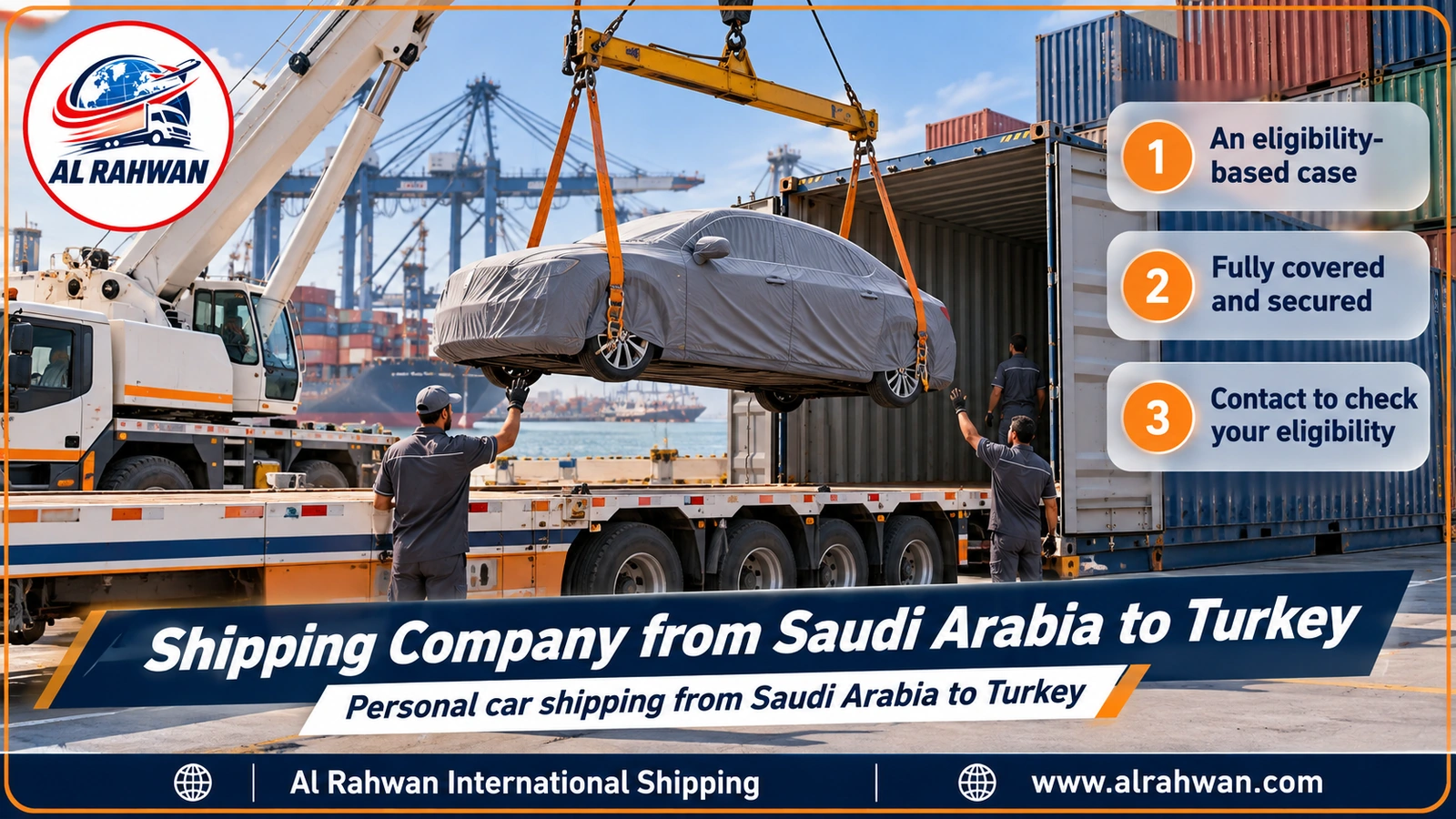
For this reason, Al Rahwan does not market personal car shipping to Turkey as a routine service open to any customer; instead, anyone wishing to ship a car is asked to call 0568829975 to review their customs eligibility carefully before any booking, because booking a car that does not meet the eligibility conditions will end in a problem at Turkish customs that cannot be undone once the car arrives. Those who genuinely meet the conditions have their car loaded on a covered carrier inside the same sea container carrying the rest of their furniture, strapped down at every wheel.
Those who genuinely meet the eligibility conditions also need to prepare documents specific to the car itself, alongside their furniture documents: a valid vehicle registration, a document proving ownership under their name, and documented, not verbally stated, proof of their length of residence abroad. Al Rahwan reviews these documents early with the broker in Turkey, because any gap in them means the car sits held at the Turkish port until the missing piece is completed, a situation every customer would rather avoid before their car is even loaded onto the vessel.
Cartons and Personal Luggage Shipping from Saudi Arabia to Turkey
Not every shipment needs a full container or an entire household; many residents and students send just a single carton or two suitcases: clothes, books, personal items, or gifts for a family living in Turkey. These small cartons are consolidated with other shipments into a shared container heading to the appropriate Turkish port, so the owner of a single carton never pays for a full container they do not need.

Every carton’s contents are written clearly on one line of the inventory list, along with the recipient’s name, Turkish phone number and city, and clothing cartons are wrapped to protect against humidity throughout the sea voyage, while book cartons are kept small so their base does not give way under their own weight. Glass items or fragile gifts are wrapped in sufficient layers of bubble wrap and reinforced cardboard, because a carton travelling by sea is handled and restacked several times before it reaches its final door.
Commercial Container Cargo Shipping from Saudi Arabia to Turkey
Commercial goods make up a large share of the traffic between Saudi Arabia and Turkey: raw materials, manufactured products, spare parts, and goods that traders resell in the Turkish market. Al Rahwan handles these shipments in two ways: a partial LCL load measured by volume inside a shared container with other cargo, and a full FCL load in a dedicated 20 or 40-foot container for a single trader’s goods only.

Commercial goods are packed on standard-sized pallets, with each pallet carrying a number that matches a line in the packing list stating its weight, carton count and content type, while the commercial invoice is matched to this list line by line, since Turkish customs reviews that match closely. A trader shipping regularly every month or every week does not need to start their paperwork from scratch each time; Al Rahwan arranges a standard packing list template and a fixed pickup day from their warehouse, so nothing changes between shipments except the invoice and the list itself.
Heavy equipment and industrial machinery are loaded differently from ordinary cargo; they need lifting gear suited to their weight rather than traditional cranes, and their owner is asked to identify the correct lifting points on the equipment’s frame before loading day, along with draining any remaining fuel or oil and disconnecting its battery if fitted. This equipment is priced with a detailed, itemised quote once its exact weight, dimensions and required offloading method at the Turkish port or final site are known, since each piece of equipment differs from another in its handling requirements.
Air Freight from Saudi Arabia to Turkey
Air freight suits documents and contracts, small commercial samples, urgent spare parts, and sensitive devices that cannot wait for a vessel or a port storage window. An air shipment typically arrives within roughly 3 to 5 days for standard international delivery, a general industry estimate for standard international air freight rather than a guaranteed figure for every flight, since the actual time is affected by the availability of direct flights from the Saudi airport to the intended Turkish airport.

Air freight pricing is usually based on actual weight or volumetric weight, whichever is greater, so a large, lightweight carton may be charged by its volumetric weight, calculated by dividing the product of its three dimensions by a fixed factor airlines use, rather than its real weight on the scale. This is why air freight suits small, relatively heavy items like metal spare parts, and does not suit large, lightweight clothing cartons, for which sea freight is far more economical.
Many customers prefer to combine both methods in one shipment: sending heavy furniture and large crates by sea through Jeddah because it is more economical for their size, while sending a small carton of documents, medication or sensitive devices by air at the same time because it needs to arrive within a few days rather than weeks. Al Rahwan coordinates between the two shipments, so the air cargo reaches the Turkish address well before the sea container arrives, in preparation for receiving it without delay.
Turkish Customs for Personal Belongings and Household Furniture
Turkish customs requires at least 24 consecutive months of prior residence outside Turkey before a final move for no customs duties to be imposed on the personal belongings and furniture being moved, and this condition differs slightly depending on the shipment owner’s nationality.
| Category | Required Documents |
|---|---|
| Returning Turkish citizen | Passport, a detailed inventory listing the brand and serial number of each appliance, a bill of lading matching the name, a Turkish tax number, an entry/exit record for the last 3 years, and one supporting document such as a final-return certificate or a notarized lease of 24 months or more |
| Foreign resident in Turkey | Passport together with a valid work or residence permit, a detailed inventory list, a bill of lading, a Turkish tax number, an entry/exit record for the last two years, and one supporting document such as a notarized lease of 12 months or more or a work permit accompanied by a bank guarantee for temporary import |
Turkish customs sets a published ceiling of 1,500 euros on the declared shipment value; only the amount above that ceiling is charged an extra fee, never the whole shipment, and how long clearance takes afterward depends on the nature of the items making up that excess. Tied to this ceiling is an equally important timing rule: the furniture must land in Turkey no more than two months before its owner’s arrival, or no later than 6 months after it, since booking outside this window exposes the shipment to a different kind of customs handling.
Customs clearance in Turkey typically takes around 4 to 5 business days after the container arrives and all documents are complete, and this period applies to a shipment whose paperwork is correct from the first submission; missing any document from the list above delays clearance well beyond this usual range.
The Turkish Tax Identification Number (TIN) is one of the most important documents a foreign resident or returning citizen is asked to obtain before their shipment arrives, since many customs and banking procedures in Turkey are tied to this number, and the clearance declaration cannot be completed without it. Al Rahwan advises every customer planning a final move to Turkey to obtain this number early, not after their shipment is already on the vessel, to avoid any hold-up at the last stage of a long journey that began in Jeddah.
The Saudi Side: Export Clearance Procedures from Jeddah
With enough time before the container leaves the quay at Jeddah Islamic Port, a licensed customs broker is tasked with completing export procedures on the “Fasah” platform run by the Zakat, Tax and Customs Authority, filing the export declaration digitally to match the real data, values and weights ahead of sailing. From the moment Al Rahwan receives the shipment until this declaration is finalized, contact with the customer stays open, so the furniture or goods owner is never left guessing where their paperwork stands, and any clarification the port requests is passed to them right away so it is resolved without delaying the container’s loading date.
The documents required from the exporter differ by shipment type: an individual shipping personal furniture needs their ID or residency card and a clear inventory list, while a trader needs a commercial registration, a genuine sales invoice, and a packing list that matches the invoice line by line. Al Rahwan reviews these documents well before the loading day, because an error in the customs declaration data is usually discovered at the last moment, and correcting it after the container is sealed is far harder than correcting it before loading.
After the export declaration is filed, a copy of it and of the packing list stays in the shipment’s digital file handed to its owner, ready to be presented for any query from Turkish customs without needing to request it again from the Saudi broker at a critical moment after the container has already arrived.
Examples of Common Shipment Types from Saudi Arabia to Turkey
The nature of people shipping to Turkey varies widely, and each category needs different handling at booking. A family relocating entirely needs a full container for their household furniture, possibly adding a car if it meets the eligibility conditions; a student or temporary resident usually needs only two or three cartons inside a shared container; a trader importing or exporting goods between the two markets needs a full container or a regular partial load every couple of weeks or month; and a company moving office or technical equipment to an office of theirs in Turkey needs special packing and higher insurance than an ordinary shipment.
Each of these categories follows a slightly different documentation path, but what stays constant across all of them is the need for an accurate inventory list and prior coordination with the broker in Turkey, regardless of the shipment’s size or type. Even a single carton needs an accurate description of its contents on the list, and even a full commercial container needs an invoice that exactly matches its packing list.
How to Choose the Right Shipping Company for Turkey?
First, ask any company exactly which Saudi port the container departs from, and the names of the Turkish ports actually served by its lines; a company that answers with a vague phrase about “sea freight to Turkey” without naming both ports does not know the route well. Then ask about the line’s sailing frequency rather than just the transit time, to understand the difference between the two when planning your shipment’s timing. For personal cars, be wary of any company that promises to ship your car without asking about your length of residence outside Turkey or your nationality, since that promise can end in a real customs problem once the car arrives.
Also ask about the free storage window at the Turkish port and how coordination with the broker there is handled, since a company that waits for the container to arrive before looking for a broker wastes part of that window for nothing. For traders, one more useful question: does the company have a standard packing list template for recurring shipments, or does the trader start from scratch every time?
Prohibited and Restricted Goods When Shipping to Turkey
Turkish customs bans weapons and ammunition, drugs, explosives, meat products, and gambling machines entirely, so these items are never accepted in any sea or air shipment regardless of their value or purpose. These items are usually discovered during customs inspection rather than at loading in Jeddah, which is why Al Rahwan reviews the contents of every carton or furniture piece with its owner before packing, asking directly about the content of any unclear item instead of relying on a general description of it.
Other items are subject to restrictions or special charges: alcohol and tobacco in very limited quantities, perfumes, duplicate or excess household electrical appliances beyond a single family’s needs, communication equipment and fax machines, and plants limited to 3 per shipment. Al Rahwan reminds every customer that this list can be updated from time to time, so checking with the Turkish consulate or contacting Al Rahwan directly before shipping is more reliable than relying on a fixed list for any item whose status is uncertain.
A common misunderstanding here is that some customers treat a second electrical appliance of a type they already own at home as a “gift” free of any restriction, while Turkish customs views duplicate appliances beyond a single family’s needs as a restricted category regardless of the stated purpose. This is why Al Rahwan asks about the quantity of each appliance type in a shipment before packing, not after it reaches Turkish customs, where amending the list becomes far harder.
Institutional and Corporate Shipments to Turkey
This route is not limited to individuals and traders alone; some institutions and companies move office or technical equipment to an office of theirs in Turkey, relocate an employee’s belongings when their job moves between the two countries, or send samples and equipment for an exhibition or trade conference. These shipments need different handling than a simple personal shipment: stronger packing for sensitive devices such as computers and large printers, careful photographic documentation of each device’s condition before loading, and insurance covering its real value rather than a low estimated figure.
Institutional shipments are usually split into separate files: one file for an employee’s personal belongings, and one file for the institution’s own equipment, so each file has its own independent inventory list and a named recipient in Turkey. This split makes customs clearance easier because each file is handled according to its own nature: personal belongings under their own conditions, and institutional equipment under its invoice and commercial list.
Insurance and Tracking for Shipments from Saudi Arabia to Turkey
Anyone who wants insurance on their shipment requests it at booking, and it is calculated on the declared value together with a photographed inventory documenting the condition of each item before loading, an option that matters more for cars, high-value commercial goods and sensitive devices. Separately from insurance, tracking updates arrive by WhatsApp and phone at four key moments: loading in Jeddah, the vessel’s departure from the Saudi coast, the container’s arrival at the Turkish port, and final delivery to the address.
Photographing items before loading is not a formality; it is the only reference point in any dispute over an item’s condition after a long sea voyage that may pass through several intermediate ports. This is why Al Rahwan’s team photographs every high-value furniture piece or sensitive device from multiple angles before packing, keeping these photos in the shipment file through to the final delivery date, ready whenever they are needed.
Delivery Cities in Turkey
Al Rahwan’s shipments reach a number of major Turkish provinces: Istanbul, Ankara, Izmir, Mersin, Antalya, Bursa, Gaziantep, and Iskenderun. The delivery city is assessed by the nearest port and the available route; Istanbul, Izmir, Mersin and Iskenderun are direct ports receiving containers from Jeddah, while the remaining inland cities such as Ankara, Bursa and Gaziantep are reached by inland road transfer from the nearest Turkish port.
This list does not mean delivery is limited to only these eight cities; they are simply the provinces most requested by Al Rahwan’s customers, and any other Turkish city is assessed as soon as an inquiry comes in, based on the nearest suitable port and the availability of an inland route reaching it. Living in a Turkish city not named on this list does not mean a shipment cannot reach it, only that its exact route is determined at booking once the precise address is known.
| Turkish City | Route |
|---|---|
| Istanbul | Direct via Ambarlı port |
| Izmir | Direct via Izmir (Aliağa) port |
| Antalya | Via Mersin port then inland transfer |
| Bursa | Via Ambarlı port then inland transfer |
| Ankara | Via nearest port then inland transfer |
| Gaziantep | Via Iskenderun port then inland transfer |
Tips Before Shipping from Saudi Arabia to Turkey
- Book early ahead of the next line’s sailing: container lines run on a fixed schedule, so knowing the next sailing date early avoids unnecessary delay.
- Prepare the inventory list well before loading day: an accurate list naming and counting every item speeds up customs clearance in Turkey and avoids wasting the free storage window.
- Review your customs eligibility before booking a car shipment: call and confirm you meet the residency condition or one of the other conditions before arranging anything for your car.
- Plan your shipment’s arrival timing relative to your own: factor in the two-month window before your arrival or the six-month window after it when setting a booking date.
- Clean and fully dry furniture before packing: any trapped moisture turns into odour or mould during the long sea voyage.
- Empty fuel and batteries from equipment before shipping: this is a basic condition for accepting equipment in both the container and the aircraft.
- Ask about insurance documentation for valuable shipments: cars, technical devices and antiques deserve insurance covering their real value.
Common Mistakes When Shipping from Saudi Arabia to Turkey
- Confusing sailing frequency with transit time: the gap between a line’s sailings does not mean the container arrives within the same period.
- Booking a car shipment without checking eligibility: the car can end up held at Turkish customs if its owner does not meet the import conditions.
- An incomplete or generic inventory list: phrases like “assorted items” delay clearance and eat into the free storage window.
- Ignoring the shipment’s arrival timing relative to its owner: a shipment arriving outside the two-month/six-month window faces extra complications.
- Packing upholstered furniture without a moisture barrier layer: the long sea voyage exposes any gap in packing.
- A commercial invoice that does not match the packing list: Turkish customs checks the match between the two line by line, and any discrepancy halts clearance.
- Relying on a fixed banned-goods list without a recent check: the restricted list can be updated, so confirming with the consulate or directly with Al Rahwan is safer.
Why Ship to Turkey with Al Rahwan?
Choosing a shipping company for this relatively new sea route is not like choosing one for a well-known road route with fixed rates and timeframes; the real difference between companies here lies in accurate knowledge of the route, and honesty about what can and cannot be done, especially in the personal car file, where marketing promises are often mixed up with customs reality.
- Accurate knowledge of the real container lines from Jeddah and the four Turkish ports receiving them.
- Complete honesty explaining personal car import conditions, instead of general promises that could cost a customer a customs problem.
- Prior coordination with the customs broker in Turkey from the moment of shipping out of Jeddah, not only after arrival.
- A detailed, itemised quote for every shipment tier instead of a generic estimate.
- Continuous tracking of the shipment through to final delivery in the Turkish city.
- Complete handling of the Fasah export clearance from Jeddah before the container departs, with the customer kept informed until it is finished.
- Organised handling of institutional shipments with separate files for each type of belongings.
For those shipping specifically from Riyadh, the article Shipping Company from Riyadh to Turkey details the inland transfer steps to Jeddah port, and for those starting from Jeddah itself, Shipping Company from Jeddah to Turkey explains the advantage of departing directly from the port, while for shipments from Dammam and the Eastern Province, Shipping Company from Dammam to Turkey explains the long inland transfer to Jeddah before sea freight. For every sea-freight service to Turkey, see the Sea Shipping to Turkey page, and anyone preparing a shipment now can start with a shipping quote request.
Frequently Asked Questions
How long does sea freight from Saudi Arabia to Turkey take?
No fixed number of days is quoted for sea transit; it is set at booking according to the carrier’s sailing schedule. Air freight usually takes roughly 3 to 5 days.
Which Saudi port do shipments to Turkey depart from?
Jeddah Islamic Port, the Saudi port documented with direct container lines to Turkey via Akkon Lines and Turkon Line.
Which Turkish ports receive the shipments?
Four ports: Mersin, Ambarlı near Istanbul, Izmir (Aliağa), and Iskenderun, with the container’s destination set by the final Turkish delivery city.
How much does shipping from Saudi Arabia to Turkey cost?
There is no fixed rate for this corridor since it is the first fully maritime route of its kind, so request a detailed, itemised quote once your shipment type, weight and destination are known.
Can I ship my personal car to Turkey?
Only a limited eligibility category qualifies: 24 consecutive months of residence outside Turkey before a final move, or a few other defined exceptions; it is entirely forbidden for dual-nationality holders, so call to review your eligibility before booking.
What are the age conditions for an importable car?
It must not be more than 3 years old, counting manufacture and registration years, and only one car is allowed per family unit.
How long does Turkish customs take to clear a shipment?
Around 4 to 5 business days after the container arrives and all required documents are complete.
What is the free storage window at the Turkish port?
A full seven days for dry containers, only three for refrigerated ones, and five for special equipment, before storage fees begin.
Does my shipment need to arrive at a specific time relative to my own arrival?
Yes, the shipment must arrive no more than two months before the owner’s arrival in Turkey, or within 6 months after.
What documents are required to clear personal furniture?
Clearing personal furniture through Turkish customs calls for five kinds of paperwork: a passport, a detailed item-by-item inventory, a bill of lading carrying the same name as the passport, the Turkish tax number, a record of entries and exits, plus one supporting document, usually either a notarized lease or a final return certificate.
What goods are entirely banned from shipping to Turkey?
Weapons and ammunition, drugs, explosives, meat products, and gambling machines.
Does Al Rahwan ship full commercial containers?
Yes, a full 20 or 40-foot container for a single trader’s goods, or a partial load in a shared container depending on quantity.
What happens if my shipment value exceeds 1,500 euros?
The extra fee applies only to the amount above the 1,500-euro ceiling, and the clearance time depends on the type of the excess.
Is a Turkish tax number required before shipping?
Yes, a Turkish Tax Identification Number (TIN) is required for foreign residents and returning citizens, and it is best obtained early before the shipment arrives to avoid delaying clearance.