
 United Arab Emirates
 Qatar
 Kuwait
 Bahrain
 Oman
 Iraq
 Turkey
 Lebanon
 Syria
 Jordan
 Egypt
 Morocco
 Tunisia
 Algeria
 Libya
 Sudan
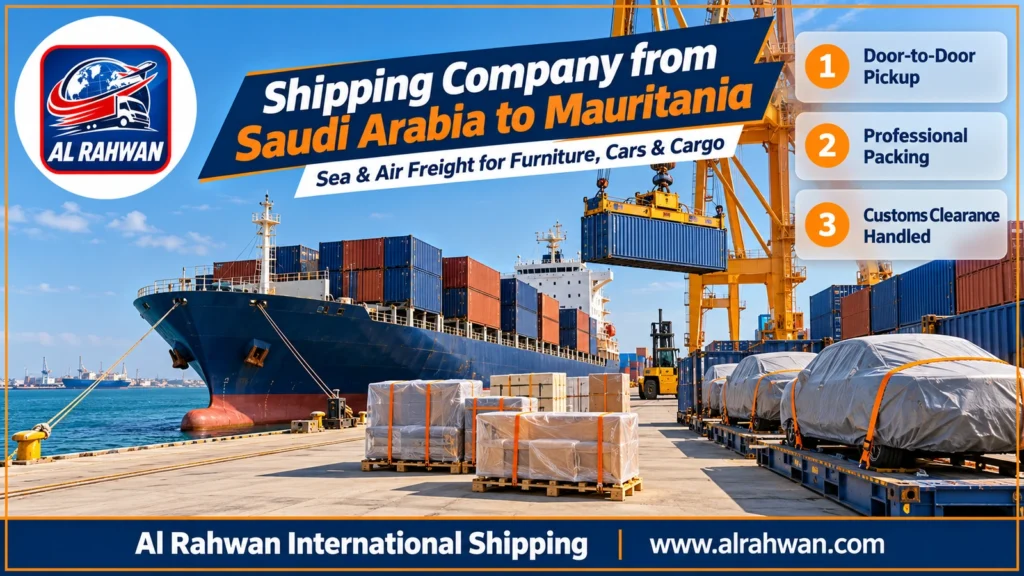
Families and traders sending furniture, cars, cartons and goods west to Nouakchott need a shipping company from Saudi Arabia to Mauritania that runs the whole chain, and that is the work Al Rahwan does: it picks the cargo up in Riyadh, Jeddah, Makkah, Madinah, Dammam, Qassim or any other Saudi town, then moves it by sea in containers that usually leave from Jeddah Islamic Port. The vessel passes through the Suez Canal to a transshipment port in the Mediterranean or on the Moroccan coast, and a feeder ship then carries the container on to the Port of Nouakchott (the Friendship Port) or to Nouadhibou in the north. Urgent and light consignments can fly to Nouakchott–Oumtounsy International Airport instead. The sea voyage takes several weeks, fixed precisely at booking according to the feeder connection, while air is far quicker. No single price fits every shipment on this lane: cartons and suitcases are charged on chargeable weight, furniture by the cubic metre and cars by method and size, so request an itemised quote for each. Call 0568829975 and the quote arrives together with a pick-up date at your door.
🧭 In this guide50 sectionsShowHide
- No land route: shipping to Mauritania is by sea or air only, and sea cargo calls at least one transshipment port on the way.
- Ports: Nouakchott (Friendship Port) for containers, cars and most imports; Nouadhibou for the north.
- Airport: Nouakchott–Oumtounsy International Airport is the main air-cargo gateway.
- Transit time: several weeks by sea, confirmed at booking; air is much faster and suits urgent, light items.
- Inventory: Mauritanian customs expects a dated, signed and valued inventory written in French for personal effects.
- Cars: the model year and import eligibility are checked before booking; left-hand drive is accepted.
- Pricing: request an itemised quote for each type of shipment once the volume or weight and the Mauritanian destination city are known.
This guide gathers everything needed to ship from the Kingdom to Mauritania, set out in the order things really happen. It traces the container from your doorstep to its berth in Nouakchott, weighs a dedicated container against groupage, air and express, and shows how cargo leaves each Saudi city. Each kind of consignment then gets its own section: household furniture and personal effects, then cars, then cartons and suitcases, then traders’ goods. Next come air freight and the volumetric-weight sum, a table of the papers each type needs, customs formalities at each end, the list of banned and restricted goods, and then insurance, shipment updates, storage, how to book and delivery across Mauritanian towns. It closes with the elements of the cost and the errors that stall consignments more often than anything else.
Anyone who works on West African lanes knows that Mauritania is not a difficult destination, but it is one that needs planning. The sea distance is long, no ship sails from Jeddah straight into Nouakchott, and Mauritanian customs works in French and Arabic and asks for papers many travellers do not expect, such as a change-of-residence certificate and a non-sale certificate. Al Rahwan International Shipping serves destinations worldwide by land, sea and air, and the Mauritania lane is one requested by Mauritanian residents returning home and by traders sourcing goods from the Saudi market, which is why its steps are set out in detail here. Calls and WhatsApp messages are picked up between 7 am and 11 pm, weekends included.
Is There Shipping from Saudi Arabia to Mauritania, and How Does Cargo Travel?
Yes, cargo moves between the two countries by sea and by air; there is no practical land route between the two countries, as the distance crosses two continents and several borders. Large shipments, from a full household to a car or a container of goods, travel by sea in containers. Light parcels, documents, samples and urgent devices fly to Nouakchott. In both cases the journey starts with collection from your address in the Kingdom and ends with delivery in the Mauritanian city you choose.
To understand transit time and cost you need to picture the container’s route. It leaves Jeddah Islamic Port heading north up the Red Sea, transits Suez to reach the Mediterranean, and is discharged at a large hub such as Algeciras in Spain or Tangier in Morocco; some cargo moves through Casablanca or Las Palmas in the Canary Islands. There it waits for a smaller feeder vessel that runs south along the Atlantic coast to Nouakchott or Nouadhibou. That last step, from the mother vessel to the feeder, is what makes the difference in journey time, and it is why no ocean carrier publishes a fixed figure for Jeddah to Nouakchott.
Air cargo departs from one of the Kingdom’s major airports, normally connects through a transit airport such as Casablanca, Istanbul or Paris, and lands at Nouakchott–Oumtounsy International Airport. Scheduled passenger flights also connect Nouakchott with Madinah, a direct air link well known to Mauritanian pilgrims. Actual air-cargo bookings still depend on the space available on the flight and on the nature of the goods.
| Stage | Where it happens | What takes place |
|---|---|---|
| Pick-up and export packing | At your home or depot in any Saudi city | Itemising, export packing, carton numbering and preparing the inventory |
| Inland leg | From your city to the quay at Jeddah Islamic Port, or to Dammam port when a suitable line sails from there | Container truck, or a long multi-deck car transporter for cars |
| Export | Saudi port | Customs declaration through the Fasah platform and loading on board |
| First ocean leg | Red Sea, then the Suez Canal | Mother vessel heading for the transshipment port |
| Transshipment | Algeciras, Tangier, Casablanca or Las Palmas | Container transferred to a feeder bound for Mauritania |
| Arrival | Port of Nouakchott (Friendship Port) or Port of Nouadhibou | Inspection and Mauritanian customs clearance through ASYCUDA |
| Delivery | Nouakchott, Nouadhibou or inland towns | Inland transport to the consignee’s address by arrangement |
Comparing Shipping Methods to Mauritania: Full Container, Groupage, Air or Express?
Sea freight is the right choice for most people, but within it there are two options that differ a great deal in cost and flexibility. A full container load (FCL) carries your shipment and nobody else’s; it is packed outside your home and sealed, and the seal is broken only at inspection in Mauritania. Groupage, or less-than-container load (LCL), puts your goods together with other customers’ cargo in one container, so you pay only for your own volume. Air suits what is light and urgent, and door-to-door express suits documents and very small parcels.
The working rule Al Rahwan applies when advising customers: if your belongings exceed roughly two rooms, or you have a car you want your things to travel with, a full container is cheaper and safer because it is not unpacked along the way. If you have a few cubic metres of cartons and light furniture, groupage suits your budget better, on the understanding that a shared container only closes once it is full and is unpacked at a consolidation warehouse in Mauritania. Anyone expecting official papers, or a spare part their work depends on, should not tie that delivery to a ship’s schedule.
| Option | Suitable cargo | Journey time | Charging basis |
|---|---|---|---|
| Dedicated 20 ft or 40 ft sea container | Whole household, car with belongings, large commercial volumes | Several weeks, confirmed at booking according to the feeder | Request an itemised quote |
| Sea groupage (LCL) | A number of cartons, part furniture, small-volume goods | Several weeks plus extra time for consolidation and unpacking | Charged per cubic metre – ask for an itemised quote |
| Sea, RoRo for cars | A running car with nothing inside it | Depends on a suitable sailing being available on the route | Request an itemised quote |
| Air | Urgent, light and valuable small items | Far shorter than sea, confirmed at booking | By chargeable weight; request an itemised quote |
| Door-to-door express | Documents and small parcels | Fastest of all options | By weight; request an itemised quote |
Sea Freight from Saudi Arabia to Mauritania: Ports, Transshipment and Transit Time
Sea freight is the backbone of the Mauritania lane, and containers arrive through two main ports: the Port of Nouakchott, known as the Friendship Port, which is the principal gateway for containers and most imports, and the Port of Nouadhibou in the north. There is no regular liner service linking Saudi ports directly with Mauritania, so transshipment is a normal part of the journey rather than an exception. Transit time is set at booking, once the sailing of the mother vessel and the schedule of the feeder that will pick up the container are known.
Port of Nouakchott (Friendship Port)
The Friendship Port in Nouakchott is where most Al Rahwan shipments are routed, because it is closest to the capital, where most consignees live, and because it handles both containers and the roll-on/roll-off vessels used for cars. Major global lines call there through their feeder services, which means more choice of arrival dates. From Nouakchott the roads serve the south and the interior, so if the consignee is in Rosso, Kiffa or Kaédi the shipment will most likely come in through this port and continue by road.
Port of Nouadhibou
Nouadhibou is the economic capital of the north. Its port sits on a sheltered bay on the Cap Blanc peninsula and handles general cargo as well as mining, fishing and project shipments, and it hosts a customs office for the Nouadhibou free zone. Nouadhibou makes sense when the consignee is in the north, in Nouadhibou itself, Zouérat or Atar, or when goods are destined for business in the free zone. The final port is decided at booking because the lines do not call at both ports with the same frequency. The port of Tanit is essentially a fishing port and does not feature in personal-effects routings.
Where Does Transshipment Happen, and Why Does It Affect Transit?
Transshipment means the container is lifted off one ship and onto another at an intermediate port. The Mauritanian coast is linked to the global shipping network by feeders running from Algeciras in southern Spain and from Tanger Med in Morocco, and some cargo passes through Casablanca or Las Palmas. Every one of these stops adds days that depend on the feeder schedule: if the mother vessel arrives a day before the feeder, the wait is short; if the container misses it, it waits for the next sailing. That is why Al Rahwan tells you “several weeks” at booking, together with an estimated arrival date updated at each stage, instead of a fixed figure that would not survive reality.
Full Container or Groupage?
A 20 ft container has an internal capacity of about 33 cubic metres and usually holds the furniture of a two- to three-bedroom flat with its cartons. A 40 ft container holds roughly twice that and suits villas and larger homes, or a single car with a good share of the furniture. Groupage is based on the cubic metre, which you get by converting the three dimensions of a piece to metres and multiplying them together. Example: a wooden crate 120 cm long, 80 cm wide and 100 cm high measures 1.2 × 0.8 × 1.0 = 0.96 cubic metres. Twenty cartons of 50 × 40 × 40 cm are 0.08 cubic metres each, so 1.6 cubic metres in total. These are the figures Al Rahwan builds your groupage quote on.
| Option | Approximate capacity | Suits | Operational note |
|---|---|---|---|
| 20 ft container | About 33 m³ | 2–3 bedroom flat, or a small car on its own | Sealed at your door or at the warehouse |
| 40 ft container | About 67 m³ | Villa or large house, or a car with furniture | Best value for large volumes |
| 40 ft high-cube | About 76 m³ | Tall furniture, or two cars depending on dimensions | About 30 cm more internal height |
| Groupage (LCL) | By the cubic metre | From one cubic metre to about 15 m³ | Waits for the shared container to fill before sailing |
Shipping to Mauritania from Riyadh, Jeddah, Dammam, Makkah, Madinah and Other Cities
Al Rahwan picks up Mauritania consignments in any part of the Kingdom; what differs from one city to another is the road the container takes to the port, not the service itself. Because ships heading for West Africa transit the Suez Canal, Jeddah Islamic Port is the natural exit for this lane, and containers reach it by road from the central, northern and southern cities. Eastern Province shipments may leave from King Abdulaziz Port in Dammam if the lines available at booking offer a suitable routing from there, or be trucked to Jeddah; the nearest sailing decides.
In Riyadh the collection team covers residential districts and warehouses in the north, east and south of the city; packing is done at home or at Al Rahwan’s warehouse, and the container then travels by road to the port. In Jeddah and Makkah the port is close, so a container is usually loaded and on the quay the same day, which makes Jeddah the most convenient point for handing over cars directly. In Madinah, Qassim, Tabuk, Abha and Khamis Mushait small shipments are consolidated on regular runs to Jeddah, while full containers are loaded in your city and go straight to the port.
| Saudi city | Usual port of exit | How cargo reaches the port | Nearest airport for air freight |
|---|---|---|---|
| Riyadh | Jeddah Islamic Port, or Dammam depending on the line | Container truck, or a multi-deck car transporter for cars | King Khalid International Airport (RUH) |
| Jeddah | Jeddah Islamic Port | Short haul from home or warehouse to the quay | King Abdulaziz International Airport (JED) |
| Makkah and Taif | Jeddah Islamic Port | Container truck straight to the port | King Abdulaziz International Airport (JED) |
| Madinah and Yanbu | Jeddah Islamic Port | Full container direct, or consolidation on regular runs | Prince Mohammad bin Abdulaziz International Airport (MED) |
| Dammam, Khobar, Jubail and Al-Ahsa | Dammam port or Jeddah, whichever line suits at booking | Container truck to the chosen port | King Fahd International Airport (DMM) |
| Qassim and Hail | Jeddah Islamic Port | Truck to the port, or consolidation for small shipments | King Khalid via Riyadh, or as the flight allows |
| Abha, Khamis Mushait and Jazan | Jeddah (by road) | Container truck or consolidation | As the available flight allows |
Household Removals and Personal Effects: Saudi Arabia to Mauritania
Furniture travels to Mauritania by sea, either in a container of its own or as part of a shared one, and it needs packing that can stand a long voyage with handling at an intermediate port, sea humidity and heat. Al Rahwan handles every stage: dismantling, packing, numbering and the inventory in Saudi Arabia, then loading and export, then clearance and delivery in the Mauritanian city. The difference between a move inside the Kingdom and a move to Nouakchott is that cartons here may be opened for inspection and the container may stand for days on the port yard in the sun, so the packing has to be designed for that from the outset.
Preparing Furniture for a Long Sea Voyage
- Survey and itemising: the supervisor goes room by room, deciding what needs dismantling, what travels as it is and what deserves a wooden crate, then works out the total volume in cubic metres so the right container size can be chosen.
- Dismantling: bedroom sets, fitted wardrobes and dining tables are broken down into panels; the fittings of each piece are sealed in a labelled pouch fixed with tape to its own panel.
- Inner wrapping: padded quilts around timber, air-cushion wrap around glassware and appliances, stiff cardboard corners on every edge, then a layer of stretch film against dust and moisture.
- Wooden crates: large mirrors, paintings, marble tops and glass get custom crates, and the timber must be treated and stamped to ISPM-15, which Mauritania requires for wooden packaging.
- Numbering: each box is marked with a clear number and the room it came from, and that number appears on the inventory, so a customs officer knows what is inside without emptying it and the consignee knows where it goes.
- Moisture absorbers: placed inside cartons and crates holding textiles, electronics or books, since the container goes through wide temperature swings.
- Loading: heavy items low and at the front of the container, fragile items on top, then straps and dividers that stop movement during handling at the transshipment port.
A French-Language Inventory: Why It Matters
What surprises most people moving to Mauritania is that customs there asks, for personal effects, for an original inventory that is dated, signed, valued and written in French. A vague list reading “assorted household items” delays release and can trigger a full inspection. Al Rahwan therefore prepares a detailed list of carton numbers, the contents of each and an estimated value, signed by the owner, and the French version is ready before loading rather than after the container lands.
Alongside the inventory, personal effects need further papers: a passport copy, a certificate of change of residence, proof of work or residence in Saudi Arabia such as an employer letter or the residence permit itself, a non-sale certificate, and invoices for electrical appliances bought less than six months earlier. Customs treatment differs with the owner’s situation, since someone returning to settle is not treated the same as someone sending goods to family, so the papers are reviewed with the clearing agent in Nouakchott before shipping.
| Item | Preparation | What matters on the Mauritania run |
|---|---|---|
| Beds and wardrobes | Full dismantling, blankets, stretch film | Panels numbered for easy reassembly on arrival |
| Sofas and Arabic majlis seating | Fabric wrap then film, leg protection | Placed on top of cartons, never beneath |
| Fridges and washing machines | Drained and dried, drum secured | Moisture absorbers; recent invoices kept with the documents |
| Televisions and monitors | Purpose-made TV box or timber crate | Listed by serial number on the inventory |
| Mirrors, glass and marble | Treated ISPM-15 wooden crates | Stood upright and wedged between solid pieces |
| Books and papers | Small cartons that can be lifted by hand | Protected against damp |
| Kitchenware | Each piece wrapped, gaps filled | Carton marked as fragile |
Car Shipping from Saudi Arabia to Mauritania
Cars reach Mauritania from Saudi Arabia by ship: strapped down on wheel chocks inside a container, or driven aboard a RoRo vessel, depending on what sailings the route offers when you book. Before anything is reserved, Al Rahwan checks the model year and whether the car qualifies for import under the Mauritanian rules that apply when it ships, because that single point decides whether the car is released or stays in the port.
Should the Car Go in a Container or by RoRo?
For container shipment the car is brought to the stuffing warehouse, its wheels set on timber chocks and strapped to the container’s floor rings, and the box is then sealed and stays closed until arrival. A container protects the car from salt, dust and passing hands at transshipment ports, and allows personal belongings to travel in the same container once they are listed on the inventory. On RoRo the car is driven up the ship’s ramp and secured on one of its decks; it must be in running order and completely free of personal items. Nouakchott handles RoRo traffic, but the availability of a suitable RoRo sailing from the Kingdom is checked at booking.
| Comparison | In a container | By RoRo |
|---|---|---|
| Car condition | Running or non-running | Must run and be driven up the ramp |
| Personal belongings | Allowed when listed on the inventory | Nothing may be left inside the car |
| Protection en route | Sealed throughout and strapped down | Open on the ship’s vehicle decks |
| Luxury and classic cars | Preferred option | Less suitable |
| Number of cars | One car in a 20 ft, two or more in a 40 ft depending on size | One car per booking |
| Pricing | Itemised quote based on container size | Itemised quote based on the available sailing |
From Your City to the Port: the Car Transporter
A car waiting in Riyadh, Dammam, Buraydah or any other inland city travels to the port on a long car transporter with several decks, where it rides under a fitted cover with straps across its wheels, travelling as part of a load of vehicles to the stuffing warehouse beside the port. At the warehouse the bodywork is checked and photographed on all four sides, the odometer and fuel level are recorded, and the chassis and engine numbers are matched against the registration before the car enters the container or the RoRo yard.
Mauritanian Car Import Rules (Check Before Shipping)
Mauritania’s Finance Act set an eight-year age limit on imported used cars, and shipping sources report that this limit was later lifted while conformity and registration conditions remain. Since this is an area that changes, Al Rahwan verifies the car’s model year and eligibility with its agent in Nouakchott before booking and does not load a car until the answer is clear. Left-hand-drive cars, the norm in the Kingdom, are accepted, so that point raises no problem. For customs, a used car may be valued against reference price tables rather than on the invoice alone.
Before shipping, the ocean bill of lading must show the chassis number, engine number and vehicle weight, and the documents must reach the receiving agent in Mauritania before the ship does. Also required are proof of ownership, a non-lien certificate valid for one month, the owner’s passport or ID, the purchase invoice and an insurance certificate, and an SGS inspection certificate may be requested. On the Saudi side the car needs its registration card and an export certificate, and if it is financed, a letter from the lending bank permitting its export.
- Run the fuel tank down to about a quarter and disable the alarm or give its code to the team.
- Leave nothing inside a car going by RoRo; in a container, list every item on the inventory.
- Photograph the car inside and out on handover day and keep a copy of the inspection report.
- Hand over at least one key, plus the smart card if there is one.
- Make sure the owner’s name on the registration matches the shipper, or attach an authorisation.
Shipping Cartons, Suitcases and Parcels to Mauritania
A good share of the Mauritania bookings are not house moves at all. They are ten or twenty boxes of clothes, books, kitchen items and gifts for relatives, or heavy suitcases that went over the airline allowance. Such consignments either fly, when there are only a few and they are needed soon, or go by sea in groupage, when there are many and time is not pressing. The cost difference between the two is large, and it becomes clear once you work out volumetric weight for air and cubic metres for sea.
Al Rahwan’s advice on packing boxes: stuff each one firmly so the contents do not rattle with every lift, but stop short of a weight that splits the base in a porter’s hands. Small cartons for books and kitchenware, large ones for clothes and bedding. Seal each box with broad tape run along and across every seam, and write the consignee’s name and city on two sides. Suitcases are wrapped in stretch film with their locks fastened, because an open suitcase at a transshipment port is an invitation to loss.
- For air freight: smaller cartons are cheaper, because volumetric weight pushes up the cost of large, light cartons.
- For sea groupage: volume is what counts, so packing your things tightly into fewer cartons lowers the cubic metres.
- Perfume and medicines: perfume above the allowance is restricted and medicines need a prescription, so declare them before packing.
- Electronics: list them by serial number; wireless devices may need type approval in Mauritania.
- Pricing: boxes and suitcases are charged on chargeable weight by air or on volume by sea, so ask for an itemised quote.
Commercial Cargo to Mauritania: From the Saudi Market to the Mauritanian Importer
Commercial cargo to Mauritania needs an importer registered there, a licensed customs broker and complete commercial documents in French or Arabic. Mauritanian customs releases commercial goods only to an approved importer listed in the Central Importers Register, and larger traders also need a tax identification number (NIF). Al Rahwan therefore starts with a simple question for the trader: who is the importer in Mauritania? The rest of the steps follow from the answer.
Every trade consignment to Mauritania rests on four papers: the sales invoice, the packing list, the transport document (ocean bill of lading or air waybill) and an origin certificate issued for the goods. Goods are subject to SGS inspection, which checks their nature, price, composition and quantity against the original invoice, so any gap between the invoice and the container’s contents stops release. Some products need conformity certificates or prior permits, among them electronics, radio equipment, food, cosmetics, chemicals and medical devices. Wooden pallets and crates must carry the ISPM-15 stamp or risk rejection or re-export.
Products often requested on this lane include Saudi dates and packaged foods, household appliances, building supplies, perfume and incense, and car spare parts. Each category has different requirements: food needs health certificates, perfume may fall under cosmetics rules, and spare parts need accurate classification. Al Rahwan advises traders to send a small first shipment to test the clearance process with their importer before booking full containers.
Air Freight from Saudi Arabia to Mauritania
Air freight from Saudi Arabia to Mauritania arrives at Nouakchott–Oumtounsy International Airport, the country’s main cargo airport, while Nouadhibou Airport handles smaller volumes. Cargo is handed in at the international airport nearest you, whether Riyadh, Jeddah or Dammam, and usually connects through a transit airport such as Casablanca, Istanbul or Paris. Transit is far shorter than by sea and is confirmed at booking according to the available flight; air is charged on chargeable weight, so request an itemised quote.
Air is the right choice in specific cases: official documents and certificates, authorised medicines, spare parts holding up work, commercial samples, small valuable devices and the luggage of someone who has already flown. Furniture and heavy loads make no sense by air to Mauritania, because the cost multiplies for no real gain. Some items are barred from air entirely, such as loose batteries, flammable liquids and pressurised cans, and batteries fitted inside devices are subject to special conditions.
Working Out Volumetric Weight for Air Cargo to Nouakchott
By air you pay on the higher of two numbers: what the piece weighs on the scale, and what its size is worth in kilos. The size figure comes from the box’s three measurements in centimetres, multiplied and then split by 6,000. So a 60 × 50 × 50 cm box weighing 18 kg gives 150,000, and dividing by 6,000 produces a size figure of 25 kg. As 25 beats 18, the bill is based on 25 kg. Pack the same box with 30 kg of books, though, and the scale wins, so the bill moves to 30 kg.
Now a three-piece consignment. The suitcase is 70 × 45 × 30 cm and 20 kg on the scale; its size figure is 94,500 ÷ 6,000 = 15.75 kg, so the 20 kg stands. Two cartons of 50 × 40 × 40 cm weighing 9 kg each have a volumetric weight of 80,000 ÷ 6,000 = 13.33 kg each, so they are charged at 13.33 × 2 = 26.67 kg. The total chargeable weight of the shipment is 20 + 26.67 = 46.67 kg, usually rounded up to the next half kilo depending on the carrier. The example shows why a tightly packed carton keeps the cost of air freight down.
| Item | Air freight to Mauritania |
|---|---|
| Main arrival airport | Nouakchott–Oumtounsy International Airport (NKC) |
| Secondary airport | Nouadhibou Airport, smaller volumes |
| Departure airports | Riyadh, Jeddah, Dammam, and Madinah depending on the flight |
| Usual transit hubs | Casablanca, Istanbul, Paris |
| Basis of charge | Greater of actual weight and volumetric weight (L × W × H ÷ 6,000) |
| Transit | Far shorter than sea, confirmed at booking |
| Price | Request an itemised quote |
Paperwork for a Saudi Arabia to Mauritania Shipment, Type by Type
The paperwork changes with what you send. A household move rests on the passport, a change-of-residence certificate and a signed, valued inventory in French; a trade consignment on the sales invoice, the packing list, an origin certificate and an importer registered in Mauritania; cars need proof of ownership, a non-lien certificate and a bill of lading showing the chassis, engine and weight. On the Saudi side the shipper needs their ID or residence permit and an authorisation for the broker on the Fasah platform. The full list for each kind of cargo is set out below.
| Cargo | Saudi export side | Mauritanian import side |
|---|---|---|
| Furniture and personal effects | ID or residence permit, broker authorisation, inventory, consignee details | Passport copy, change-of-residence certificate, employer letter or residence permit, original bill of lading, dated, signed and valued French inventory, non-sale certificate, invoices for appliances under 6 months old |
| Commercial goods | Company CR, sales invoice, packing list, origin certificate | Invoice in French or Arabic, packing list, bill of lading, certificate of origin, approved importer, conformity certificates where needed, ISPM-15 stamp on timber |
| Cars | Registration card, export certificate, the owner’s ID, and a no-objection letter from the lender when the car is financed | Proof of ownership, non-lien certificate valid one month, owner’s passport, purchase invoice, insurance certificate, valued inventory, bill of lading showing chassis, engine and weight; SGS inspection may be requested |
| Cartons and parcels | ID, description of contents and value | Consignee details, precise description of contents, appliance invoices on request |
| Air freight | ID, invoice or inventory, consignee details | Air waybill and documents for the contents according to type |
Advice drawn from files that ran into trouble: send copies of your documents to Al Rahwan days before loading, not on loading day. Some papers, such as the change-of-residence certificate or the bank letter, take time to obtain, and a car’s bill of lading in particular cannot easily be amended once issued; any error in the chassis number travels with you to the port of Nouakchott.
Customs Clearance in Saudi Arabia and Mauritania
A shipment clears customs twice. Saudi export clearance runs through Fasah, the electronic platform of Saudi customs (ZATCA, the Zakat, Tax and Customs Authority); Mauritanian import clearance is handled by the General Directorate of Customs on its ASYCUDA system. In both cases a licensed broker handles the formalities under your authorisation, and Al Rahwan follows the file between the two until release.
On the Saudi Side
Before loading, a Fasah declaration is submitted by the broker, carrying the shipper’s and consignee’s details, a description of the goods and the container number. Saudi customs checks that the declaration agrees with the bill of lading and with the invoice or packing inventory, and may scan or physically inspect the container before giving permission to load. For cars the export certificate is checked, and the car must be free of outstanding fines and restrictions.
On the Mauritanian Side
The General Directorate of Customs in Mauritania uses ASYCUDA, the automated customs system developed by the United Nations Conference on Trade and Development (UNCTAD), and accepts supporting documents in French or Arabic. A single window handles the non-customs fees linked to release. The clearing agent enters the declaration, the shipment goes through inspection, and goods undergo SGS checks against the invoice. The charges due vary with the type of shipment, the owner’s situation and the value, and are set under the rules in force on arrival, so no general figures are given; each file is reviewed with the agent before shipping.
Three things lengthen release in Nouakchott more than anything else: an inventory with no values or no French version, an invoice whose lines disagree with what is actually in the container, and car documents that arrive after the ship. All three can be avoided in Saudi Arabia before the container is sealed.
Prohibited and Restricted Items for Mauritania
Alcoholic drinks, pork products, narcotics and psychotropic substances, counterfeit goods and currency, ivory, turtle shell, coral and other protected species, stuffed animals and animal skins may not be imported. Restricted items include firearms, which need an import licence and a gun licence before arrival; tobacco and perfume above the allowance; radio and wireless equipment, which needs type approval; and food, cosmetics, chemicals and medical devices, which need permits or registration.
| Category | Examples | Rule |
|---|---|---|
| Prohibited | Alcohol, pork products, narcotics, psychotropic substances | Never shipped |
| Prohibited | Counterfeit goods and currency, ivory, turtle shell, coral, stuffed animals and skins | Never shipped |
| Restricted | Firearms | Import licence and gun licence before arrival |
| Restricted | Tobacco and perfume above the allowance | Declared and assessed |
| Restricted | Wireless and radio equipment | Type approval |
| Restricted | Food, cosmetics, chemicals, medical devices | Prior permits or registration |
| Barred by air | Loose batteries, flammable liquids, pressurised cans | Excluded from air freight |
In practice: when an item leaves you in doubt, check with the team before it is packed. Taking something out of a sealed container at a transshipment port or in Nouakchott is far harder than leaving it at home, and it can hold up the whole shipment, not just one carton.
Insuring Your Shipment to Mauritania
Marine insurance is not compulsory, but it makes sense on a long voyage with transshipment and repeated handling. It is calculated on the declared value of the goods on the inventory, which is why a valued inventory helps twice: at customs and in a claim. At booking Al Rahwan explains the difference between all-risks cover for damage and loss and cover for total loss only; insurance is added to the itemised quote if you ask for it.
Cover only pays off in a claim if you prepare for it at the start: photograph anything of value while it is still unwrapped, keep the receipts, and make sure the inventory describes them precisely rather than in general terms. On delivery day in Mauritania, look over the boxes before you sign and write any damage on the delivery note, since a clean signature weakens any later claim.
Tracking Your Shipment from Saudi Arabia to Mauritania
Two references are enough to follow a sea consignment on the carrier’s tracking page, the container number and the B/L number, while air cargo is followed with its air waybill (AWB) number. Al Rahwan passes these references to the owner once the ship sails and reports each turning point: the vessel leaving Saudi Arabia, its call at the hub port, the transfer onto the feeder, arrival at Nouakchott or Nouadhibou, then release and delivery.
Because transshipment is the link where dates can change, the most important update to wait for is confirmation that the container is on the feeder vessel. At that point the arrival date in Mauritania becomes far more precise, and the consignee can plan the collection day and prepare the clearance papers.
Storage Before Shipping and After Arrival
Sometimes the owner leaves the Kingdom before the paperwork is complete, wants to gather belongings in stages before a full container is loaded, or is waiting for a suitable sailing. In those cases Al Rahwan offers storage on request in a closed warehouse, where goods stay packed and numbered until loading day; it shows up as its own item on the quote, worked out from cubic metres and days stored. In Mauritania it is best not to leave the container in the port beyond the free days, since late charges build up daily, which is why clearance is prepared before the ship arrives.
How to Book Shipping to Mauritania with Al Rahwan
- First contact: phone 0568829975 or message the team on WhatsApp; mention where you are in Saudi Arabia, the Mauritanian town of delivery, and a rough list of the items.
- Survey or photos: a home survey or photos and videos of the rooms for furniture, the number and rough sizes for cartons, and the registration and model year for a car.
- Itemised quote: broken down into packing, transport to the port, sea or air freight, clearance and delivery.
- Eligibility and paperwork check: especially for cars and commercial goods, with the receiving agent in Mauritania.
- Collection day: the team dismantles, packs and numbers, and the inventory is signed.
- Haulage and export: to the port, then the Fasah declaration and loading.
- Follow-up: tracking numbers and transshipment updates.
- Clearance and delivery: in Nouakchott or Nouadhibou, then on to the consignee’s address.
Delivery Inside Mauritania: Nouakchott, Nouadhibou, Rosso, Kiffa and Atar
The main delivery point is Nouakchott, home to the principal port and airport and to most consignees, with Nouadhibou serving the north. From these two gateways Al Rahwan arranges onward transport by agreement to Rosso on the Senegal River, to Kiffa and Kaédi in the south and centre, and to Atar and Zouérat in the north. The arrival port depends on the final city: Nouakchott for the south and interior, Nouadhibou for the north.
| City | Best gateway | What is most often shipped there |
|---|---|---|
| Nouakchott | Friendship Port and Oumtounsy Airport | Furniture, cars, cartons, commercial goods, air freight |
| Nouadhibou | Port of Nouadhibou or its airport | Commercial goods, equipment, cars |
| Rosso | Nouakchott, then by road | Cartons, furniture, personal belongings |
| Kiffa | Nouakchott, then by road | Cartons, appliances, light goods |
| Atar | Nouakchott or Nouadhibou depending on the line | Furniture, spare parts, personal belongings |
| Kaédi | Nouakchott, then by road | Cartons and personal belongings |
| Zouérat | Nouadhibou, then by road | Equipment, spare parts, commercial shipments |
Conditions vary between districts in Nouakchott: some streets are sandy and closed to large trucks, so goods may be transferred from the container to a smaller truck near the address. Al Rahwan advises the consignee to give a precise location for the house, a working Mauritanian phone number, and to have someone there to receive the goods on delivery day.
Mauritania Shipping Costs from Saudi Arabia: What Goes into the Price
There is no single fixed price for shipping from Saudi Arabia to Mauritania, because the cost is made up of several items that each vary with the shipment: the furniture volume in cubic metres or the container type, the weight of cartons by air, the type of car and how it ships, the Saudi city of collection and the Mauritanian city of delivery. So request an itemised quote, which follows as soon as these details are clear.
| Factor | How it affects the cost |
|---|---|
| Shipping method | Full containers are priced per container, groupage by the cubic metre, air by chargeable weight |
| Container size | A 40 ft is better value per cubic metre than a 20 ft |
| Collection city | Cities far from Jeddah port add inland haulage |
| Arrival port | Nouakchott or Nouadhibou, depending on the line and transshipment |
| Mauritanian city | Onward transport to Rosso, Kiffa or Atar is added according to distance |
| Packing | Wooden crates and special packing add line items |
| Insurance | Based on the declared value |
| Storage | On request, by volume and duration |
A Worked Example of How a Quote Is Built
A Riyadh family is relocating a four-bedroom flat’s contents and a saloon car to Nouakchott. The supervisor estimates the furniture at about 40 cubic metres, and assuming the car takes up around 15 cubic metres of container space given its dimensions, the total is 55 cubic metres, below the capacity of a 40 ft container (about 67 m³). The proposal is therefore one 40 ft container carrying both car and furniture, rather than a container for the car and groupage for the furniture. The quote then comes in line items: packing and dismantling, haulage from Riyadh to Jeddah port, ocean freight for a 40 ft container to Nouakchott, clearance at both ends, delivery in Nouakchott, and insurance if requested.
If the belongings came to only 6 cubic metres of cartons and light furniture with no car, groupage would be cheaper, charged on 6 m³. If the need were five urgent cartons, chargeable weight would be the basis, as in the air-freight example above. That way the owner knows exactly what they are paying for and can decide whether to reduce the volume or change the method.
How Can You Lower the Cost of Shipping to Mauritania?
- Choose sea for everything that is not urgent and keep air for light, essential items only.
- Gather your belongings into one shipment rather than sending them in separate batches.
- Before packing, let go of old pieces not worth the cost of a long voyage.
- If your volume nears half a container, compare groupage with a full 20 ft container.
- Put the car and the furniture in one container whenever space allows.
- Fix the final Mauritanian city from the start, since it decides the arrival port.
Common Mistakes That Delay Shipments to Mauritania
- A general inventory, or one in Arabic only: Mauritanian customs wants a detailed, valued inventory in French for personal effects.
- Shipping a car before checking eligibility: model year and compliance are checked before booking, not after arrival.
- Belongings inside a RoRo car: they are refused or removed; if the car has belongings with it, ship it in a container.
- Untreated timber: wooden crates and pallets without the ISPM-15 stamp put the shipment at risk of rejection.
- Wrong numbers on the bill of lading: an incorrect chassis number, engine number or weight holds up release.
- Documents arriving after the ship: the papers must be with the agent in Nouakchott before the container arrives.
- Hiding restricted items: large quantities of perfume, wireless devices and medicines should be declared in advance.
- Expecting a fixed date: transshipment shifts schedules; rely on the update once the container is on the feeder.
- Weak cartons: second-hand cartons cannot take repeated handling on a long voyage.
Hardly any of these problems stem from the vessel or the length of the voyage; nearly all trace back to papers and preparation on the Saudi side. For that reason Al Rahwan’s staff put more hours into the opening stage than customers anticipate, because an hour of checking in Riyadh or Jeddah saves a week of waiting in Nouakchott.
Why Choose Al Rahwan for Shipping to Mauritania?
Al Rahwan International Shipping manages the shipment from your home in the Kingdom to your address in Mauritania as a single file, so the owner does not have to deal separately with an inland haulier, a Saudi broker, a shipping line and an agent in Nouakchott. The valued French inventory is prepared before loading, a car’s eligibility is checked with the Mauritanian agent before booking, and the packing is designed for a long voyage with transshipment.
With a worldwide network behind it, the Al Rahwan team is used to transshipping through Mediterranean and Moroccan hubs and to working with a customs service that operates in French. Ring 0568829975 or send a WhatsApp message saying which city you are in and what needs to go, and an itemised quote with a pick-up date will follow.
Related Articles and Pages
- Shipping to Mauritania: the destination page with routes and services
- Shipping Company from Saudi Arabia to China
- Shipping Company from Saudi Arabia to India
- Request a shipping quote: send your shipment details and receive an itemised quote
Frequently Asked Questions
What is the transit time from Saudi Arabia to Mauritania by sea and by air?
Several weeks by sea, because the container calls at a transshipment port in the Mediterranean or Morocco before Nouakchott; the transit is confirmed at booking according to the feeder schedule. Air freight to Nouakchott airport is far shorter and is set at booking according to the available flight.
Which port do shipments arrive at in Mauritania, Nouakchott or Nouadhibou?
The Port of Nouakchott (Friendship Port) receives most containers and cars and serves the capital, the south and the interior; the Port of Nouadhibou serves the north, including Nouadhibou and Zouerat. The arrival port is fixed at booking according to the final city and the shipping line.
Is there a direct shipping line from Jeddah to Nouakchott, or is cargo transshipped?
There is no regular direct service; the container passes through the Suez Canal to a hub such as Algeciras or Tangier, sometimes via Casablanca or Las Palmas, and a feeder carries it to Nouakchott or Nouadhibou. Transit is therefore given at booking and updated after transshipment.
Is there a per-kilo rate for shipping from Saudi Arabia to Mauritania?
There is no fixed per-kilo rate. By air you pay on the higher of a carton’s scale weight and its size weight; a 60 × 50 × 50 cm carton, for instance, has a size weight of 150,000 ÷ 6,000 = 25 kg. Send Al Rahwan the number and sizes of your cartons on 0568829975 and request an itemised quote.
What decides the cost of shipping a car to Mauritania from Saudi Arabia?
The cost depends on the method (container or RoRo), the size of the car, the collection city and the arrival port. Al Rahwan checks the car’s eligibility first, then sends an itemised quote covering haulage to the port, ocean freight and clearance.
Is there an age limit on cars imported into Mauritania?
Mauritania’s Finance Act set an eight-year limit on used cars, and shipping sources report it was later lifted while conformity and registration conditions remain. Al Rahwan therefore checks the model year and eligibility with its Nouakchott agent before booking.
What documents are needed to move furniture and personal effects to Mauritania?
Seven main documents: a passport copy, a change-of-residence certificate, an employer letter or residence permit, the original bill of lading, a dated, signed and valued French inventory, a non-sale certificate, and invoices for appliances bought less than six months earlier.
Does the inventory have to be in French?
Yes. For personal effects Mauritanian customs asks for an original inventory in French, dated, signed and showing the value of the goods. Al Rahwan prepares a detailed list by carton number and contents before loading to avoid delays to release in Nouakchott.
What documents are required to ship commercial goods to Mauritania?
Four core papers: a sales invoice in French or Arabic, the packing list, the transport document and an origin certificate, together with an approved importer registered in Mauritania and a licensed broker. Some products also need conformity certificates, and wooden packaging must carry the ISPM-15 stamp.
Can I send air freight from Riyadh or Jeddah to Nouakchott?
Yes. Air shipments leave Riyadh, Jeddah or Dammam and arrive at Nouakchott–Oumtounsy International Airport, usually connecting in Casablanca, Istanbul or Paris. Air suits documents and light, urgent parcels.
What items are prohibited from shipping to Mauritania?
Alcohol, pork products, narcotics, counterfeit goods and currency, ivory, coral, turtle shell, stuffed animals and skins are prohibited. Firearms, tobacco and perfume above the allowance, wireless devices, food and medicines are restricted and need licences or approvals.
Does the service include customs clearance and delivery in Nouakchott and other cities?
Yes. Al Rahwan handles clearance in Saudi Arabia through Fasah and in Mauritania through a licensed agent and ASYCUDA, then delivers in Nouakchott or Nouadhibou, with onward transport by arrangement to Rosso, Kiffa, Atar, Kaedi and Zouerat.
Can I ship a full container or groupage to Mauritania?
Yes, both are available: a full 20 ft container (about 33 m³) or 40 ft (about 67 m³) for large volumes, or groupage charged by the cubic metre for a number of cartons and part furniture.
How can I track my shipment to Mauritania?
With two references for sea freight, the container number and the B/L number on the carrier’s tracking page, and with the air waybill (AWB) number for air. Al Rahwan sends them once the ship sails, then updates you at the transshipment port and on arrival at Nouakchott or Nouadhibou.