
 United Arab Emirates
 Qatar
 Kuwait
 Bahrain
 Oman
 Iraq
 Turkey
 Lebanon
 Syria
 Jordan
 Egypt
 Morocco
 Tunisia
 Algeria
 Libya
 Sudan
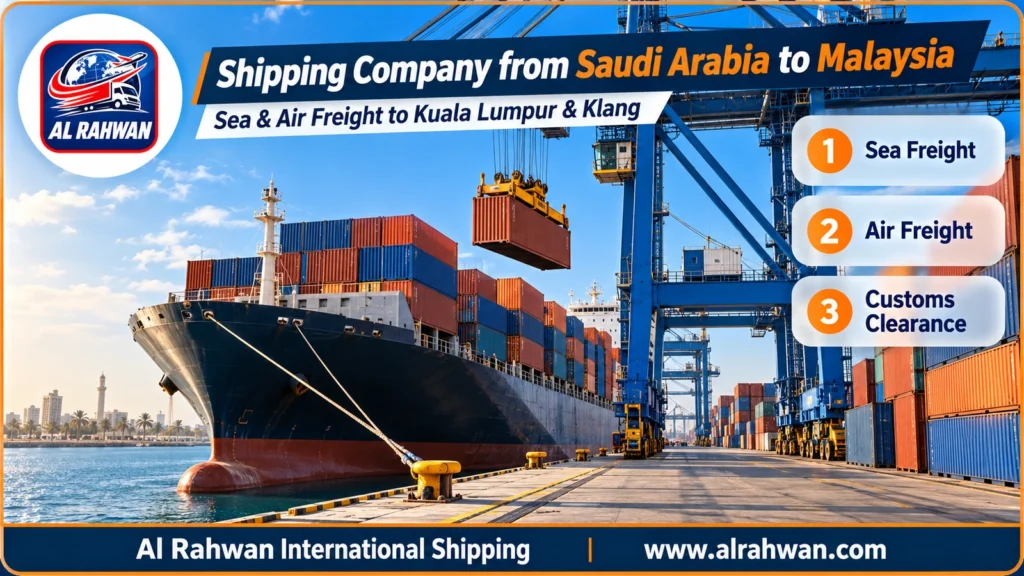
Household furniture, cars, parcels and traders’ goods travel from Jeddah, Riyadh, Dammam, Qassim, Makkah, Madinah and the rest of the Kingdom with Al Rahwan, the shipping company from Saudi Arabia to Malaysia that handles both the sea and the air routes. By sea, containers are loaded onto vessels at Jeddah Islamic Port or at Dammam’s King Abdulaziz Port and head for Port Klang, the Port of Tanjung Pelepas or Penang Port; by air, cargo flies out of Jeddah, Riyadh and Dammam and lands at Kuala Lumpur International Airport. The sea leg for a full container is roughly 11 to 20 days between ports, which usually puts the goods at your door in two to four weeks, while air cargo gets there in 2 to 7 days. A small courier parcel starts from SAR 145; for a full container, consolidated freight, household moves and cars, request an itemised quote. Call 0568829975 with your city and the Malaysian town you are shipping to, and the team will set out the route and timing that fit your shipment.
🧭 In this guide54 sectionsShowHide
- Available modes: only two, sea and air; no land route reaches Malaysia from the Kingdom.
- Departure ports: Jeddah Islamic Port handles cargo from the western cities, King Abdulaziz Port in Dammam cargo from the Eastern Province, and Riyadh cargo is trucked to whichever suits the sailing.
- Arrival ports: Port Klang for Kuala Lumpur and Selangor, Tanjung Pelepas for Johor, Penang for the northern states.
- Sea transit: around 11 to 20 days between ports for FCL and 15 to 30 days for LCL, with 2 to 7 days added for clearance.
- Air transit: about 9 hours on the direct Jeddah–Kuala Lumpur flight; cargo arrives within 2 to 7 days, or 4 to 10 days door to door.
- Prices: small courier parcels start from SAR 145; for every other shipment, request an itemised quote once volume and weight are known.
- Customs: the export declaration goes through Fasah with ZATCA, and the import declaration (K1) is lodged with Royal Malaysian Customs.
- Cars: Malaysia requires an Approved Permit (AP) from its Ministry of Investment, Trade and Industry, and a left-hand-drive car may not be registrable, so check the rules before you ship.
This guide is for anyone who wants the full picture before picking up the phone: how a shipment leaves the Kingdom, which Malaysian port suits your address, how long the sea and air legs take, what the customs officer in Klang or Kuala Lumpur will ask for, how weight is charged in air freight, and what Malaysia bans or restricts. Each section opens with a direct answer, then the explanation, then a table or list that sums it up.
Al Rahwan International Shipping moves cargo by land, sea and air to destinations worldwide, and Malaysia is one of the Asian routes it is asked about most: graduates of Saudi universities heading home with their books and belongings, Malaysian families who spent years in the Kingdom and want to move an entire household, expatriates of other nationalities taking up a job in Kuala Lumpur or Johor, and traders sending goods and samples to Malaysian buyers. The bookings desk takes calls and WhatsApp messages every day of the week from 7 am until 11 pm, and no question about Malaysia goes unanswered.
Is there shipping from Saudi Arabia to Malaysia, and which modes are available?
Yes, and the shipper has exactly two routes to choose from: the sea, in containers, and the air, which includes express courier. No land route links the two countries, so any consignment, small or large, is either loaded onto a container ship at Jeddah or Dammam or put on an aircraft departing from one of the main Saudi airports.
Malaysia sits on the Strait of Malacca, one of the busiest container lanes between the Middle East and East Asia, so many shipping lines coming from the Red Sea and the Arabian Gulf call at its ports. That keeps sea freight fairly regular: a shipper does not wait months for a sailing but chooses between several lines and departure dates. By air, Jeddah has direct flights to Kuala Lumpur and other services via stopovers, and all of them end at Kuala Lumpur International Airport, where most inbound air cargo is handled.
The first decision shapes everything after it: sea is far cheaper for large, heavy volumes, and air is faster for light, urgent items. Between the two sit consolidated sea freight for those who cannot fill a container, and courier for a small parcel or documents. The next section puts all four options side by side.
Comparison of shipping modes from Saudi Arabia to Malaysia
The cheapest way to ship a full home or a large consignment to Malaysia is a full container by sea, and the fastest way to send a small parcel is express courier by air. The table below sets out the four options by suitable cargo, transit time and pricing method.
| Shipping method | Cargo it suits | How long it takes | How the price is worked out |
|---|---|---|---|
| Full container (FCL) by sea, 20 or 40 ft | An entire household, a car, trade goods in bulk | 11–20 days between ports; about two to four weeks to the door | Container price: request an itemised quote |
| Shared container (LCL) by sea | Some of the furniture, a large batch of cartons, cargo too small for its own box | 15–30 days between ports | Based on cubic metres: request an itemised quote |
| Air via Kuala Lumpur airport | Urgent belongings, samples, spare parts, light devices | 2–7 days; 4–10 days to the door | Chargeable weight: actual or volumetric, the larger figure |
| Express courier | Small parcels, papers, gifts | 2–5 days | Small parcel from SAR 145 |
In a consolidated (LCL) shipment your goods share a container with other customers’ cargo heading to Malaysia, and you are charged only for the space they occupy. That suits someone with twenty or thirty cartons and a handful of furniture pieces. The downside: the box only sails once it has been filled, and on arrival everything is unpacked and sorted again at the depot, so the journey takes a little longer than FCL. A full container is closed at your door or at the loading warehouse and stays shut until customs inspection or delivery, so far fewer hands touch your belongings.
A practical rule the Al Rahwan team uses with customers: once your goods take up more than about half of a 20 ft container, a full container is usually better value than consolidation; if the shipment weighs a few kilos and you need it within days, air or courier is the answer. Anything in between is costed both ways and compared before booking.
Sea freight from Saudi Arabia to Malaysia: which port, and how many days
Every sea shipment to Malaysia starts at one of the Kingdom’s two big container ports: Jeddah Islamic Port on the western coast, or King Abdulaziz Port, which serves Dammam and the Eastern Province. The fastest published Jeddah–Port Klang sailing takes about 11 days, direct sailings 12 to 15 days, and direct Dammam–Port Klang services 11 to 15 days. As a working figure, a full container needs 11 to 20 days from port to port.
The choice of departure port has less to do with the distance to Malaysia than with where the goods are in the Kingdom and which sailings are available. Furniture loaded in Jeddah, Makkah or Madinah naturally goes to Jeddah Islamic Port, and shipments in Dammam, Khobar, Dhahran, Jubail and Al-Ahsa go to King Abdulaziz Port. Riyadh and Qassim sit in the middle, so the Al Rahwan team chooses between the two ports according to the nearest sailing and the most suitable line at the time of booking.
Port Klang: the main gateway to Kuala Lumpur
Port Klang is Malaysia’s largest port and the closest to the capital, on the Selangor coast west of Kuala Lumpur. Most personal and commercial shipments from Saudi Arabia arrive here, because it serves Kuala Lumpur, Shah Alam, Petaling Jaya, Putrajaya and the rest of the Klang Valley, where most returnees and expatriates live and most businesses are based. After discharge and clearance, the container or the sorted goods travel by truck to the final address.
Port of Tanjung Pelepas and Penang Port
The Port of Tanjung Pelepas lies in Johor at the southern tip of the Malaysian peninsula, close to the border with Singapore, and is a major container hub where many lines call. It is chosen for shipments to Johor Bahru and the south, because the onward haul from there is shorter than from Klang. In the north, Penang Port serves Penang Island, George Town and the northern states, and is a good option for customers living there when a line reaches it directly or via another port.
Direct sailings and transshipment
Not every vessel sails straight from Saudi Arabia to Malaysia. Some Dammam services first take the container to Jebel Ali, where it is discharged and loaded onto a larger ship, and some routings call at Singapore before the Malaysian port. This is transshipment; it is routine in ocean freight and does not mean the container is opened, but it can add days to the voyage. That is why published transit times vary between sources, and some lines from Jeddah run 18 to 30 days.
| Route | Service | Port-to-port transit |
|---|---|---|
| Jeddah → Port Klang | Fastest published sailing | About 11 days |
| Jeddah → Port Klang | Direct sailings | 12–15 days |
| Saudi Arabia → Malaysia | Full container in general | 12–20 days |
| Jeddah → Malaysia | Some lines with transshipment | 18–30 days |
| Dammam → Port Klang | Direct full container | 11–15 days |
| Dammam → Malaysia | Full container in general (may route via Jebel Ali) | 11–20 days |
| Dammam → Malaysia | Consolidated | 15–30 days |
| On arrival | Customs clearance | Add 2–7 days |
When a customer asks “when will my things arrive?”, the honest answer adds three periods together: the days for preparing, loading and trucking the container to the port in the Kingdom, the days at sea, and the days for clearance and inland delivery in Malaysia. Al Rahwan therefore tells customers that a sea shipment usually reaches the door in about two to four weeks, and gives a firmer date once the line and container number are confirmed.
Full container or consolidation?
A full container (FCL), 20 or 40 ft, is reserved for your goods only; it is packed right outside your house or warehouse, then shut with a seal whose number goes onto the bill of lading. With LCL, your goods are combined with other consignments at a consolidation warehouse, and the container ships once it is full. FCL is faster and safer for a complete household; LCL costs less for small volumes. If you are torn between the two, a survey and a measurement in cubic metres will decide it.
Riyadh, Jeddah, Dammam and other cities: getting your cargo to Malaysia
From any region of the Kingdom, Al Rahwan gathers the Malaysia-bound shipment and moves it to the most suitable export port or to the airport. The west ships via Jeddah Islamic Port and King Abdulaziz International Airport; the east via Dammam’s King Abdulaziz Port and King Fahd International Airport; Riyadh and Qassim reach either port by road, and use King Khalid International Airport for air cargo.
| City | How the cargo reaches the coast | Usual export port | Airport and code |
|---|---|---|---|
| Riyadh and Al-Kharj | By truck to either coast | Dammam or Jeddah, whichever sails first | King Khalid – KKIA |
| Jeddah | A short haul within the city | Jeddah Islamic Port | King Abdulaziz – KAIA |
| Makkah and Taif | The container comes down to Jeddah after loading | Jeddah Islamic Port | King Abdulaziz – KAIA |
| Madinah and Yanbu | By truck to Jeddah on the coastal or main highway | Jeddah Islamic Port | King Abdulaziz – KAIA |
| Dammam, Khobar and Dhahran | The port lies within the Dammam metropolitan area | King Abdulaziz Port | King Fahd – KFIA |
| Jubail and Al-Ahsa | By truck to Dammam | King Abdulaziz Port | King Fahd – KFIA |
| Qassim (Buraidah and Unaizah) | By truck; the coast depends on the schedule | Dammam or Jeddah, whichever sails first | King Khalid – KKIA |
From Riyadh to Malaysia
In Riyadh, collection happens in your own neighbourhood: Al Malqa, Al Narjis, Al Suwaidi, Al Olaya or anywhere else. The goods are packed, loaded into a container on a truck, and driven to the export port. Since the capital is a long way from the sea, this road leg takes up part of the total transit. Parcels and urgent items skip the coast entirely and fly out of King Khalid International Airport.
From Jeddah, Makkah and Madinah
Jeddah customers have a clear advantage: Jeddah Islamic Port is in the city itself, so the container reaches it soon after loading. Containers from Makkah, Madinah and Taif also come down to Jeddah. This region sees many Malaysian students who have finished their studies; they send books, clothes and devices in cartons by consolidated sea freight, or fly the essentials from King Abdulaziz International Airport.
From Dammam, Khobar and Jubail
The Eastern Province is home to many people working in energy and industry, including Malaysians whose contracts are ending and who are taking their household goods home. These shipments sail from Dammam’s King Abdulaziz Port, either on a direct line to Klang or via Jebel Ali before turning east. Lighter items can go by air from King Fahd International Airport.
Air freight from Saudi Arabia to Malaysia
Air cargo from Saudi Arabia to Malaysia generally takes 2 to 7 days: 2 to 5 days on express service, 3 to 7 on standard, and 4 to 10 days door to door. It departs from King Abdulaziz International Airport (Jeddah), King Khalid International Airport (Riyadh) or King Fahd International Airport (Dammam) and arrives at Kuala Lumpur International Airport; flying direct from Jeddah to Kuala Lumpur takes about 9 hours.
The time in the air is only a few hours. The remaining days go on pickup, packing and securing space on a flight, then clearance at Kuala Lumpur’s airport, then the final drive to the address. Customers in Penang or Johor Bahru should note that air cargo usually lands in Kuala Lumpur and continues by road, which adds a day or two.
What is worth sending by air?
- Things the owner needs in the first week after arrival: seasonal clothes, official papers, a work laptop.
- Trade samples that a Malaysian buyer is waiting for before placing a large order.
- Spare parts and small equipment where a delay costs more than the difference in freight.
- Small, valuable items the owner does not want spending weeks at sea.
Working out air-freight weight to Malaysia: an example
Air freight is not charged on the scale reading alone. The carrier also works out a volumetric weight and bills whichever figure is larger. For the volumetric figure, measure the carton in cm, take the product of its length, width and height, and split that product by 6000. The logic is simple: a plane runs out of space before it runs out of payload, so a bulky, light carton uses room that could have carried something heavier.
| Step | Operation | Outcome |
|---|---|---|
| Measure the carton (L × W × H) | 60 × 50 × 40 cm | 120,000 cm³ |
| Convert volume to weight | 120,000 ÷ 6000 | 20 kg volumetric |
| What the scale shows | — | 14 kg actual |
| Weight the fare is charged on | The larger of 20 and 14 | 20 kg |
In this example the owner pays for 20 kg, not 14, because the carton is large for what it holds. The simple fix is to choose cartons that fit the contents, avoid empty space padded with paper, and send heavy clothing by sea instead. Done this way, chargeable weight can come down close to actual weight.
Some items follow special rules by air, such as loose lithium batteries, perfumes and flammable liquids. These are declared at booking, and whether they fly or switch to sea depends on the airline’s conditions and the type of shipment.
Moving household furniture and personal belongings from Saudi Arabia to Malaysia
The best way to move a full household from Saudi Arabia to Malaysia is a full container by sea, while part loads go by consolidation. Al Rahwan starts with a survey, then dismantling, export packing, numbering and an inventory, then loading and securing in the container, and the home reaches its Malaysian address in roughly two to four weeks depending on the shipping line.
Furniture on a long sea voyage has two enemies: movement and moisture. Movement comes from the truck on the road and the handling of the container in port; moisture comes from going from Saudi Arabia’s dry air into Malaysia’s humid tropical climate. Packing that works for a move across town will not do here; the furniture needs export packing that survives weeks inside a sealed container.
Preparation steps before loading
- Survey and listing: the crew walks through each room, agrees with you what will be shipped and what stays behind, and estimates the cubic metres to decide between FCL and LCL.
- Dismantling: beds, wardrobes and big tables are broken down into their parts; each piece’s fittings, screws and hinges alike, are sealed in a clear bag with its number and taped on, so nothing goes missing when it is reassembled in Malaysia.
- Export packing: padded blankets around wooden pieces, air-bubble film over glass and appliances, card protectors on every corner, and stretch film wrapped tight over the lot.
- Wooden crates: for large mirrors, ornaments, marble and glass panels, which cardboard alone will not protect on a sea voyage.
- Numbering and inventory: cartons are numbered and marked with their room, and the numbers are gathered on one master list that travels with the shipping papers.
- Loading and securing: heavy pieces go on the container floor with fragile ones above them, then gaps are packed out and straps tightened so nothing moves during the voyage.
The inventory Malaysian customs asks for
For personal effects, the Royal Malaysian Customs Department requires a clear packing list, plus a separate list of electrical items giving each appliance’s make, model, serial number and year of purchase, and another list of books, CDs and DVDs. These lists are prepared in the Kingdom before the container is closed; doing them after arrival is much harder, as serial numbers cannot be read once appliances are wrapped.
It helps to photograph the back of each appliance, where the details are printed, before packing. Filling in the list then becomes easy, and you also have a record of the condition of your appliances should you need it for insurance.
| Item | Preparation | Best mode |
|---|---|---|
| Bedroom sets and wardrobes | Dismantled and numbered, bagged screws, furniture blankets | Sea |
| Sofas and majlis seating | Stretch film with cardboard on legs and corners | Sea |
| Fridge, washing machine, air conditioners | Drained, moving parts secured, bubble wrap | Sea |
| TVs and screens | A purpose-made carton or a wooden crate, with the screen face protected | Sea, or air for a small screen |
| Mirrors, ornaments, marble | Padded wooden crate | Sea with special care |
| Books and clothes | Small cartons for heavy books, large ones for clothes | Consolidated sea, or air if urgent |
Humidity: the detail that is often forgotten
Malaysia is tropical and humid all year, and a container closed in dry air and opened in humid air can collect condensation on metal and wooden surfaces. Al Rahwan therefore places moisture-absorbing sachets inside the container, wraps wood in a layer that lets it breathe rather than trapping vapour against it, and advises against shipping rugs or soft furnishings that are not completely dry after washing.
Anyone returning to Malaysia after years in the Kingdom, or moving there on a work contract, needs particular documents for a personal-effects shipment; these are set out in the documents section below.
Car shipping from Saudi Arabia to Malaysia
Cars travel from Saudi Arabia to Malaysia by sea, usually inside a container, sitting on wheel chocks and held down with straps. Being able to ship a car, however, is not the same as being able to register it in Malaysia: importing it requires an Approved Permit (AP) from Malaysia’s Ministry of Investment, Trade and Industry, a PUSPAKOM inspection and registration with the Road Transport Department (JPJ), and cars from the Saudi market are left-hand drive, whose registration there is not confirmed. Check the rules before shipping; for the freight cost, request an itemised quote.
Shipping the car in a container or by RoRo
Inside a container, the car is driven into a 20 or 40 ft box, chocked under the wheels and secured with four-point straps; a 40 ft container can carry the car together with part of the household goods. This protects the car from rain and salt spray, and the container stays sealed until arrival. On a RoRo vessel the car is driven up the ship’s ramp under its own power; availability on the Malaysia route depends on vehicle-carrier schedules and is confirmed at booking.
Moving the car inside the Kingdom to the export port
A car in Riyadh, Qassim or another inland city rides to the coast on a long multi-level car carrier, covered against dust and tied down with straps, sharing the trip with other export vehicles. The car stays on the transporter until it reaches the port yard, and is loaded into its container there or at the loading station.
Malaysian import rules: what to know before you ship
Malaysia keeps tight control over vehicle imports. Treat the points below as broad outlines and confirm each one with the Malaysian authorities, since the rules in force when you ship are the ones that count:
- Approved Permit (AP): issued by the Ministry of Investment, Trade and Industry (MITI); the car cannot enter without it.
- Returning Malaysian citizens: must have lived abroad legally for at least one year, the car must have been registered and insured in their name for at least nine months, the licence is granted once in a lifetime, and the car cannot be transferred to anyone else within two years of registration.
- Driving licence: must be a valid full licence, not a provisional one.
- Steering side: right-hand-drive vehicles are permitted for import; whether a left-hand-drive Gulf car can be registered must be confirmed before shipping.
- Non-citizens: the ministry’s page covers citizens and government staff, so non-Malaysians should confirm their position before taking any step.
- After arrival: a technical inspection at PUSPAKOM, then registration with JPJ.
Al Rahwan ships the car and prepares its Saudi export documents, but acceptance and registration in Malaysia are decisions for the Malaysian authorities. Obtain the AP or confirm your eligibility, ask about left-hand-drive registration, and then book the shipping. Doing it in that order saves you from shipping a car you may not be able to register.
On the Saudi side the export papers include the istimara (vehicle registration), the number plates, an export certificate, a release letter from the financing bank where the car is still on finance, and the owner’s ID or iqama copy. Before loading, the team photographs the car from all angles, notes the mileage and the state of the tyres, and drains most of the fuel before the car goes into the container.
Cartons, suitcases and small parcels to Malaysia from Saudi Arabia
Sending a small parcel to Malaysia by express courier starts from SAR 145, with delivery in 2 to 5 days. When there are many cartons or suitcases, consolidated sea freight priced by the cubic metre works out cheapest, while anything urgent can fly on chargeable weight. In both cases, request an itemised quote based on how many cartons you have and what they weigh.
Students send more cartons to Malaysia than anyone: years of books, course notes, clothes and a few small devices. One piece of advice comes up with every student shipment: books are very heavy, so never put them in a large carton. A big box full of books tears at the bottom and is hard for one person to lift. Small, sturdy cartons for books; large ones for clothes and pillows.
- Label every carton with the recipient’s name, Malaysian phone number and city, plus a serial number matching the list.
- Do not tuck open liquids or perfumes among clothes; perfume is a restricted item in Malaysia and needs a permit.
- Wrap suitcases in plastic and lock them, and note the locks and keys on the list.
- Used electronics such as laptops and phones are restricted imports; declare them with their details rather than hiding them in cartons.
Anyone sending only a handful of cartons may find air better value than sea, because consolidation has a minimum volume and fixed charges at both ports. The exact sums follow once the number, dimensions and weight are known.
Shipping commercial goods from Saudi Arabia to Malaysia
Trade goods travel to Malaysia by sea, filling a container of their own or sharing one depending on volume, and by air when they are samples or rush orders. The paperwork comprises a commercial invoice, a packing list, the K1 import declaration, the bill of lading and a certificate of origin, plus an import licence and permits for controlled products. For the price, request an itemised quote reflecting volume, weight and the nature of the goods.
A Saudi trader dealing with the Malaysian market needs two things before shipping: a registered Malaysian importer to receive the goods in its name, and certainty about whether the product is restricted. Perfumes, cosmetics, supplements, commercial food, wood products, tyres and telecom products all need a licence or permit in Malaysia. Anyone shipping oud, oud oil or oriental fragrances should confirm the permit before the container moves.
The Al Rahwan team helps customers prepare the invoice and packing list with an accurate description of the goods, quantities and weights, because most delays in commercial clearance come from a vague description that is not enough to classify the goods, or from figures on the invoice that do not match the packing list.
Paperwork for shipping to Malaysia from Saudi Arabia
The paperwork for Malaysia varies with what you are sending. Personal effects call for a passport, packing list, work permit or employment letter, and the Malaysian address; trade goods for an invoice, packing list, K1 declaration and certificate of origin; a car for its registration, an export certificate and the AP. Whatever the shipment, the customs broker receives an authorisation on Fasah to handle the export.
| Shipment type | Saudi side | Malaysian side |
|---|---|---|
| Household goods of a foreign national | ID or iqama, inventory, Fasah authorisation | Bill of lading or air waybill, packing list, passport copy, work permit or employment letter, full Malaysian address, list of electrical items, list of books and discs |
| Returning Malaysian’s effects | Passport, inventory, Fasah authorisation | All of the above, plus a copy of the Malaysian identity card (IC) and the work permit or employment letter from the previous country of residence |
| Trade shipment | Commercial registration plus sales invoice, packing list and certificate of origin | K1 declaration, commercial invoice, packing list, bill of lading, import licence, certificate of origin, insurance certificate, permits for restricted goods |
| Car | Istimara, plates, export certificate, bank letter if financed, owner’s ID | AP, PUSPAKOM inspection, JPJ registration |
| Cartons and parcels | Sender’s ID and a description of the contents with their value | Name, address and phone number of the person receiving |
Having these papers ready before loading saves days at the Malaysian port. A container that arrives with incomplete documents waits in the port yard until they are complete, and every day of waiting incurs storage charges. The Al Rahwan team therefore reviews the file with the customer before the container is closed and sends clear copies to the delivery side in Malaysia.
Customs clearance in Saudi Arabia and Malaysia
Clearance happens at two points. On the Saudi end, your customs broker lodges the export declaration through Fasah, ZATCA’s online customs gateway; in Malaysia, the Royal Malaysian Customs Department (RMCD, or JKDM) handles the import on Customs Form No. 1, usually called the K1. Personal effects generally clear in 3 to 5 working days once the paperwork is complete.
Saudi export clearance
Fasah takes the export declaration online, together with the bill of lading and the invoice or inventory. You never have to log in yourself: an authorisation to the broker is enough, and the broker submits the declaration and follows it until release. Customs may want to look at the goods before the container is sealed, especially with commercial cargo, so cartons are stacked in a way that keeps them reachable.
Malaysian import clearance
Royal Malaysian Customs operates an integrated electronic system, uCustoms, connected to the National Single Window through which permit-issuing agencies work. A Malaysian customs agent lodges the K1, the documents are checked, and the goods may be examined. Duties and taxes are assessed by Malaysian customs according to the type of goods, the recipient’s status and whatever regulations apply on the day of shipping, and the exact figure is only known once that assessment is made.
Clearance in Malaysia moves faster when the recipient’s address is complete and matches their documents, when the list of electrical items is detailed, and when no new goods in trade quantities are mixed in with personal effects, since that alone can reclassify the entire shipment.
Prohibited and restricted items for shipping to Malaysia
Malaysia absolutely prohibits material offensive to religion or that may disrupt national harmony, and pornographic material, and restricts many other goods to licence or permit, including perfume, cosmetics, supplements, tobacco and used electronics. The legal basis is Malaysia’s Customs (Prohibition of Imports) Order.
| Category | Examples | Status |
|---|---|---|
| Absolutely prohibited | Material offensive to religion or beliefs, material disruptive to national harmony, pornographic material | Cannot be shipped |
| Personal care | Cosmetics, perfume, vitamins and supplements | Licence or permit required |
| Tobacco and alcohol | Cigarettes, tobacco and nicotine products, alcoholic drinks | Licence required |
| Food and natural products | Commercial food, animal skins, bird’s nests, wood products, CITES-listed plants | Permit required |
| Technology | Telecom products, used and scrap electronics such as laptops and phones | Permit required |
| Other | Tyres, goods originating from Israel | Licence required |
On the Saudi side, hazardous and flammable materials, weapons and ammunition may not be exported, and some goods need approvals before export. The rule the Al Rahwan team applies: everything in the shipment is declared before packing, and anything doubtful is checked before it goes into a carton, because a single undeclared restricted item can hold the whole container at the port.
Insuring your shipment to Malaysia
Marine cargo insurance is optional for personal effects but recommended for any shipment with furniture, appliances or a car, because the voyage is long and involves several rounds of loading and unloading. The premium is based on the declared value, so the customer needs a list of approximate values for the goods.
It is worth knowing the difference between two kinds of cover: all-risks cover that includes breakage and damage, and limited cover for major incidents such as loss of the container. Photos of the goods before packing and the numbered inventory are what any claim relies on; insurance does not pay for what cannot be shown to exist or to have been in good condition. For commercial goods, an insurance certificate is already part of the Malaysian import documents.
Tracking your shipment from Saudi Arabia to Malaysia
Each mode has its own reference: a container is followed by its number and bill of lading on the shipping line’s website, an air shipment by its air waybill number, and a courier parcel by the tracking number issued at dispatch. Al Rahwan keeps the customer informed at every point: loading, port entry, departure, arrival, clearance and the delivery date. Keep these numbers until the last carton has been delivered; they are your reference for any query with the shipping line or the delivery team.
It helps to know that shipping-line updates sometimes pause for days while the vessel is at sea, then resume at the transshipment or destination port. This is normal and does not signal a delay. If the container passes through Jebel Ali or Singapore, the tracking history shows it with the new vessel name.
Storing your goods in the Kingdom or in Malaysia
Storage can be arranged whenever it is needed, for example if you must hand back your home in the Kingdom before the sailing date, or need your goods held for a few days in Malaysia until the new place is ready. Everything stays wrapped and numbered as packed; for the period and cost, request an itemised quote. One costly slip is leaving a container at the arrival port with nothing arranged: port storage fees grow every day and quickly overtake the price of a warehouse. Where storage in Malaysia is needed, it is agreed with the delivery side there before the container lands, so the goods go from the port straight to the warehouse without days of waiting in the yard.
Steps to book shipping to Malaysia with Al Rahwan
Booking starts with a call or WhatsApp message to 0568829975 and ends with delivery at the Malaysian address. The steps in order:
- Send the type of shipment, your Saudi city and the Malaysian destination, plus photos if it is furniture.
- A survey or estimate of the volume in cubic metres or the weight, and a choice of mode: full container, consolidation, air or courier.
- An itemised quote showing inland transport, packing, freight, clearance and delivery separately.
- Booking of the collection date and the sailing or flight.
- Dismantling, packing, numbering, and preparation of the inventory and appliance list.
- Loading and trucking the container to the port or the shipment to the airport, and filing the export declaration on Fasah.
- Sailing or flight, with the container or bill of lading number for tracking.
- Clearance in Malaysia on a K1, then inland transport and delivery to the address.
Delivery to Malaysian cities
Al Rahwan delivers to Kuala Lumpur, Selangor and Putrajaya via Port Klang and Kuala Lumpur airport, to Johor Bahru via the Port of Tanjung Pelepas or Johor Port, to Penang and George Town via Penang Port, and to Malacca and the rest of the peninsula by road from the nearest port. East Malaysia, in Sabah and Sarawak, is usually reached by transshipment from peninsular ports, and the routing is confirmed when quoting.
| City or area | Usual arrival point | Note |
|---|---|---|
| Kuala Lumpur | Port Klang / Kuala Lumpur International Airport | The most requested destination for furniture and parcels |
| Selangor (Shah Alam, Petaling Jaya) | Port Klang | Close to the port, short inland haul |
| Putrajaya | Port Klang / Kuala Lumpur International Airport | Suits returning government staff |
| Johor Bahru | Port of Tanjung Pelepas or Johor Port | The south, near the Singapore border |
| Penang and George Town | Penang Port | Subject to a line serving it |
| Malacca | By road from the nearest port | Port chosen when quoting |
| Kota Kinabalu and Kuching | Transshipment from peninsular ports | Routing checked before quoting |
In Kuala Lumpur’s high-rise condominiums, which are the norm there, building management usually requires the service lift to be booked and a set time for the move. The customer should arrange this with the building before the truck arrives, so delivery goes ahead without waiting.
Shipping costs from Saudi Arabia to Malaysia: what to expect
Sending a small parcel from Saudi Arabia to Malaysia by courier is priced from SAR 145; all other shipments, whether containers, consolidation, air freight, furniture or cars, are priced by itemised quote, because the cost depends on volume, weight, collection city, delivery city, shipping line and type of packing.
| Service to Malaysia | Where the price starts |
|---|---|
| A small parcel sent by express courier | From SAR 145 |
| A 20 or 40 ft container booked for your shipment alone | Request an itemised quote |
| LCL space, priced per cubic metre of cargo | Request an itemised quote |
| An air shipment to Kuala Lumpur on chargeable weight | Request an itemised quote |
| A whole home with dismantling and export packing | Request an itemised quote |
| A car in a container, including transport to the port | Request an itemised quote |
Six things that move your shipping price up or down
- Volume and weight: on a ship you pay for the cubic metres your goods occupy, on a plane for the chargeable weight.
- Collection city: the inland haul from Riyadh or Qassim to the port is longer than within Jeddah or Dammam.
- Arrival port and final city: Kuala Lumpur is close to Klang, while Sabah and Sarawak need extra transshipment.
- Shipping line: a direct service differs from one routed via Jebel Ali or Singapore.
- Packing: wooden crates and full export packing cost differently from basic wrapping.
- Services in Malaysia: door delivery, carrying to upper floors, and temporary storage.
Worked example
A student in Madinah wants to send three small parcels to family in Penang by courier: the total starts from SAR 435 (3 × SAR 145), and each parcel arrives in 2 to 5 days. If 15 cartons of books and clothes go with them, the better value is consolidated sea freight: their volume is measured in cubic metres and an itemised quote is requested, then compared with the cost by air on chargeable weight before deciding.
In the same way, if one carton measures 60 × 50 × 40 cm and weighs 14 kg, its chargeable weight by air is 20 kg, as in the air-freight example; with ten similar cartons the chargeable weight reaches 200 kg, and at that point consolidated sea freight is usually clearly better value.
Mistakes that hold up shipments from Saudi Arabia to Malaysia
- Shipping a car before confirming the AP: the car arrives but cannot leave the port, and charges pile up.
- Packing perfume and cosmetics among belongings without declaring them: these are restricted in Malaysia and can hold the whole shipment.
- An incomplete appliance list: Malaysian customs wants make, model, serial number and year of purchase for every electrical item.
- An incomplete Malaysian address: unit number, condominium name and postcode save days at delivery.
- Large cartons for books: they tear and are hard to carry; small cartons are the right choice.
- Ignoring humidity: wood and fabrics shipped unprotected come out of the container with odours or marks.
- Mixing new goods in commercial quantities with personal effects: it changes the classification and lengthens clearance.
- Leaving the container at the arrival port without arranging delivery or storage: port charges accrue every day.
Hardly any of these problems come from the ship or the aircraft; they start with how the shipment is prepared. That is why the Al Rahwan team sits down with the customer early on to go through the goods, the paperwork and the address: an hour spent checking in the Kingdom can save a week of waiting in Malaysia.
Why choose Al Rahwan for shipping to Malaysia?
Al Rahwan International Shipping handles the whole job itself: pickup in any Saudi city, dismantling and export packing, moving the container to Jeddah or Dammam port or the cargo to the airport, export clearance on Fasah, the sea or air leg, and coordinating clearance and delivery in Malaysia. You are not left juggling a packing firm, a haulier and a clearing agent.
Al Rahwan has learned the details of this route from moving students, families and traders: when LCL works out cheaper than a full container, which Malaysian port is nearest to your address, which lists Malaysian customs expects, and which items to ask about before packing. Call 0568829975 and send photos of your goods, your city and your Malaysian destination; an itemised quote and a pickup date follow.
Related Articles and Pages
- Shipping to Malaysia: the destination page with routes and services
- Shipping Company from Saudi Arabia to China
- Shipping Company from Saudi Arabia to India
- Request a shipping quote: send your shipment details and receive an itemised quote
Frequently Asked Questions
How much is shipping to Malaysia from Saudi Arabia?
SAR 145 is where prices begin, for a small parcel sent to Malaysia by express courier. Everything else, whether a full container, space in a shared container, an air shipment, a household move or a car, needs an itemised quote, which depends on volume, weight and which cities the goods move between.
Jeddah to Malaysia by sea: how long does it take?
About 11 days is the fastest published Jeddah–Port Klang sailing; direct services take 12 to 15 days, and some lines with transshipment run 18 to 30 days. Customs clearance in Malaysia adds 2 to 7 days.
How quickly does air cargo reach Kuala Lumpur from Saudi Arabia?
2 to 7 days in most cases: express 2–5 days, standard 3–7 days, and 4–10 days door to door. Shipments leave Jeddah, Riyadh or Dammam airport for Kuala Lumpur International Airport; the direct flight from Jeddah takes about 9 hours.
Overland to Malaysia from the Kingdom: is it possible?
No, there is no land route between the Kingdom and Malaysia. Cargo either sails in a container from Jeddah via Jeddah Islamic Port or from Dammam via King Abdulaziz Port, or flies from Jeddah, Riyadh or Dammam into Kuala Lumpur International Airport.
Which Malaysian ports receive shipments from Saudi Arabia?
3 main ports: Port Klang for Kuala Lumpur and Selangor, the Port of Tanjung Pelepas for Johor and the south, and Penang Port for the north. Some containers call at Jebel Ali or Singapore first, and East Malaysia is reached by transshipment from peninsular ports.
Can students and returnees ship furniture and personal effects to Malaysia?
Yes: a full household goes in a 20 or 40 ft container, and part loads or cartons by consolidation. Foreign nationals need a passport, work permit or employment letter and Malaysian address; returning Malaysians add an IC copy. Clearance usually takes 3–5 working days.
What documents are needed for customs clearance in Malaysia?
A K1 declaration with Royal Malaysian Customs, plus the bill of lading and packing list. Personal effects also need a passport copy, work permit, address and a list of electrical items with make, model, serial number and year; commercial goods need an invoice, certificate of origin and import licence.
Can a car be shipped to Malaysia from Saudi Arabia, and what is the AP?
An AP is an import permit issued by Malaysia’s Ministry of Investment, Trade and Industry, and a car cannot enter without it; PUSPAKOM inspection and JPJ registration follow. Cars ship by sea in a container, but left-hand-drive registration is not confirmed, so check the rules before shipping.
What items are prohibited or restricted for shipping to Malaysia?
Two categories: absolutely prohibited, such as material offensive to religion or national harmony and pornographic material; and restricted to licence, such as perfume, cosmetics, supplements, tobacco, commercial food, used electronics, tyres and telecom products.
Can I ship perfume and cosmetics to Malaysia?
Only with a licence or permit, because perfume and cosmetics are restricted items in Malaysia. Declare them before packing rather than tucking them among clothes; some airlines refuse them by air, in which case they go by sea.
How do airlines calculate the weight of cargo to Malaysia?
6000 is the fixed divisor: multiply the three dimensions in centimetres, divide by 6000 to get the volumetric weight, and the fare is charged on whichever is higher, that or the actual weight. A carton measuring 60×50×40 cm and weighing 14 kg is therefore billed as 20 kg.
Is delivery available to Johor Bahru and Penang?
Yes: Johor Bahru via the Port of Tanjung Pelepas or Johor Port, Penang and George Town via Penang Port, while air cargo lands in Kuala Lumpur and is trucked onward in an extra day or two. The routing is confirmed when quoting.
How do I track my shipment to Malaysia?
Three references, one per mode: container and bill of lading numbers if it goes by sea, an air waybill number if it flies, and a courier tracking number for parcels. Al Rahwan also keeps you posted at loading, departure, arrival, clearance and delivery.
