
 United Arab Emirates
 Qatar
 Kuwait
 Bahrain
 Oman
 Iraq
 Turkey
 Lebanon
 Syria
 Jordan
 Egypt
 Morocco
 Tunisia
 Algeria
 Libya
 Sudan
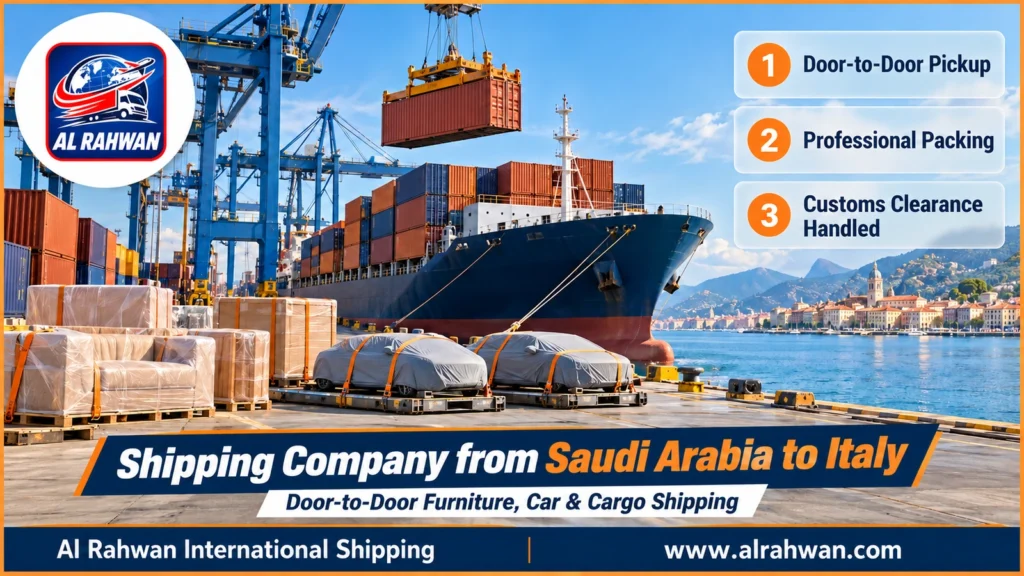
Families, students and traders all over the Kingdom call on Al Rahwan when they want a shipping company from Saudi Arabia to Italy: its crew comes to the door wherever they live, be it Riyadh, Jeddah, Dammam, Makkah, Madinah or Qassim, to take household belongings, a car, cartons or shop stock on to Italy. It sails them in a private or shared container through Jeddah Islamic Port to Genoa, La Spezia, Gioia Tauro and Naples, and flies anything urgent to Malpensa for Milan or Fiumicino for Rome. Expect 8 to 15 days at sea on a direct service out of Jeddah (Genoa can be reached in roughly 10 to 11), then a further 1 to 3 days by road or rail into Milan or Rome; by plane, door-to-door delivery takes 1 to 5 days. Space in a shared box costs from SAR 5,500, a container of your own from SAR 11,000, and a saloon sent by sea from SAR 6,900. Call 0568829975 to arrange a collection date and receive an itemised quote.
🧭 In this guide43 sectionsShowHide
- Available modes: sea in a full (FCL) or shared (LCL) container, RoRo for vehicles, and air for urgent, light items. There is no practical overland route to Italy.
- Arrival ports: Genoa and La Spezia in the north-west, Naples, Salerno and Gioia Tauro in the south, and Trieste in the north-east, which is widely used by RoRo vessels.
- Timing: 8–15 days by sea from Jeddah (Genoa about 10–11 days), 3–7 extra days for shared containers, 1–3 days inland, and 1–5 days door to door by air.
- Starting prices: trade goods at sea from SAR 2.3 a kilo, anything flown from SAR 23 a kilo, and a four-wheel drive by ship from SAR 10,000.
- Customs: the exit declaration goes on Fasah in the Kingdom, the EU ENS goes through ICS2 before loading, and on arrival the Agenzia delle Dogane e dei Monopoli takes over via its AIDA system.
- Delivery: to the door in Rome, Milan, Naples, Turin, Florence, Bologna and the rest of Italy.
This guide gathers the questions people ask when preparing a consignment for Italy: a student starting at a university in Milan or Bologna, a family relocating to Rome, a trader supplying goods to Naples, or a car owner who wants the vehicle to follow. It begins with the sea and air routes and the realistic transit time for each, then prices and worked examples, then each kind of load on its own: a household’s contents, a vehicle, boxes and luggage, and trade goods. After that come documents and customs in both countries, prohibited items, insurance, tracking, storage, booking steps, delivery within Italian cities, and the mistakes that most often raise the cost or hold a shipment up.
Italy is just one destination among many. Al Rahwan International Shipping serves customers bound for any country in the world, by road where a road exists, by sea for heavy loads and by air for what cannot be delayed. Italian requests reach the team regularly from students, employees and shop owners, and the route is a practical one: Italy’s Mediterranean ports are among the nearest in Europe to Jeddah once a ship clears the Suez Canal. Phone lines and WhatsApp stay open daily with no weekly day off, between 7 in the morning and 11 at night.
Can you ship from Saudi Arabia to Italy, and by which routes?
Yes. Sea and air services both run from the Kingdom to Italy, and between them they cover every kind of consignment. Furniture, vehicles and anything bulky go by ship, whether in a container you hire outright, in a slot inside a box you share with others, or, for cars, aboard a RoRo carrier you drive straight onto. The plane is kept for parcels, paperwork, trade samples and anything on a deadline.
Vessels bound for Italy sail from Jeddah Islamic Port, work their way up to Suez, transit the canal and then cross the Mediterranean to the Italian coast. That makes Jeddah the natural gateway for this lane, even for cargo collected in Riyadh, Qassim or the Eastern Province. Some services call directly at the Italian port; others stop at a transhipment hub such as Port Said, where the container moves to another vessel, which explains the gap between the shortest and longest times in the table below.
Choosing the right mode is not only about price. Twenty cartons may be cheaper by sea in a shared container but can take weeks, while the same parcel by air arrives within days at a higher rate per kilo. A car can travel in a closed container or on a RoRo vessel, and each has advantages explained in the car section further down.
| Mode | Best suited to | Approximate time | Price from |
|---|---|---|---|
| Full container (FCL) | A whole household, large commercial loads, a car with belongings | 8–15 days by sea from Jeddah + 1–3 days inland | SAR 11,000 |
| Shared container (LCL) | Part of a home, dozens of cartons, or stock smaller than a container | Sea time + 3–7 days for consolidation and unpacking | SAR 5,500, or SAR 2.3 a kilo for trade goods |
| RoRo for cars | A car driven on board and off again | Depends on the sailing schedule, usually to Trieste | Saloon from SAR 6,900; SUV from SAR 10,000 |
| Air freight | Parcels, documents, samples, urgent items | 1–5 days door to door | SAR 23 a chargeable kilo |
| Express courier | Documents and very small parcels | A few days | Request an itemised quote |
Transit time from Saudi Arabia to Italy: how many days?
Sea freight from Jeddah to Italian ports takes 8 to 15 days on direct sailings, the fastest to Genoa about 10 to 11 days, while a plane puts the consignment at its address within 1 to 5 days. What the customer actually cares about, though, is the time from collection at home to delivery in Italy, and that is made up of several stages, each with its own duration.
The first stage is preparation in Saudi Arabia: dismantling, packing, writing the inventory, moving the load to the port and lodging the export declaration. Then comes the wait for a suitable vessel; ships from Jeddah to Genoa sail once or twice a week, and the cut-off before departure fixes when the container must be at the port. In a shared container the load waits until the box is filled with other shipments, and in Italy it is unpacked at a consolidation warehouse before delivery, so this option adds roughly 3 to 7 days. After arrival comes Italian clearance, then the inland leg by truck or rail, which takes 1 to 3 days to Milan or Rome.
| Stage | Approximate time | Note |
|---|---|---|
| Sailing from Jeddah to Genoa | About 10–11 days on the fastest services | Once or twice a week |
| Direct sailing from Jeddah to Italian ports in general | 8–15 days | Gioia Tauro is among the routes with least transhipment |
| Sailing from Dammam | Longer than from Jeddah | Check the sailing schedule at booking |
| Consolidation and unpacking for shared containers | 3–7 extra days | Depends on how quickly the container fills |
| Inland leg from the port to Milan or Rome | 1–3 days | By truck or rail |
| Air freight door to door | 1–5 days | Direct flight Jeddah–Milan about 5 hours 22 minutes |
A practical tip: if you have a fixed date in Italy, such as the start of term or the handover of a new flat, book sea freight well ahead of it, and put what you need in the first days (papers, seasonal clothes, a laptop) in a small air shipment or your suitcase, so you are not left waiting for the container.
Sea freight from Saudi Arabia to Italy: ports and sailing times
For anything bigger than a handful of cartons the sea is the cheapest way to go, and the only practical way to move a household, a car or commercial goods in quantity. Containers from Saudi Arabia most often arrive at Genoa, while nearby La Spezia also serves the north and centre of Italy. Gioia Tauro, at the far south, receives large vessels whose containers are then distributed to other ports, and Naples and Salerno serve the south and the Campania region. Trieste in the north-east is widely used for cars carried on RoRo vessels.
The delivery address decides the best port first. Someone living in Milan or Turin usually has the container landed at Genoa, because the road from there to the northern cities is short and well organised. Someone in or around Naples saves days of inland haulage if the container lands at Naples or Salerno. Al Rahwan agrees the port with the customer at booking, based on the services running that week and the cost of the inland leg after arrival; a port slightly further from your city can be quicker if its vessel sails sooner.
| Italian port | Code | Location | Typically serves |
|---|---|---|---|
| Genoa | ITGOA | North-west, on the Ligurian Gulf | Milan, Turin and the north; the most common destination for Saudi containers |
| La Spezia | ITSPE | North-west, south of Genoa | The north, Tuscany and Florence |
| Gioia Tauro | ITGIT | The far south, in Calabria | A major hub; one of the routes with least transhipment from Jeddah |
| Naples | ITNAP | The south, on the Bay of Naples | Naples, Campania and southern Italy, sometimes Rome |
| Salerno | ITSAL | South of Naples | Campania and the south |
| Trieste | ITTRI | North-east, on the Adriatic | RoRo vessels for cars, and the north-east |
Full container or shared container?
With FCL the box is yours and nobody else’s. The crew packs it in front of your house or inside the Al Rahwan warehouse, a seal goes on, and it stays shut all the way to Italy unless an inspection is called. That means less handling of your belongings, and it is the best choice for a household of three rooms or more, a car travelling with household goods, or commercial cargo that fills the box. It starts from SAR 11,000.
With a shared container (LCL) you pay only for the space your consignment takes. It is combined with other shipments at a consolidation warehouse and separated again in Italy before delivery. It suits part loads of furniture, a large number of cartons, and medium volumes of commercial goods. A shared shipment starts from SAR 5,500, and commercial cargo by weight from SAR 2.3 per kg. Regular groupage services link Jeddah and Genoa, so this option is available without a long wait.
| Criterion | Full container (FCL) | Shared container (LCL) |
|---|---|---|
| Price from | SAR 11,000 | SAR 5,500 per shipment |
| Time | Sailing time only | Sailing time + 3–7 days |
| Handling | Once: loading, then unloading | More: consolidation warehouse, then unpacking in Italy |
| Best for | A whole home, a car with furniture, a trader with a large load | Part loads, many cartons, medium cargo |
| Packing | Standard, with bracing inside the container | Stronger, as the load sits beside other shipments |
If you are unsure how much you have, ask for a survey: the team calculates the volume in cubic metres and compares the cost of shared and full containers for you, because a large load in a shared container can come close to the price of a full one that nobody else shares.
Shipping to Italy from every Saudi city: Riyadh, Jeddah, Dammam and more
Wherever you live in the Kingdom, the Al Rahwan crew picks up your Italy-bound consignment and brings it to the right seaport or airport. That domestic leg differs from city to city, and knowing it helps you understand the total time and how the price is built.
Jeddah, Makkah, Madinah and Taif: all four sit within easy reach of Jeddah Islamic Port, from which vessels sail towards the Suez Canal and the Mediterranean, so the container reaches the quay shortly after loading. King Abdulaziz International Airport in Jeddah handles air freight for the region.
Riyadh, Qassim and central Saudi Arabia: Riyadh has no seaport, so its containers first travel to a port. The option most used for Europe is road haulage to Jeddah, because the sailing to Italy from there is shorter. There is also a rail option, since container trains run between the capital’s dry port and King Abdulaziz Port in Dammam, which makes sense when the right ship is sailing from the Gulf side. Air freight departs from King Khalid International Airport in Riyadh.
Dammam, Khobar, Dhahran, Jubail and Al-Ahsa: King Abdulaziz Port in Dammam is an option, yet its voyage to Italy runs longer than Jeddah’s, as ships must round the Arabian Peninsula to reach the Red Sea; at booking the team weighs that schedule against trucking the box across to Jeddah. Air freight from the Eastern Province leaves from King Fahd International Airport in Dammam.
| Collection city | Air freight airport | How the container reaches the sea | Note |
|---|---|---|---|
| Jeddah | King Abdulaziz Airport, Jeddah | Straight into Jeddah Islamic Port | Shortest domestic leg |
| Makkah and Taif | King Abdulaziz Airport, Jeddah | Trucked to Jeddah Islamic Port | Pick-up from homes and warehouses |
| Madinah and Yanbu | King Abdulaziz Airport, Jeddah | Trucked to Jeddah Islamic Port | The haul to Jeddah is added |
| Riyadh | King Khalid International | Trucked to Jeddah, or railed to Dammam from the capital’s dry port | Decided by the vessel date |
| Qassim and Hail | Via Riyadh or Jeddah | Trucked to Jeddah or Dammam | Loads grouped on regular runs |
| Dammam, Khobar and Jubail | King Fahd International | King Abdulaziz Port, or trucked to Jeddah | The voyage from Dammam is longer |
Shipping prices from Saudi Arabia to Italy
So what will an Italy-bound consignment from the Kingdom cost? Prices begin at SAR 2.3 a kilo for merchandise in a shared sea container and SAR 23 a chargeable kilo by plane; a whole LCL consignment opens at SAR 5,500 and a private FCL box at SAR 11,000, while cars start at SAR 6,900 (saloon) and SAR 10,000 (four-wheel drive). Treat these as floor prices; the exact amount for each consignment is fixed once its volume, type, collection city and delivery address in Italy are known.
| Consignment | Mode | Price |
|---|---|---|
| Commercial cargo by the kilo | Sea (LCL groupage) | From SAR 2.3 per kg |
| Air freight | Air to Milan or Rome | From SAR 23 per chargeable kg |
| Shared-container (LCL) shipment | Sea | From SAR 5,500 |
| Full container (FCL) | Sea | From SAR 11,000 |
| Saloon car | Sea (container or RoRo) | From SAR 6,900 |
| SUV | Sea (container or RoRo) | From SAR 10,000 |
| Household furniture by number of rooms | Sea | Request an itemised quote |
| Express courier, door to door | Express air | Request an itemised quote |
| Insurance and storage | Additional services | Request an itemised quote |
What raises or lowers the cost of shipping to Italy?
The first factor is size: at sea, volume is charged in cubic metres; in the air, volumetric weight applies when it exceeds the actual weight. Next is the mode, since air raises the rate per kilo considerably in return for speed. Then the collection city, because a load from Riyadh or Dammam needs a domestic leg to Jeddah, and the delivery address, as a city far from the arrival port means a longer inland haul. Packing also matters, such as wooden crates for valuable pieces, as do storage before shipping or after arrival and insurance if you request it.
- Volume in cubic metres or chargeable weight.
- Mode: full container, shared container, RoRo or air.
- Collection city in Saudi Arabia and its distance from Jeddah or Dammam port.
- Arrival port and delivery city in Italy.
- Packing: standard, reinforced export packing, or treated wooden crates.
- Extra services: dismantling and reassembly, storage, insurance.
- The nature of commercial goods and their customs classification.
Worked examples for estimating the cost
Example 1 — a trader in Dammam sending 800 kg of goods by sea: multiply 800 by 2.3 and the sea leg in a shared box begins at SAR 1,840; packing and the final road leg in Italy are added according to where the buyer is.
Example 2 — a family in Jeddah moving their home and their car: SAR 11,000 for a container of their own plus SAR 6,900 for the saloon gives a starting total of SAR 17,900. Should a shared slot from SAR 5,500 hold everything, that falls to a starting total of SAR 12,400.
Example 3 — a student in Riyadh sending two cartons by air to Milan: each carton is 55 × 45 × 35 cm and the scale reads only 8 kg. The dimensions multiply to 86,625 cm³, and dividing by 6000 gives 14.4 kg, so that larger figure is used and rounded to 14.5 kg. Two cartons make 29 chargeable kilos, costing from 29 × 23 = SAR 667.
Furniture and household removals from Saudi Arabia to Italy
Moving furniture to Italy means a long sea voyage during which the pieces pass through cranes, warehouses and trucks, and face humidity and temperature swings between the Saudi and Mediterranean climates. Wrapping that would do for a local move falls short here, which is why Al Rahwan uses export-grade packing built for weeks on the water and tags each piece with a number tied to the customs inventory.
The service begins with a survey of the home to estimate volume and choose the container. On the agreed day the crew dismantles beds, wardrobes and tables, wraps each piece in blankets and heavy-duty film, and places delicate appliances and ornaments in dedicated boxes. The furniture is loaded in a planned order, heavy items at the bottom, with straps holding each tier so nothing shifts at sea. In Italy the belongings are delivered to your address, and reassembly can be arranged.
Steps for preparing furniture for international shipping
- Survey the home and decide what will be shipped and what will stay or be sold.
- Choose the container: shared for a part load, or 20 ft or 40 ft by volume.
- Dismantle beds, wardrobes and tables, with the screws for each piece bagged, numbered and taped to it.
- Wrap wood in blankets then film, glass and mirrors in crates, and appliances in their boxes or reinforced cartons.
- Number every item and write a detailed inventory in English.
- Load the container, strap each tier, then seal it.
- Clearance and sailing, then delivery in Italy and reassembly if agreed.
Export packing and the inventory list
Wood used in crates or pallets for export to Europe must carry the ISPM-15 treatment stamp; untreated wood is restricted. That is why Al Rahwan uses treated crates and pallets for valuable pieces such as chandeliers, large mirrors and antiques. The packing list is the most important document in a furniture shipment: every item or carton is listed with its number and a clear description, for example “Carton 14: glass kitchenware” rather than “miscellaneous items”, because vague descriptions slow clearance.
If you are settling in Italy, EU law provides a customs relief for personal belongings on a transfer of residence, and it is Italian customs, using their own forms, that decide whether a particular person qualifies. Ask Al Rahwan before shipping so your papers are prepared to suit your situation.
| Item | Packing method |
|---|---|
| Wooden beds and wardrobes | Fully dismantled, blankets, heavy-duty film, straps |
| Sofas and armchairs | Bubble wrap then a fabric cover, with legs protected |
| Glass, mirrors and paintings | ISPM-15 treated wooden crates or reinforced cartons with corner guards |
| Electrical appliances | Original or reinforced cartons; fridges and washing machines drained |
| Tableware and ornaments | Individually wrapped in paper and bubble wrap inside double-wall cartons |
| Clothes and soft furnishings | Wardrobe cartons or sealed cartons with moisture-absorbing sachets |
Car shipping from Saudi Arabia to Italy
A car can be shipped from Saudi Arabia to Italy in two ways: sealed in a container, or rolled aboard a RoRo ship under its own power and driven off again at the far end, which for RoRo is usually Trieste. On the Italian lane a saloon goes by sea from SAR 6,900, while a four-wheel drive starts at SAR 10,000.
Inside a box, chocks under the tyres and ratchet straps keep the car rigid, and the doors stay shut until Italy; this suits luxury and classic cars, and in a full container some belongings can travel with the car. RoRo is simpler, as the car is driven onto an enclosed deck like a floating car park, but personal items are not normally allowed inside the vehicle. Before it ever sees the sea, your car crosses the Kingdom to the port strapped to a deck of a lengthy car carrier truck, wrapped in a fitted dust cover among other export vehicles.
| Criterion | In a container | RoRo |
|---|---|---|
| Loading | Chocked and strapped inside a closed container | Driven on board and off again |
| Protection | Higher; the car is not exposed to air or salt | Good, on an enclosed deck |
| Belongings with the car | Possible in a full container with an inventory | Not normally allowed |
| Usual arrival port | Genoa, Naples or others depending on the service | Usually Trieste |
| Price from | Saloon from SAR 6,900; SUV from SAR 10,000 | Saloon from SAR 6,900; SUV from SAR 10,000; final price by vessel |
Registering the car in Italy: what to check before shipping
Any vehicle that is to carry plates in the EU has to meet European technical standards. If your car is new and was built for Europe in the first place, the factory’s COC certificate normally proves it. If it is used and carries Saudi registration, you will generally need its original logbook, proof of purchase and proof of clearance, and it may face an inspection or single-vehicle approval before it can wear Italian plates. Gulf-market models are not always built to the European spec, with headlamps and exhaust standards being typical differences, and only the Italian authorities can say whether a given car will be accepted. Al Rahwan therefore advises checking whether the car can be registered in Italy before it is shipped, not after it arrives.
For the Saudi formalities the owner prepares an in-date istimara, hands in the plates, obtains an export certificate, and obtains a clearance letter from whoever financed the car if payments are still outstanding, along with ID or a notarised authorisation for whoever acts on their behalf. Before handover leave only a little fuel, empty the cabin and boot, and photograph the bodywork from front, back and both flanks, plus the mileage on the dashboard.
Shipping cartons, suitcases and parcels to Italy
Not everyone heading to Italy needs a container. A student taking books and clothes, an employee on a fixed-term contract, or a family sending gifts and belongings to relatives all need to ship a limited number of cartons or suitcases. Al Rahwan offers two options for these: sea in a shared container for those in no hurry, and air for those who want their things within days.
Whichever you pick, a driver picks the boxes up at your door, flimsy ones get re-boxed, suitcases are film-wrapped and belted shut, and every carton is labelled with a number plus the recipient’s name and Italian address. It helps to weigh and measure every carton before booking, because air freight is charged on volumetric weight, which means a bulky but light box may be billed well above what the scale shows.
- Pick fresh double-wall boxes and stop at about 25–30 kg each, a weight one person can lift.
- Fill empty space with paper or clothes; a hollow carton gets crushed in transit.
- Note down the contents of every box; customs will want that list.
- Do not pack meat or dairy foods, medicines without a prescription, or loose lithium batteries.
- Keep important papers and valuable devices in your hand luggage rather than in the shipment.
Air freight from Saudi Arabia to Italy: Milan Malpensa and Rome Fiumicino
Flying cargo from the Kingdom to Italy takes 1 to 5 days from door to door, at prices beginning at SAR 23 per chargeable kilo. Your consignment is handed in at whichever Saudi airport is nearest (Jeddah, Riyadh or Dammam) and lands at Malpensa (MXP) when it is bound for Lombardy and the north, or at Fiumicino (FCO) when it is going to Rome and the centre. Airborne time on a direct Jeddah–Milan service is about 5 hours 22 minutes, and the remaining days are spent on pick-up, clearance and the final delivery.
People usually fly a file of papers someone is waiting for, a sample a trader wants to show, a spare part without which work stops, or the laptop and books a student needs from week one. It does not suit heavy furniture or large volumes, because the cost climbs with every kilo. Some items face special restrictions in the air, chiefly lithium batteries, flammable liquids and perfumes in quantity, which fall under dangerous-goods rules.
How is volumetric weight calculated in air freight?
A plane charges for space as well as mass, so the box’s scale weight is set against its size and the larger number wins. For the size-based figure, take the box’s three measurements in centimetres, multiply them, and divide the total by 6000. Example: a box of 80 × 60 × 50 cm weighing 22 kg. Its volume is 240,000 cm³ and its volumetric weight 240,000 ÷ 6000 = 40 kg. The volumetric figure is higher, so 40 kg is charged and the cost starts from 40 × 23 = SAR 920. Put the same contents into a tighter 60 × 50 × 40 cm box and the size-based weight drops to 20 kg, the chargeable weight becomes the actual 22 kg, and the cost starts from 22 × 23 = SAR 506. Getting the box size right alone saves more than SAR 400.
| Size (cm) | Actual weight | Volumetric weight | Chargeable weight | Cost from |
|---|---|---|---|---|
| 80 × 60 × 50 | 22 kg | 40 kg | 40 kg | SAR 920 |
| 60 × 50 × 40 | 22 kg | 20 kg | 22 kg | SAR 506 |
| 40 × 30 × 30 | 12 kg | 6 kg | 12 kg | SAR 276 |
Shipping commercial goods from Saudi Arabia to Italy
Trade cargo for Italy travels with Al Rahwan by ship, either filling a container or sharing one, while samples and rush orders go by plane. Goods by weight in a shared container start from SAR 2.3 per kg, and a full container from SAR 11,000. Commercial cargo differs from a personal shipment in that Italian customs assess it by classification and value, so it needs an accurate commercial invoice and a Harmonised System (HS) code for every line.
Goods shipped on this lane include dates and date products in retail packaging, processed foods, plastic and chemical products from Saudi factories, perfumes and incense, clothing, spare parts, exhibition material and samples. Each has its own requirements: plant products may need a phytosanitary certificate, alcohol-based perfumes are restricted by air, and chemicals fall under dangerous-goods rules. Al Rahwan therefore reviews the nature of the goods before booking to choose the right mode and documents.
The importer in Italy must hold an EORI number, a registration number that is mandatory for all customs operations in the European Union for businesses. If the consignee does not have one, it must be obtained before the cargo arrives, because its absence halts clearance. Traders also benefit from clear carton marks tied to the packing list, and from ISPM-15 treated pallets.
Paperwork for shipping from Saudi Arabia to Italy by consignment type
What you hand over depends on what you are sending. Household goods call for a passport or iqama copy, an item-by-item inventory, the Italian recipient’s name and address, and authority on Fasah for the customs broker to file in your name. Trade cargo calls for the exporter’s commercial register, a packing list, a commercial invoice giving each line its HS code, a certificate of origin, and the EORI number of the Italian importer. A vehicle needs its istimara, its plates and an export certificate, plus the lender’s release letter when the car is financed.
| Consignment | Documents in Saudi Arabia | Documents in Italy |
|---|---|---|
| Household goods | Passport or iqama copy, itemised inventory, broker authorised on Fasah | Passport copy, inventory, bill of lading, proof of new residence, and transfer-of-residence relief forms where applicable |
| Cartons, suitcases and parcels | Iqama or passport, a list of what each box holds, recipient’s name and address | Air waybill or bill of lading, inventory |
| Trade cargo | Certificate of origin, commercial register, packing list, priced commercial invoice | EORI of the Italian importer, an HS code per line, a licence where goods are restricted, health or plant-health certificates if required |
| Car | Valid istimara, plates handed in, export certificate, lender’s letter where relevant, owner’s ID | Original logbook, proof of purchase and clearance, plus a COC or single-vehicle approval for registration |
Keep a digital copy of all these documents on your phone and send one to the consignee in Italy; customs may ask for an extra paper during clearance, and a quick reply saves days.
Customs clearance in Saudi Arabia and Italy
Every shipment to Italy goes through two clearances: export in Saudi Arabia and import in Italy. On the Saudi side, the exit declaration goes in through Fasah, the electronic window of the Saudi customs authority ZATCA, filed by the broker you have authorised. In Italy clearance is handled by the customs and monopolies agency, Agenzia delle Dogane e dei Monopoli, through its electronic system AIDA, and imports from outside the European Union are declared on the Single Administrative Document (SAD).
Before all that there is a European step that many people overlook: the Import Control System 2 (ICS2), which requires an Entry Summary Declaration (ENS) for every consignment entering the EU. A container leaving Jeddah or Dammam is not lifted aboard until its data has reached the European system a full day ahead (24 hours at least), with a six-digit HS code against every line. By air, part of the data is enough before the cargo boards, provided the declaration is completed before landing. So the Al Rahwan team chases your contents list days before loading; a list that turns up on the morning itself can cost you the sailing.
Duties and taxes in Italy depend on the type of consignment: commercial goods are assessed by classification and value, while the personal effects of someone transferring residence may be relieved once customs has reviewed the case. Al Rahwan does not quote fixed rates, since they change from one item to another and with the regulations that apply; instead it reviews your case before booking and tells you which documents support your claim.
| Body or system | Country | Role |
|---|---|---|
| Fasah platform — Zakat, Tax and Customs Authority | Saudi Arabia | Export declaration and release of the shipment |
| ICS2 and the ENS | European Union | Safety and security data before loading or arrival |
| EORI number | European Union | Registration number of the importer for customs operations |
| Agenzia delle Dogane e dei Monopoli | Italy | Clearance, inspection and collection of charges |
| AIDA system | Italy | Electronic platform for customs declarations |
| Single Administrative Document (SAD) | Italy and the EU | Import declaration form for goods from outside the EU |
Prohibited and restricted items when shipping to Italy
What most often stops shipments at Italian customs is not paperwork but small items put in a carton without thinking. The European Union does not allow meat, milk and their products from Saudi Arabia as personal imports, with conditional exceptions for infant milk and medical foods in sealed branded packs under 2 kg, fish up to 20 kg, and honey and similar animal products up to 2 kg. Plant-based foods may be subject to plant-health checks, so if you want to ship dates, keep them in sealed retail packs and list them clearly on the inventory.
| Category | Examples | Rule |
|---|---|---|
| Prohibited | Weapons, ammunition and explosives, narcotics, ivory and endangered species, counterfeit goods | Not shipped |
| Prohibited | Meat, milk and their products as personal imports | Not shipped, except the stated exceptions |
| Prohibited | Live animals, plants and seeds without permits; furs of non-domesticated animals | Not shipped |
| Restricted | Alcohol and tobacco | Within allowances and subject to excise |
| Restricted | Medicines | With approvals and prescriptions |
| Restricted | Lithium batteries and chemicals | Under dangerous-goods rules by air and road |
| Restricted | Gold and jewellery or cash above EUR 10,000 | Must be declared |
| Restricted | E-bikes and e-scooters without CE marking | May be refused |
| Restricted | Untreated wood | ISPM-15 stamp required |
Insuring your shipment to Italy
A sea voyage of two weeks or more, during which the container passes through ports, cranes and warehouses, makes insurance worth considering, especially for valuable furniture, appliances, cars and high-value commercial goods. Cover is available from Al Rahwan whenever you ask, priced on the value you declare and the kind of goods; request an itemised quote with it included.
For insurance to be useful, write the value of each valuable item on the inventory, photograph belongings before packing, and keep invoices for appliances and artwork. When the goods arrive, check them before you sign and write any damage straight onto the delivery note.
Tracking your shipment from Saudi Arabia to Italy
After loading you receive the bill of lading (B/L) number for sea freight or the air waybill (AWB) number for air, plus the container number for sea shipments, which let you follow the consignment at every stage. The Al Rahwan team keeps in touch on WhatsApp at the key points: the container entering the port, the vessel sailing, arrival at the Italian port, completion of clearance, and the delivery appointment. For shared containers the team also tells you when the box is unpacked at the consolidation warehouse in Italy.
Storing belongings before shipping or after arrival
Moves rarely line up neatly: the lease in Saudi Arabia may end before an Italian flat is found, or the ship may beat the new landlord’s handover. In such cases your belongings can wait in a closed Al Rahwan warehouse before sailing, or space can be organised for them after landing, until you pick a delivery day. Since cost follows cubic metres and weeks, request an itemised quote for it.
Booking a shipment from Saudi Arabia to Italy, step by step
It all starts with a phone call or a WhatsApp to 0568829975 and finishes when the last box is inside your Italian home. Here is what happens in between, each stage tracked with you by the Al Rahwan team.
- Get in touch and state the consignment type: furniture, car, cartons or commercial goods.
- Arrange a survey, or send photos and measurements to estimate volume and weight.
- Choose the mode (full container, shared container, RoRo or air) and the arrival port.
- Receive an itemised quote and fix the collection date.
- Dismantling, packing and the inventory, then loading.
- Lodging the export declaration on Fasah and the EU ENS before loading.
- Sailing or flight, with the tracking number sent to you.
- Clearance in Italy through Italian customs.
- Inland transport and delivery to the address, with reassembly if agreed.
Delivery to Italian cities
Al Rahwan delivers to the door in major and smaller Italian cities, with the inland route depending on the arrival port or airport. The inland leg from the port to Milan or Rome takes 1 to 3 days. In historic centres with narrow streets, such as Florence, Rome and old Naples, a large truck may need to transfer the load to a smaller vehicle near the address, so let the team know in advance how wide the street is, which floor you live on and whether the building has a lift.
| City | Usual arrival port or airport | Commonly shipped |
|---|---|---|
| Milan | Genoa or La Spezia by sea, Malpensa by air | Students’ belongings, commercial goods, trade-fair samples |
| Rome | Fiumicino by air; Naples or Genoa by sea | Household furniture, personal effects, staff relocations |
| Naples | Naples, Salerno or Gioia Tauro | Furniture, goods, personal shipments |
| Turin | Genoa | Spare parts, equipment, personal items |
| Florence | La Spezia or Genoa | Students’ belongings, flat furniture |
| Bologna | Genoa or La Spezia | Students’ belongings, goods |
| Trieste and the north-east | Trieste | Cars by RoRo, goods |
Common mistakes that raise the cost or delay a shipment to Italy
Most delays on this lane happen not at sea but on land: before loading in Saudi Arabia or during clearance in Italy. These are the mistakes that recur most often, and all of them can be avoided with a little planning.
- A vague inventory: “personal items” written on twenty cartons invites inspection. Describe each carton.
- Leaving the list until loading day: without the ENS lodged a day before loading, the box stays on the quay.
- Shipping the car before checking registration: a Gulf-spec model may need changes or be refused outright, so confirm first.
- Packing banned foods: meat, dairy and their products are confiscated and can hold up the whole consignment.
- Untreated wooden crates: without an ISPM-15 stamp they may be refused or treated at your expense.
- Choosing air for a large load: volumetric weight pushes the cost up sharply; sea is cheaper for big volumes.
- No EORI for the trader: commercial clearance stops until one is issued.
- An incomplete Italian address: give the street, building number, postcode and the consignee’s phone number.
How to lower the cost of shipping to Italy without losing quality
The best savings come from planning. Send big volumes by ship and fly only what is small and pressing, put everything into a single consignment instead of spreading it out, and leave behind tired or low-value pieces whose freight would exceed the price of buying them fresh in Italy. Reduce empty space in cartons, use suitable box sizes for air freight, prepare documents early, and be clear about whether you need door-to-door or port-to-port service, as each has its own price.
Why Al Rahwan for your shipment to Italy?
Long experience of European lanes means Al Rahwan International Shipping knows in advance what Italian ports expect: packing that survives the sea, papers in order, and data that arrives before loading rather than after it. Its team handles the consignment from your door to the consignee’s: survey, dismantling, packing, loading, clearance on Fasah, coordination of Italian clearance, inland transport and delivery. Every quote is broken down line by line, so the cost of each service is clear before anything is collected.
Start now: send your consignment type, your Saudi city and the delivery city in Italy to 0568829975, and the team will come back with the best mode, the expected transit time and an itemised quote.
Related Articles and Pages
- Shipping to Italy: the destination page with routes and services
- Shipping Company from Saudi Arabia to Greece
- Shipping Company from Saudi Arabia to Germany
- Request a shipping quote: send your shipment details and receive an itemised quote
Frequently Asked Questions
What is the starting price for shipping from Saudi Arabia to Italy?
SAR 5,500 opens the price list for a shared-container consignment, SAR 11,000 for a full container; trade goods go by sea from SAR 2.3 a kilo and by plane from SAR 23 a chargeable kilo. The final amount follows the volume, collection city and delivery address.
How many days does it take by sea from Jeddah to Genoa?
About 10–11 days on the fastest services; direct sailings from Jeddah to Italian ports generally take 8–15 days, plus 1–3 days inland to Milan or Rome and 3–7 days for a shared container.
Which Italian ports receive shipments from Saudi Arabia?
Six main ports: Genoa and La Spezia in the north-west, Naples, Salerno and Gioia Tauro in the south, and Trieste in the north-east. Containers mostly arrive at Genoa, while RoRo vessels carrying cars usually head to Trieste.
How fast does air cargo reach Milan or Rome from Saudi Arabia?
1–5 days to the recipient’s address, of which about 5 hours 22 minutes is a direct flight between Jeddah and Malpensa in Milan. Rates start from SAR 23 per chargeable kilo, and the bill uses the heavier of the two figures: real weight or size-based weight.
Can you deliver door to door in Milan and Rome?
Yes. Al Rahwan delivers to the door in Milan, Rome, Naples, Turin, Florence, Bologna and the rest of Italy, and the inland leg from the port to Milan or Rome takes 1 to 3 days.
Moving furniture to Italy: what paperwork is required?
A passport or iqama copy comes first, then a list of each carton’s contents written in English, the recipient’s details and Italian address, and authority for the broker on Fasah. Anyone moving residence adds proof of the new home and the relief forms reviewed by Italian customs.
Is car shipping to Italy possible from the Kingdom?
From SAR 6,900 by sea for a saloon car and from SAR 10,000 for an SUV, either in a container or aboard a RoRo ship. Confirm before booking that the Italian authorities will register your car, since Gulf-spec models can differ from European ones.
What items are prohibited when shipping to Italy?
Chiefly weapons, ammunition, narcotics, counterfeit goods and ivory, plus meat, milk and their products as personal imports. Restricted items include medicines, alcohol and tobacco, lithium batteries, and gold, jewellery or cash above EUR 10,000, which must be declared.
Can I ship dates and food to Italy?
Dates can go in sealed retail packs, listed clearly on the inventory, and may face plant-health checks. Meat, dairy and products made from them cannot enter as personal imports, apart from specific exceptions such as honey up to 2 kg.
Do I need an EORI number for clearance in Italy?
An EORI number is compulsory for businesses dealing with customs anywhere in the EU, so anyone importing trade goods into Italy must have it before the cargo lands. For private individuals national rules apply, so ask Al Rahwan before shipping.
Full container or shared shipping to Italy: which is better?
A full container starts from SAR 11,000 and suits a household of three or more rooms, or furniture travelling with a car; a shared container starts from SAR 5,500 and suits part loads and cartons, but adds 3–7 days for consolidation and unpacking.
Can I ship from Riyadh or Dammam to Italy?
Yes. Riyadh cargo is trucked to Jeddah port or put on a freight train from the dry port in Riyadh to Dammam, and a voyage starting in Dammam is longer than one from Jeddah. Air freight leaves from King Khalid Airport in Riyadh or King Fahd Airport in Dammam.
What is the ENS when shipping to Italy?
At least 24 hours ahead of loading at the Saudi port, the Entry Summary Declaration has to be lodged in the EU’s ICS2 system, with a six-digit HS code for each line, which is why the inventory is needed before loading day.
