 United Arab Emirates
 Qatar
 Kuwait
 Bahrain
 Oman
 Iraq
 Turkey
 Lebanon
 Syria
 Jordan
 Egypt
 Morocco
 Tunisia
 Algeria
 Libya
 Sudan

Alrahwan – Shipping Company from Riyadh to Tunisia – moves goods, furniture, cars, cartons and commercial cargo from Saudi cities to Jeddah Islamic Port, where the shipment sails toward Tunisia via the Suez Canal, usually relayed at a major Mediterranean hub before a feeder service carries it to Radès port or an alternative Tunisian port. Call 0568829975 to check the next sailing and get a detailed, itemised quote.
🧭 In this guide48 sectionsShowHide
From Riyadh come a range of reasons for shipping belongings to Tunisia: a doctor who ended his contract with a Saudi hospital returning his own clinic’s furniture to Tunis, an import company sending a cargo batch to a distributor in Sfax, a Tunisian who spent years in Riyadh and decided on a final return shipping his family car under the FCR programme’s conditions, and a household-goods factory sending machinery to a partner in Sousse. In every case Alrahwan asks the same first question — the shipment’s real type and size, and the Tunisian city it will ultimately reach — noting that shipments from Riyadh and elsewhere travel by land, sea and air to every country in the world, not just Tunisia.
- Main route: a sea departure from Jeddah Islamic Port on the Red Sea, transiting the Suez Canal, toward Tunisia.
- Relay: no named weekly direct line exists; the shipment is usually relayed at a known major Mediterranean hub such as the Malta Freeport onto a feeder service reaching Tunisia.
- Tunisian port: Radès is the main commercial port near Tunis, with Sousse, Sfax and Bizerte named as alternative ports.
- Duration: set at booking by the carrier’s schedule and the relay hub used, not a fixed number of days.
- Car shipping: conditioned on the FCR programme for Tunisians returning from living abroad, not an open service for every shipper.
- Pricing: no published competitor rate exists for this corridor, so every item is quoted in detail on request via 0568829975 or the quote request page.
Sea Freight from Riyadh to Tunisia through Jeddah Islamic Port
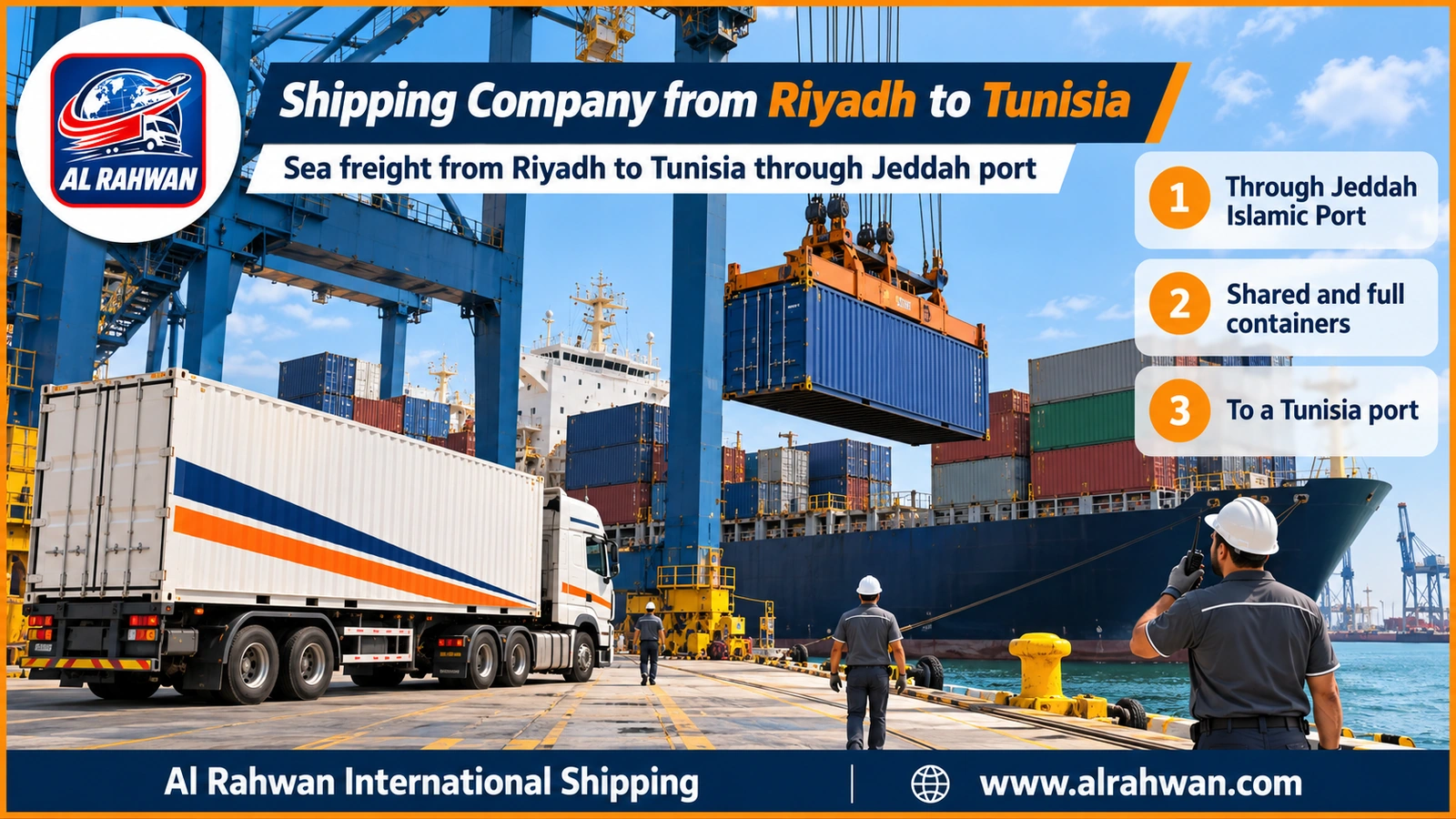
No confirmed sea line sails from Riyadh itself, since Riyadh is an inland city with no coastline, while Jeddah Islamic Port on the Red Sea is the only approved Saudi port of departure for Alrahwan’s shipments to Tunisia. A Riyadh shipment is therefore honestly moved first by an inland transfer to Jeddah, before its actual sea voyage toward Tunisia begins, a fact Alrahwan states plainly to every Riyadh customer from the first booking call.
Riyadh Is an Inland City: an Honest Inland Transfer to Jeddah Port
Riyadh sits in the centre of the Kingdom, far from every coastline, so a Riyadh shipment needs a genuine inland-transfer stage in which the truck crosses a clear distance from the centre of the Kingdom to its western coast where Jeddah port sits, a real distance that adds noticeable time to the shipment’s full timeline before its sea voyage even begins. This stage is organised by booking a dedicated inland truck or consolidating it with other Riyadh shipments heading to Jeddah at the same time.
Alrahwan prefers explaining this difference to the Riyadh customer with complete honesty rather than downplaying the inland-transfer stage, since it is objectively longer here than an inland transfer from a city closer to the Red Sea coast. A Riyadh customer is advised to finish preparing their shipment with enough lead time before the next sea sailing, so it does not miss it because of how long the inland transfer from central Saudi Arabia to Jeddah takes.
Why is there no named direct sea line to Tunisia?
A Riyadh shipment starting from Jeddah does not mean there is a named direct weekly sea line to Tunisia, a fact Alrahwan confirms after checking several major global carriers’ schedules without finding any such line by name. The real route begins with the container crossing the Red Sea then the Suez Canal into the Mediterranean, where it is typically offloaded at a major regional hub like the Malta Freeport, the documented feeder hub for North Africa, before being reloaded onto a smaller feeder line reaching the Tunisian port.
Alrahwan prefers presenting this fact as it is rather than promoting an imagined weekly line or a fixed schedule never actually documented, because a customer planning their shipment’s arrival in Tunisia needs accurate information, not a vague promise. This fact is stated as a general pattern of the sea route, never as a named weekly line with a fixed, pre-known schedule for every sailing.
Radès port and Tunisia’s alternative ports
On the Tunisian side, the shipment is usually received at Radès port, the main commercial container port in Tunisia, located near the capital Tunis. Sousse, Sfax and Bizerte are offered as alternative Tunisian ports depending on how close the final Tunisian city sits to each of them, and the feeder services reaching each of these ports differ by carrier and by the Mediterranean relay hub used on that specific sailing.
Why isn’t a fixed day count given for the sea voyage?
The Riyadh-Tunisia route carries no published, fixed transit schedule under one named line, a fact Alrahwan states plainly to every customer planning their shipment’s arrival in Tunisia. What is known is the route’s pattern itself: a Suez Canal transit, then a relay at a Mediterranean hub, then a final feeder leg to the Tunisian port; the actual duration is only set at booking, according to the carrier’s schedule and the relay hub used on that specific sailing.
Tunisian delivery cities
From Radès port or one of Tunisia’s alternative ports, the shipment is moved inland to its final Tunisian city: Tunis and its suburbs, Sousse, Sfax, Bizerte, Monastir, Ariana, or Kairouan. This inland Tunisian transfer time is counted separately from the sea voyage itself, and varies according to how close the city is to the receiving port.
Household Furniture Shipping from Riyadh to Tunisia
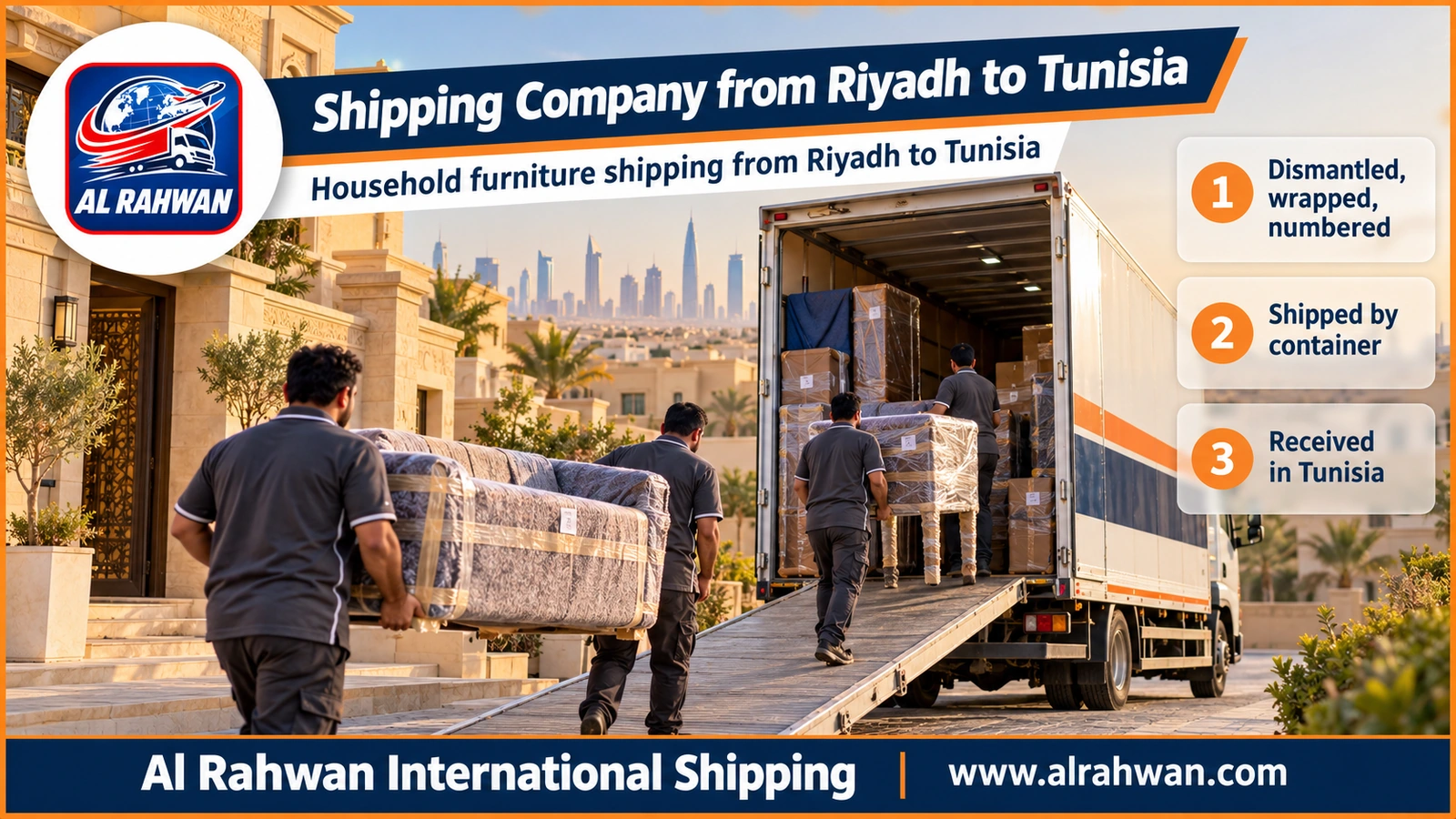
The furniture service opens with a careful home survey, in person or through photos the customer sends, followed by a room-by-room inventory: the living room’s seat count, the bedrooms’ beds and wardrobes, and the kitchen’s appliances, to avoid any shortfall discovered after the shipment reaches Tunisia. This same inventory is relied on during Tunisian customs clearance to match items the moment they land. Each material gets its own packing method: glass and mirrors sit upright in boxes sized to fit, polished wood has its edges shielded, and sofas are covered in cloth, then a blanket, then a loose, unsecured layer of plastic so no moisture gets trapped during the sea crossing.
Documents required for shipping personal furniture to Tunisia
The core file for a personal furniture shipment to Tunisia consists of the passport first, then a detailed packing list recording every item’s description and count, followed by the bill of lading, an invoice or a declared value estimate for the contents, and the final delivery address in the destination Tunisian city. Anyone holding original purchase invoices for valuable appliances should add them to the file, since they make matching the declared value easier during customs inspection at Radès port.
How does Tunisian customs treat fees on used furniture?
Furniture and personal belongings shipments in Tunisia undergo inspection and fees set by Tunisian customs according to the content type and its declared value, and these fees are not set at one fixed, publicly announced rate for every case, since Tunisian customs rules change from time to time. Alrahwan therefore always advises customers to check with a licensed Tunisian customs broker or Tunisian customs authority before shipping, so every customer learns exactly what applies to their own case rather than relying on a general figure that may not apply to them.
Split air conditioners, chandeliers and large screens in Saudi homes
Disconnecting a split air conditioner technically starts with gathering its gas into the outdoor unit, and the price for this job is decided after inspection based on the number of units involved. Chandeliers are treated by separating their crystals and arms individually and wrapping each piece on its own, while large television screens remain in their original boxes if those exist, or go into boxes lined with foam on all four sides otherwise. High-value pieces are photographed and set apart on a list with their declared value, because the insurance requested is calculated on that value, not on any later estimate.
Professional Packing and Crating for Shipments from Riyadh to Tunisia
The long voyage across the Red Sea and the Suez Canal to the Mediterranean relay hub makes professional packing the most important step before loading. Wooden furniture is first wrapped in a layer of reinforced cardboard around its sharp corners, then wrapped in a cloth blanket to protect the surface from scratches, and finally given a loose, unsecured layer of plastic that allows light ventilation without trapping moisture during the days of the sea voyage. Large appliances such as refrigerators and washing machines are emptied of any remaining liquids before shipping, and their doors are secured with special tape that leaves no mark on the exterior surface when removed in Tunisia.
Glass items, mirrors and screens need dedicated boxes sized close to their actual dimensions, not generic boxes far larger than they are, because the extra empty space inside a box is what most exposes glass to breaking during the container’s movement at sea. Layers of foam or sponge are placed between each glass piece when packing more than one in a single box, with a clearly written “fragile” mark on all four sides of the box.
Numbering and a loading map for every shipment to Tunisia
Every box or piece of furniture gets one serial number that appears both on the box itself and in the attached inventory list, and this number is used when unloading in Tunisia to match every piece with its original description without needing to open every box to confirm its content. Alrahwan prepares a loading map inside the container itself, placing heavy, solid pieces at the base and light, fragile pieces on top, to avoid any pressure that could harm the more sensitive content during the voyage.
Alrahwan also makes sure to photograph every piece before and after packing, providing a clear reference in case any dispute arises over the shipment’s condition upon receipt in Tunisia. This simple step saves the customer significant effort in any later review, since it proves the piece’s real condition at the moment it left Saudi Arabia, before any later transfer or loading stage.
Personal Car Shipping from Riyadh to Tunisia
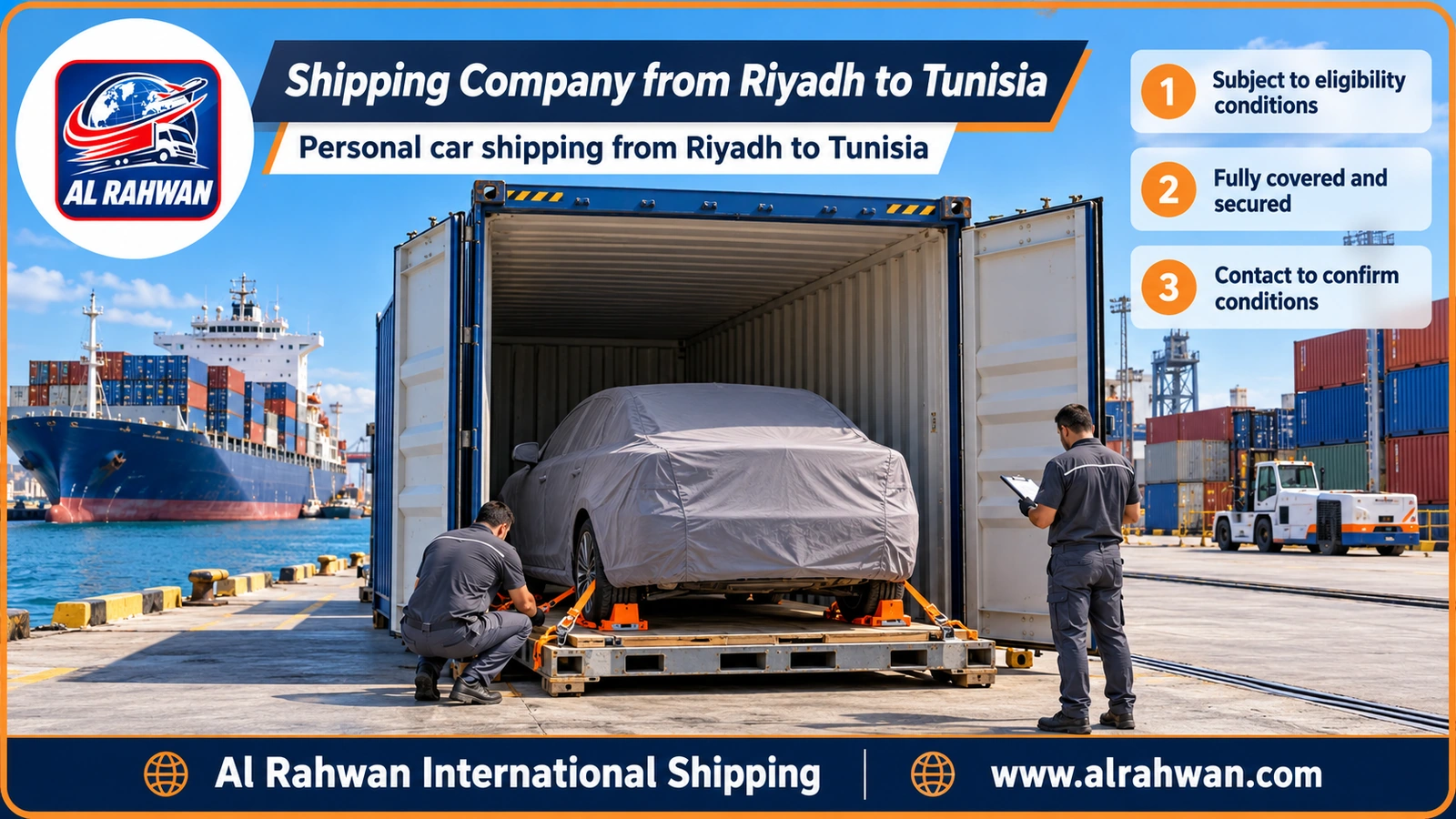
Anyone shipping a personal car from Riyadh to Tunisia will not find an open service available to every shipper the way other cargo types are, since importing a used car into Tunisia is tied mainly to a special customs programme known as FCR (“Franchise de Changement de Résidence”), aimed at Tunisians who are permanently returning from living abroad, not a general service any shipper can use regardless of nationality or status.
The FCR programme lets a permanently returning Tunisian resident abroad benefit from special customs facilities on their personal used car, but the eligibility details and the accepted car age genuinely vary according to the regulations in force at a given time, so no firm age figure is stated here as applying to every case, since these details are updated repeatedly on the Tunisian side.
Car age and eligibility conditions: no firm figure
Tunisian customs sets conditions under the FCR programme for car age and the applicant’s status, but the details genuinely vary according to the importer’s status and classification, so no fixed figure is stated here as a firm fact applicable to every case. Anyone considering shipping a car from Riyadh to Tunisia is advised to check their personal status and their car’s technical condition with Alrahwan before any booking, rather than relying on a general number heard from an acquaintance or read on an unofficial source.
Why does this honesty matter before booking a car shipment?
Alrahwan prefers stating the eligibility condition as it actually is rather than promising to ship any car that reaches its warehouse, because a car that does not meet the FCR programme’s conditions can be rejected by Tunisian customs after it has already arrived at Radès port, costing the shipper far more time and money than checking in advance. Every customer considering shipping a car is therefore asked to call 0568829975 to review their status and their car’s condition carefully before booking any shipping date.
The Tunisian community in the Kingdom is spread across many sectors and has often lived there for many years, and these are usually the people who first reach out to Alrahwan to learn the FCR programme’s conditions before any final return decision or car shipment. Alrahwan advises this group to review their personal file in advance, since knowing the conditions before arranging a return date saves significant time and effort compared with trying to resolve a customs issue after the car has already arrived at Radès port.
Alrahwan also handles shipping requests from non-Tunisians who hold business or property partnerships in Tunisia, or who send gifts and supplies to Tunisian relatives living there, and these cases are not subject to the FCR programme’s conditions since they do not involve importing a personal car, but are instead subject only to the general customs rules on furniture and goods described in this article.
Differences in handling a personal shipment versus one for a third party
Anyone shipping on behalf of someone else in Tunisia, such as a son sending furniture to his father living in Sousse or a friend sending supplies to a friend in Sfax, needs to clearly state this relationship in the bill of lading and recipient details, since the final recipient’s name must exactly match the name registered at the Tunisian delivery address. Alrahwan advises coordinating in advance with the recipient in Tunisia about their availability and receipt date in these cases, to avoid any delay in final delivery once the shipment reaches the Tunisian port and moves inland to its city.
Cartons and Luggage from Riyadh to Tunisia
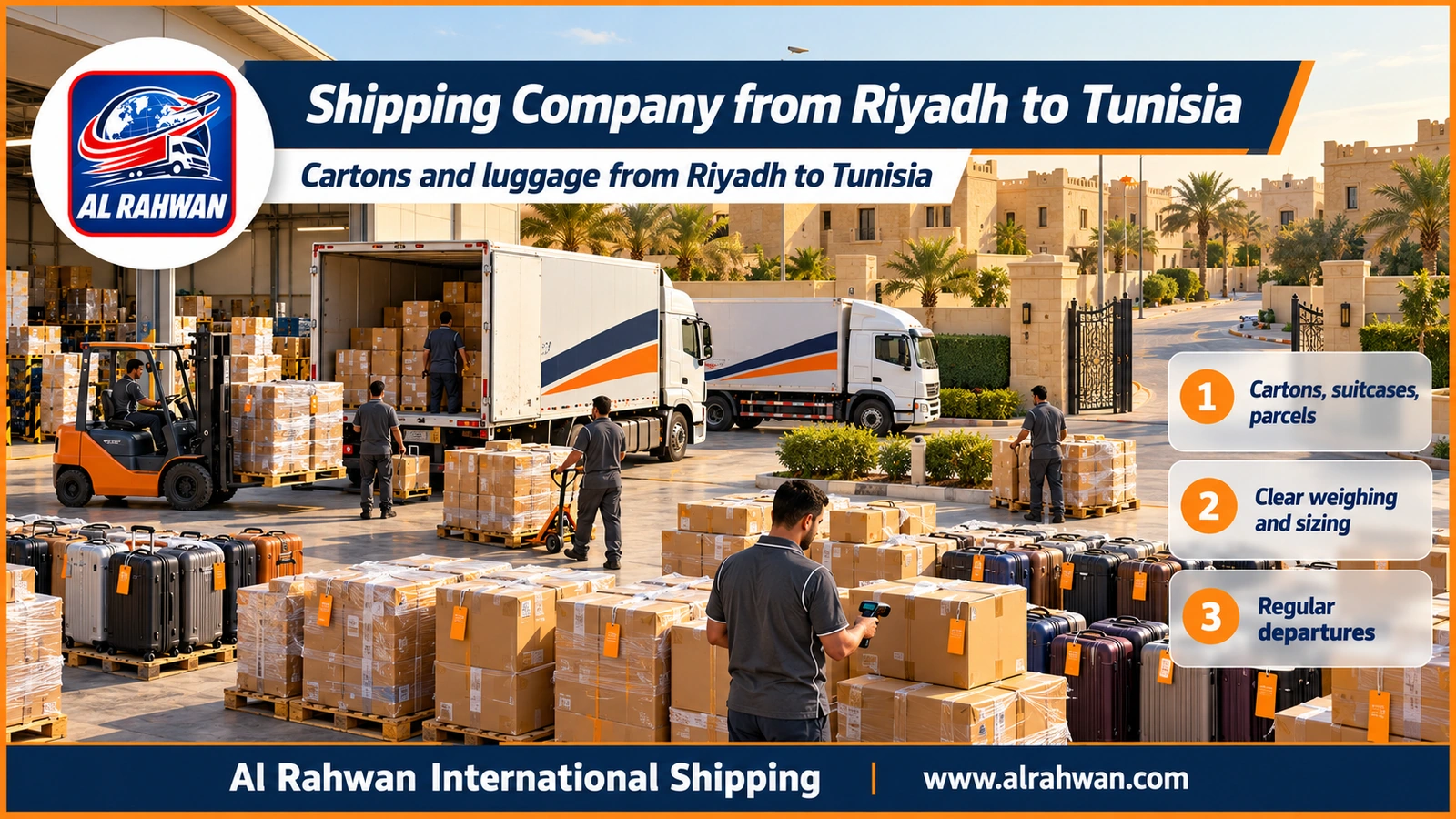
Every carton in a shipment list carries a number, weight, dimensions, and a short content description, and suitcase handles and wheels are protected with foam tape before loading onto the truck heading to Jeddah port. The outer label on each parcel carries the recipient’s name and phone number in Tunisia, never their personal ID number.
Saudi online stores and their customers in Tunisia
Online stores in the Kingdom selling to customers in Tunisia need a fixed, regular pickup schedule from their warehouse rather than a separate booking for every order, along with a clear commercial invoice for each batch and a list of order numbers linked to each carton number. Occasion gifts sent to Tunisia need an accurate content description, especially when they include perfumes or separate batteries, since acceptance differs between sea and air shipping.
Consolidating purchases from more than one store before one shipment to Tunisia
Anyone buying from more than one store in the Kingdom opens a single address at Alrahwan’s warehouse where all purchases arrive over several days; every package is opened to confirm its content matches the invoice, and everything is logged into one consolidated list instead of separate lists per store. Cartons are renumbered according to loading order before departing toward Jeddah port, so the recipient in Tunisia ends up opening one organised shipment instead of receiving scattered parcels on different schedules.
Commercial Container Cargo from Riyadh to Tunisia

A Saudi trader has two options for commercial cargo heading to Tunisia: a partial load sharing container space with other customers’ goods, or a full dedicated container in either 20 or 40 foot size. Because no published competitor rate exists at all for this corridor, every item is given a detailed, itemised quote based on the cargo type, its real size, and its final Tunisian destination, via 0568829975 or the quote request page.
Factories in the Kingdom’s industrial cities sometimes send heavy equipment that needs its real weight, packaging dimensions, and correct lifting points stated, along with a note of any oils or batteries inside it, and an advance photo of the unloading site at Radès port. Recurring commercial shipments need a fixed data template that is updated with each batch’s details rather than being rewritten from scratch every time.
The difference between commercial cargo and a returning owner’s personal belongings
Commercial cargo is treated very differently from a customs point of view than someone’s own personal belongings, so the document conditions described in the furniture and car sections above do not apply to a shipment intended for sale. Commercial cargo needs a formal commercial invoice and a detailed packing list instead of a personal belongings inventory, and this distinction should be made clear to the customer from the first booking call to avoid any confusion between the two kinds of treatment upon arrival at the Tunisian port.
Air Freight from Riyadh to Tunisia
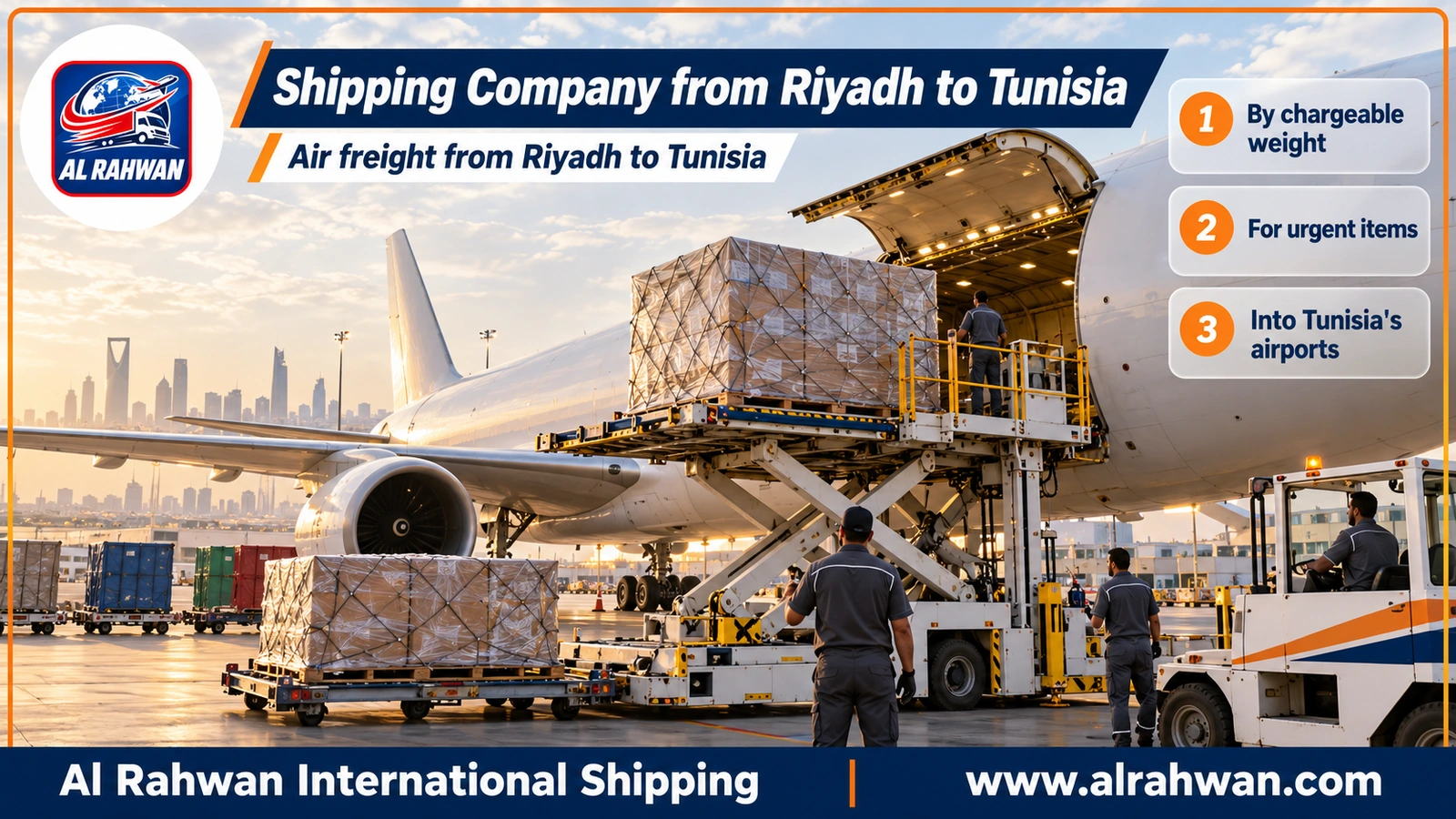
Air freight from Riyadh to Tunisia suits forgotten documents and paperwork, computers, and small urgent items that cannot wait for the long sea voyage through the Suez Canal and the Mediterranean relay hub. International air shipments usually arrive within a few days of being handed to the carrier, a general industry estimate for standard international air freight, not a guaranteed figure for every flight.
Air freight is billed on whichever is higher of two figures: the actual scale weight, or the volumetric weight derived from the parcel’s dimensions, and a large, light carton’s volumetric weight can far exceed its real weight. For this reason air freight is not recommended for furniture or large numbers of cartons, remaining instead an option that supplements sea freight without replacing it, chosen only when arrival timing outranks any concern about size or cost.
Comparing sea and air freight to Tunisia
| Mode | Duration | Best suited for |
|---|---|---|
| Sea via Jeddah, the Suez Canal and a Mediterranean relay hub | actual duration set at booking by the carrier’s schedule | furniture, eligible cars, cartons and commercial cargo |
| Air freight | usually a few days from handover to the carrier | documents and small, urgent items |
Prohibited and Restricted Items on the Riyadh-Tunisia Route
Before worrying about packing details or shipment size, a customer first needs to know what Tunisia refuses outright: weapons of every kind, ammunition, explosives and drugs, items with no room for debate at any Tunisian port. Below that level of total prohibition sits a lighter tier of scrutiny covering items such as wireless radios, specialised communication equipment, and alcohol or tobacco quantities that go beyond what counts as reasonable personal use — these are not automatically banned, but they do draw extra inspection on arrival. Alrahwan’s standing advice to every customer is that this restricted-items list gets revised by Tunisian customs from time to time, so asking Alrahwan directly about any unusual item before it is loaded beats relying on something a customer heard from someone who shipped years ago.
Anyone shipping a large commercial quantity of one item, such as electrical equipment or cosmetics, needs to check in advance with Alrahwan about any extra documents Tunisian customs may require for that kind of goods, since commercial treatment here differs from treating a single piece as part of personal belongings.
Tunisian Customs on Furniture and Personal Belongings
Tunisian customs reviews every incoming shipment according to its type and the owner’s status, and the fees applied genuinely vary from one case to another depending on content type and declared value, since Tunisian customs rules change from one period to the next. The core document list required stays the same in most cases: passport, detailed packing list, bill of lading, an invoice or declared value estimate, and the delivery address in the Tunisian city.
Because the sources on Tunisian customs duties vary by each shipment’s case and carry no single fixed rate for every case, Alrahwan always advises checking with a licensed Tunisian customs broker or Tunisian customs authority to learn the actual rate that applies to your case before shipping, rather than relying on a general figure that may not apply to your specific shipment.
Document completeness remains the single biggest factor in how fast customs clearance moves in Tunisia, often more so than the shipment type itself. An accurate packing list with a clear description of every item, and a bill of lading that matches the recipient’s name and address exactly, reduce the chances of a shipment being held at the port for extra review. Anyone who prepares these documents before their shipment arrives, not after, saves themselves valuable time at this stage.
Consolidating Shipments from Different Saudi Cities to Jeddah Port
Alrahwan’s shipments to Tunisia arrive from many Saudi cities, each with its own distance from Jeddah Islamic Port: Jeddah itself is the port of departure and needs no prior inland transfer, Riyadh and central cities need a moderately long inland transfer, while far eastern and northern cities need a relatively longer inland-transfer stage before their shipment reaches the port. Alrahwan assigns each address its own pickup time, then consolidates these shipments at one point before loading them onto the inland trucks heading to Jeddah, instead of sending each part separately and repeating the inland-transfer cost on it.
Alrahwan explains to every customer, regardless of their city, that their shipment’s preparation time and the inland-transfer handover date differ according to how far their city sits from Jeddah, so they can plan their shipment’s preparation date accounting for how long this stage takes before the actual sea voyage toward Tunisia begins.
The Saudi Side: Export Procedures through Fasah
A licensed customs broker completes the export procedures in full on the Fasah platform of the Zakat, Tax and Customs Authority before the shipment leaves Jeddah Islamic Port, with Alrahwan staying in touch with the customer throughout until it’s done. Usefully, this is often finished even before the shipment reaches Jeddah, since the export paperwork is prepared while it is still on its way from the departure city, so the sea container’s loading never has to wait for documents to be finalised after arrival.
Insurance, Tracking and Storage for Shipments from Riyadh to Tunisia
Anyone booking a shipment who wants insurance requests it directly at booking, and it is priced from the declared value in the photographed inventory itself, never a later estimate made after damage occurs. Tracking messages then follow at clear points: loading from the departure city, arrival at Jeddah port, the vessel leaving the Saudi coast, transiting the Suez Canal, the relay at the Mediterranean hub, and arrival at Radès or an alternative Tunisian port. Storage at Alrahwan’s warehouse also stays available for anyone who finishes preparing their shipment before the next sailing, priced after inspecting the size and the number of storage days needed.
How is a damage complaint handled after delivery in Tunisia?
If damage appears in an item when opened after delivery in Tunisia, the package number from the original list and a clear photo of the item are requested before any repair attempt, and tracking messages are reviewed to see which stage the shipment passed through since loading. If insurance was requested at booking, compensation is calculated on the value declared in the inventory list itself, not a new estimate set after the damage occurred.
Booking Steps for Shipping from Riyadh to Tunisia
- Call or WhatsApp 0568829975, stating your city, the shipment type, and the destination Tunisian city.
- Send photos of the items and the largest pieces’ dimensions, or request a free survey.
- Alrahwan reviews the FCR programme’s conditions with you if the shipment is a car, before any booking is confirmed.
- Receive a detailed, itemised quote, never a figure written before a survey.
- Get the export documents ready in advance and authorise the customs broker to act on the Fasah platform on your behalf.
- On loading day everything is inventoried, wrapped and numbered before the shipment departs to Jeddah port.
- Track your shipment with messages on arrival at Jeddah, when the vessel crosses the Suez Canal, and on arrival at the Tunisian port.
A client gets their quote after sending a few specifics: the type of shipment, the approximate number of packages, the destination city in Tunisia, and the expected ready date. Clear photos and measurements are attached, and contact is made via 0568829975 or the shipping quote request page.
Choosing a Reliable Shipping Company from Riyadh to Tunisia
| Sign | A professional company | An unreliable carrier |
|---|---|---|
| Describing the sea route | honestly explains the Suez Canal transit and the relay hub, naming no invented line | promises a vague direct service or invents a fake carrier name |
| Car shipping | explains the FCR eligibility condition before any promise | promises to ship any car without asking about the owner’s status |
| Voyage duration | explains that duration is set at booking by the carrier’s schedule and relay hub | quotes a fixed, undocumented day count |
| Pricing | a detailed, itemised quote once the details are known | a vague total figure that changes at loading |
A company that promises to ship any shipper’s car to Tunisia without checking FCR eligibility conditions, or quotes a fixed, undocumented day count for the sea voyage, or invents the name of a direct line that does not exist, deserves an extra question before committing, regardless of its size or how long it has operated.
Tips Before Shipping from Riyadh to Tunisia
- Book with enough lead time, especially if your shipment is a car that needs its FCR eligibility conditions checked in advance.
- Photograph every room in your home before disassembly, and photograph valuable appliances along with their serial numbers.
- Keep a first-days bag separate from the rest of the shipment: clothes, medication and important papers stay with you personally.
- Check the FCR programme’s conditions with Alrahwan before any other arrangement for your car, not after preparing it for loading.
- Agree with the recipient in Tunisia on their number, address and availability before the shipment departs, not after.
- Do not expect a fixed day count for the sea voyage; ask about the carrier’s schedule and relay hub directly at booking.
Common Mistakes When Shipping from Riyadh to Tunisia
- Expecting a fixed day count for the sea voyage: the duration is genuinely set by the carrier’s schedule and the Mediterranean relay hub at booking.
- Assuming car shipping is an open service for every shipper: the reality is it is tied to the Tunisian FCR programme’s eligibility conditions.
- Relying on a fixed accepted car-age figure: sources conflict and the details genuinely vary by the regulations in force.
- Imagining a named weekly direct line exists: the reality is the shipment is relayed at a Mediterranean hub before a final feeder leg to Tunisia.
- Writing an inventory list with a vague description: “household furniture” alone is not enough for Tunisian customs.
- Relying on a fixed customs rate heard from acquaintances: fees genuinely vary by each shipment’s case and documents.
Why Alrahwan for Shipping from Riyadh to Tunisia?
- Alrahwan honestly describes the Suez Canal transit and the Mediterranean relay, never inventing the name of a line that does not exist.
- It explains the car-shipping eligibility condition tied to the FCR programme with full honesty, not as an imagined open service.
- It checks every car’s condition and its owner’s file carefully before any promise to ship it.
- It coordinates the inland transfer date with the customer’s shipment-readiness date to avoid later complications.
- A detailed, itemised quote for every service, never a vague general figure.
- Tracking messages from the moment of loading through delivery in Tunisia.
- Alrahwan ships from every Saudi city to every country in the world, on the same number for any other destination.
The complete Saudi Arabia to Tunisia route is covered in Shipping Company from Saudi Arabia to Tunisia, and Jeddah clients can check Shipping Company from Jeddah to Tunisia. For a direct quote request, start from Request a Shipping Quote.
Related Articles and Pages
- Sea Shipping to Tunisia
- Shipping Company from Saudi Arabia to Tunisia
- Shipping Company from Jeddah to Tunisia
- Request a Shipping Quote
Frequently Asked Questions
How much does shipping from Riyadh to Tunisia cost?
No specialised Arabic competitor publishes rates for this corridor, so a detailed, itemised quote is given for every case based on shipment type, weight and size, via 0568829975 or the quote request page.
Is there a named direct shipping line from Jeddah to Tunisia?
No, there is no confirmed named weekly direct line between Jeddah and Tunisia; the shipment transits the Suez Canal and is usually relayed at a major Mediterranean hub such as the Malta Freeport onto a feeder service reaching the Tunisian port.
How long does the sea voyage to Tunisia take?
No fixed day count is quoted for this route since it is not documented on one named carrier’s schedule; the actual duration is set at booking according to the carrier’s schedule and the relay hub used on that specific sailing.
Which Tunisian port receives the shipment?
Radès is the main commercial container port receiving shipments near Tunis, with Sousse, Sfax and Bizerte named as alternative Tunisian ports.
Can any shipper ship their personal car to Tunisia?
No, shipping a used personal car to Tunisia is tied to the FCR programme for Tunisians permanently returning from living abroad, not an open service for every shipper; checking your personal status and your car’s condition before booking is advised.
What is the FCR programme for car shipping to Tunisia?
FCR stands for “Franchise de Changement de Résidence”, a customs facility for Tunisians who lived abroad and are permanently returning, with its conditions and accepted car age varying according to the regulations in force at the time.
Is there a fixed customs duty rate on furniture and belongings in Tunisia?
No single published rate applies to every case; shipments undergo inspection and fees set by Tunisian customs according to content type and declared value, and checking with a licensed Tunisian customs broker or Tunisian customs authority before shipping is advised.
What documents are required to ship personal furniture to Tunisia?
A passport, a detailed packing list for every item, the bill of lading, an invoice or declared value estimate, and the final delivery address in the Tunisian city.
Does air freight suit every kind of shipment to Tunisia?
No, air freight suits documents and small urgent items, while furniture, large volumes of cartons and eligible cars remain naturally suited to sea freight through Jeddah.
Which Tunisian cities does Alrahwan deliver to?
Tunis and its suburbs, Sousse, Sfax, Bizerte, Monastir, Ariana, and the rest of the Tunisian cities once the shipment clears at Radès port or the nearest alternative port.
What is the difference between shipping from Jeddah and from another Saudi city to Tunisia?
A Jeddah shipment starts directly at the port of origin with no prior inland transfer, while a shipment from another Saudi city such as Riyadh first needs an inland transfer to Jeddah Islamic Port before the actual sea voyage begins.
How do I request shipping to Tunisia?
Call or WhatsApp 0568829975, stating your city, the shipment type and its size, to get a detailed quote and review eligibility conditions if the shipment is a car.