 United Arab Emirates
 Qatar
 Kuwait
 Bahrain
 Oman
 Iraq
 Turkey
 Lebanon
 Syria
 Jordan
 Egypt
 Morocco
 Tunisia
 Algeria
 Libya
 Sudan

Alrahwan – Shipping Company from Jeddah to Libya – moves goods, furniture, cartons and commercial cargo, and reviews personal cars for shipping only once feasibility is confirmed, from Jeddah to Jeddah Islamic Port, where the shipment sails toward Libya via the Suez Canal, usually relayed at a major Mediterranean hub before a feeder service carries it to Tripoli port or an alternative Libyan port. Call 0568829975 to check the next sailing and get a detailed, itemised quote.
🧭 In this guide49 sectionsShowHide
Jeddah’s closeness to the port makes it a repeated launch point for varied shipments to Libya: an engineer who finished his contract with a Jeddah factory returning his personal equipment to Benghazi, an electronics shop owner sending a batch of goods to a client in Tripoli, a furniture factory sending an order to a partner in Misrata, and a Libyan family living in Jeddah consolidating its purchases into organised cartons before its final return. Whatever the case, Alrahwan first asks about the shipment’s real type and size and the Libyan destination city, making clear that its service from Jeddah reaches every country in the world by land, sea and air, not Libya alone.
- Main route: a sea departure from Jeddah Islamic Port on the Red Sea, transiting the Suez Canal, toward Libya.
- Relay: no named weekly direct line exists; the shipment is usually relayed at a known major Mediterranean hub such as the Malta Freeport onto a feeder service reaching Libya.
- Libyan port: Tripoli is the traditional main port, Misrata a growing modern container hub, Benghazi the main eastern port, and Khoms (Al Khums) a further named alternative.
- Duration: set at booking by the carrier’s schedule and the relay hub used, not a fixed number of days.
- Car shipping: subject to longstanding legal restrictions on importing used personal vehicles, needing feasibility confirmation before any booking.
- Pricing: no published competitor rate exists for this corridor, so every item is quoted in detail on request via 0568829975 or the quote request page.
Sea Freight from Jeddah to Libya through Jeddah Islamic Port

Jeddah Islamic Port is the only approved Saudi port of departure for Alrahwan’s shipments to Libya, and shipments from Jeddah reach it by an inland transfer whose length differs according to how close or far the city sits from the western coast, before the container begins its actual sea voyage. Alrahwan states this arrangement with complete honesty to every customer from the first booking call.
A Jeddah customer holds a genuine advantage no other Saudi city’s customer has: Jeddah is itself the port of departure, so the shipment needs no prior inland-transfer stage at all before reaching the quay at Jeddah Islamic Port. While a Riyadh or Dammam customer needs an inland truck covering a relatively long distance before reaching the western coast, a Jeddah customer hands the shipment straight from their address to Alrahwan’s warehouse near the port, and export clearance and loading begin without waiting for any earlier road-transfer stage. This honest distinction saves a Jeddah customer real time and cost, not a marketing promise, because the actual distance between their address and the port of departure is the shortest among every Saudi city on this route.
Why is there no named direct sea line to Libya?
A common question from Jeddah customers: is there a named weekly line to Libya? The honest answer, after checking several major global carriers’ schedules, is that no direct feeder line of that kind exists. Instead the container crosses the Red Sea then the Suez Canal into the Mediterranean, usually offloaded at a major regional hub such as the Malta Freeport, a documented feeder hub for North Africa, before being reloaded onto a smaller line finishing the trip at the Libyan port.
Alrahwan prefers presenting this fact as it is rather than promoting an imagined weekly line or a fixed schedule never actually documented, because a customer planning their shipment’s arrival in Libya needs accurate information, not a vague promise. This fact is stated as a general pattern of the sea route, never as a named weekly line with a fixed, pre-known schedule for every sailing.
Tripoli, Misrata, Benghazi and Khoms: Libya’s four ports
On the Libyan side, the shipment is usually received at Tripoli port, Libya’s traditional main port, located near the capital Tripoli. Misrata port has in recent years grown into an important modern container hub following a genuine, well-documented agreement between MSC and Al Maha to develop a container terminal there; this agreement is mentioned here as a general infrastructure fact about the port’s development, not as a fixed sailing schedule or a named weekly service. Benghazi is Libya’s main eastern port and serves the eastern cities directly, while Khoms (Al Khums) is a further named alternative Libyan port depending on how close the final Libyan city sits to it.
Khoms and Benghazi: when is each one used?
Choosing the receiving Libyan port is not an arbitrary decision, but depends on the final Libyan city and on the feeder service actually available for that specific sailing. A shipment heading to Tripoli and its suburbs, Zawiya or Sabratha naturally finds its way through Tripoli port itself, one heading to Misrata and central Libyan cities benefits from its growing modern container terminal, while a shipment heading to Benghazi, Derna or other eastern Libyan cities arrives more directly and shorter through Benghazi port itself, instead of first passing through Tripoli and then transferring inland a long distance eastward. Khoms remains an additional option for anyone whose final destination sits close to its coastal location, and Alrahwan determines the most suitable port for each shipment once its exact Libyan destination is known.
Why isn’t a fixed day count given for the sea voyage?
The Jeddah-Libya route carries no published, fixed transit schedule under one named line, a fact Alrahwan states plainly to every customer planning their shipment’s arrival in Libya. What is known is the route’s pattern itself: a Suez Canal transit, then a relay at a Mediterranean hub, then a final feeder leg to the Libyan port; the actual duration is only set at booking, according to the carrier’s schedule and the relay hub used on that specific sailing.
Libyan delivery cities
From Tripoli port or one of Libya’s alternative ports, the shipment is moved inland to its final Libyan city: Tripoli and its suburbs, Benghazi, Misrata, Zawiya, Sabratha, or Derna. This inland Libyan transfer time is counted separately from the sea voyage itself, and varies according to how close the city is to the receiving port and which port actually received the shipment.
Household Furniture Shipping from Jeddah to Libya
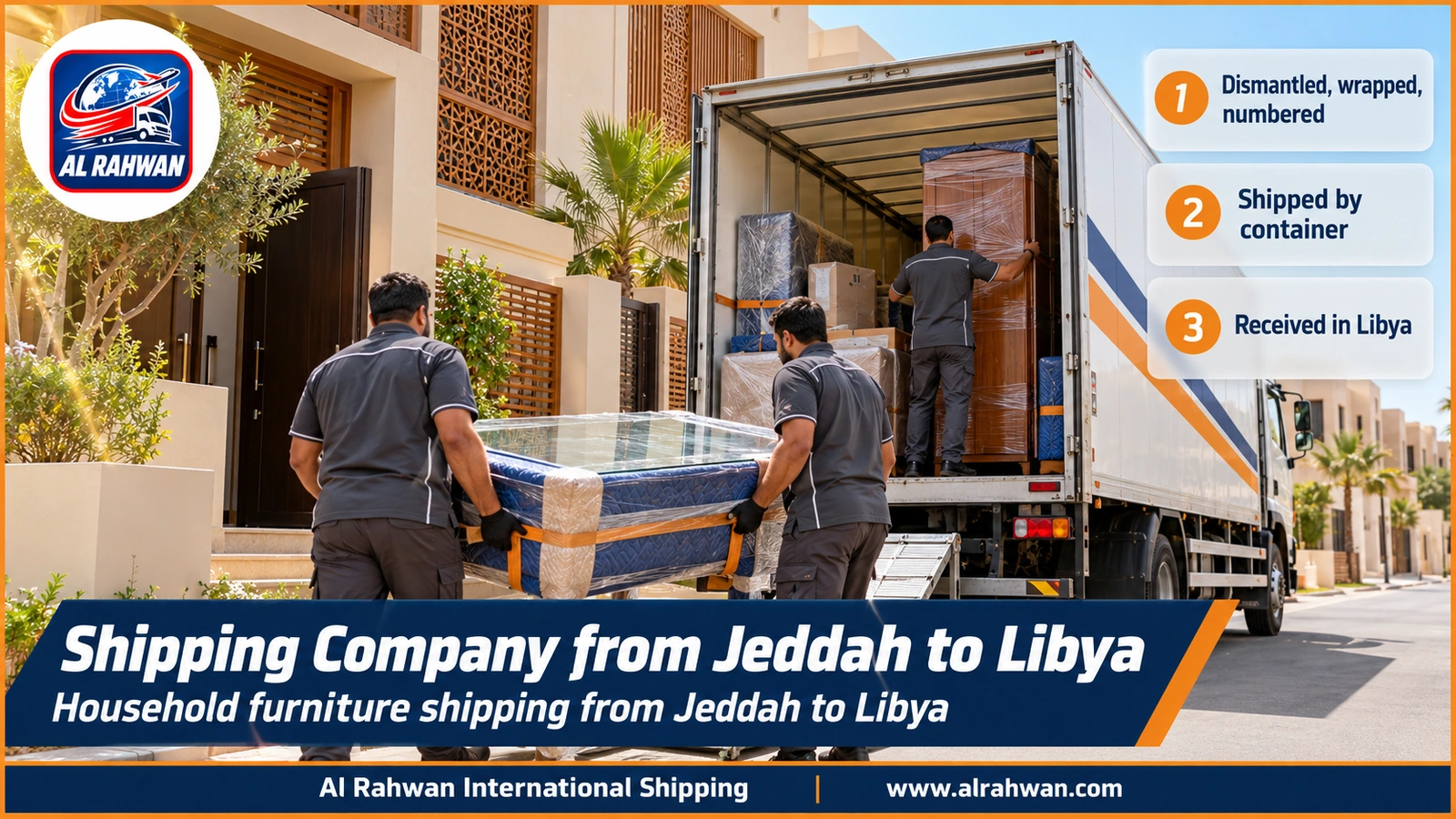
The furniture service opens with a careful home survey, in person or through photos the customer sends, followed by a room-by-room inventory: the living room’s seat count, the bedrooms’ beds and wardrobes, and the kitchen’s appliances, to avoid any shortfall discovered after the shipment reaches Libya. This same inventory is relied on during Libyan customs clearance to match items the moment they land. Each material gets its own packing method: glass and mirrors sit upright in boxes sized to fit, polished wood has its edges shielded, and sofas are covered in cloth, then a blanket, then a loose, unsecured layer of plastic so no moisture gets trapped during the sea crossing.
Documents required for shipping personal furniture to Libya
The core file for a personal furniture shipment to Libya consists of the passport first, then a detailed packing list recording every item’s description and count, followed by the bill of lading, an invoice or a declared value estimate for the contents, and the final delivery address in the destination Libyan city. Anyone holding original purchase invoices for valuable appliances should add them to the file, since they make matching the declared value easier during customs inspection at Tripoli port or the alternative Libyan port.
How does Libyan customs treat fees on used furniture?
Furniture and personal belongings shipments in Libya undergo inspection and fees set by Libyan customs according to the content type and its declared value, and these fees are not set at one fixed, publicly announced rate for every case, since Libyan customs rules change from time to time. Alrahwan therefore always advises customers to check with a licensed Libyan customs broker or Libyan customs authorities before shipping, so every customer learns exactly what applies to their own case rather than relying on a general figure that may not apply to them.
Split air conditioners, chandeliers and large screens in Jeddah homes
Disconnecting a split air conditioner technically starts with gathering its gas into the outdoor unit, and the price for this job is decided after inspection based on the number of units involved. Chandeliers are treated by separating their crystals and arms individually and wrapping each piece on its own, while large television screens remain in their original boxes if those exist, or go into boxes lined with foam on all four sides otherwise. High-value pieces are photographed and set apart on a list with their declared value, because the insurance requested is calculated on that value, not on any later estimate.
Professional Packing and Crating for Shipments from Jeddah to Libya
The long voyage across the Red Sea and the Suez Canal to the Mediterranean relay hub makes professional packing the most important step before loading. Wooden furniture is first wrapped in a layer of reinforced cardboard around its sharp corners, then wrapped in a cloth blanket to protect the surface from scratches, and finally given a loose, unsecured layer of plastic that allows light ventilation without trapping moisture during the days of the sea voyage. Large appliances such as refrigerators and washing machines are emptied of any remaining liquids before shipping, and their doors are secured with special tape that leaves no mark on the exterior surface when removed in Libya.
Glass items, mirrors and screens need dedicated boxes sized close to their actual dimensions, not generic boxes far larger than they are, because the extra empty space inside a box is what most exposes glass to breaking during the container’s movement at sea. Layers of foam or sponge are placed between each glass piece when packing more than one in a single box, with a clearly written “fragile” mark on all four sides of the box.
Numbering and a loading map for every shipment to Libya
Every box or piece of furniture gets one serial number that appears both on the box itself and in the attached inventory list, and this number is used when unloading in Libya to match every piece with its original description without needing to open every box to confirm its content. Alrahwan prepares a loading map inside the container itself, placing heavy, solid pieces at the base and light, fragile pieces on top, to avoid any pressure that could harm the more sensitive content during the voyage.
Alrahwan also makes sure to photograph every piece before and after packing, providing a clear reference in case any dispute arises over the shipment’s condition upon receipt in Libya. This simple step saves the customer significant effort in any later review, since it proves the piece’s real condition at the moment it left Saudi Arabia, before any later transfer or loading stage.
Personal Car Shipping from Jeddah to Libya

Jeddah’s closeness to the port speeds up the paperwork for furniture and cartons, but that closeness changes nothing in the personal-car file bound for Libya, because the restriction here is legal in nature, not logistical: an old Libyan ministerial decision still stands as the reference legal basis, with no exception for citizens returning from abroad, and only narrow exceptions for goods-transport vehicles or certain free-zone or transit cases. Alrahwan is fully upfront about this with a Jeddah customer, and does not promise to ship a car before verifying it can be accepted in their specific case.
The legal basis for Libya’s ban on importing used cars
The ban on importing used cars for personal use into Libya rests on an old Libyan ministerial decision that still forms the basic legal reference relied on in this matter today, regardless of any attempts or proposals to amend it from time to time. This means shipping a used personal car to Libya, unlike shipping furniture, cartons or commercial cargo, is not a simple regulatory matter tied to the car’s age or value, but is fundamentally prohibited except in narrow exceptional cases that do not include ordinary personal shipping.
The narrow exceptions and what they do not cover
The exceptions to this ban are very limited and are not tied to a Libyan citizen returning from living abroad, as is common in some neighbouring countries, but concern narrower cases such as commercial goods-transport vehicles or certain cases linked to free zones or specific transit situations. In practice this means an ordinary shipper wanting to move their personal family car from Jeddah to Libya for personal reasons or a permanent return does not find an open car-shipping service like the one available for other destinations, and needs to contact Alrahwan directly to find out whether their specific case falls under any narrow exception that actually exists.
Contact to confirm feasibility before any commitment
Instead of describing a routine booking process for car shipping as with other services, Alrahwan asks every customer considering shipping a personal car to Libya to contact directly on 0568829975 to review their actual case first: the car type, the purpose of shipping it, and the destination Libyan city, before any talk of a loading date or a quote. Without this prior review, a car could genuinely reach Tripoli port or an alternative Libyan port only to be refused entry because of this longstanding legal restriction, costing the shipper far more time and money than checking in advance. Alrahwan confirms that verifying actual shipping feasibility for each case always comes before any booking, and no promise to ship a car is made before this review is complete.
What about shipping a commercial goods-transport vehicle rather than a personal car?
Anyone needing to ship a commercial goods-transport vehicle rather than a personal car for individual use finds their case different from the narrow exceptions mentioned above, and needs a separate review with Alrahwan to learn the commercial documents required and the actual conditions tied specifically to this kind of vehicle, apart from the personal-car restrictions. The rule stays the same in every case: contact Alrahwan in advance to confirm actual shipping feasibility before any booking or commitment to a loading date, regardless of the vehicle type or its purpose.
Alrahwan also handles furniture, carton and commercial-cargo shipping requests from Libyans living in Jeddah or from non-Libyans who hold business or property partnerships in Libya, and these cases are not affected by the car-shipping restriction at all since they do not involve importing a personal car, but are instead subject only to the general customs rules on furniture and goods described in this article.
Cartons and Luggage from Jeddah to Libya

Every carton in a shipment list carries a number, weight, dimensions, and a short content description, and suitcase handles and wheels are protected with foam tape before loading onto the truck heading to Jeddah port. The outer label on each parcel carries the recipient’s name and phone number in Libya, never their personal ID number.
Online stores in Jeddah and their customers in Libya
Online stores selling to customers in Libya need a fixed, regular pickup schedule from their warehouse rather than a separate booking for every order, along with a clear commercial invoice for each batch and a list of order numbers linked to each carton number. Occasion gifts sent to Libya need an accurate content description, especially when they include perfumes or separate batteries, since acceptance differs between sea and air shipping.
Consolidating purchases from more than one store before one shipment to Libya
Anyone buying from more than one store opens a single address at Alrahwan’s warehouse where all purchases arrive over several days; every package is opened to confirm its content matches the invoice, and everything is logged into one consolidated list instead of separate lists per store. Cartons are renumbered according to loading order before departing toward Jeddah port, so the recipient in Libya ends up opening one organised shipment instead of receiving scattered parcels on different schedules.
Commercial Container Cargo from Jeddah to Libya

A trader has two options for commercial cargo heading to Libya: a partial load sharing container space with other customers’ goods, or a full dedicated container in either 20 or 40 foot size. Because no published competitor rate exists at all for this corridor, every item is given a detailed, itemised quote based on the cargo type, its real size, and its final Libyan destination, via 0568829975 or the quote request page.
Factories in the Kingdom’s industrial cities sometimes send heavy equipment that needs its real weight, packaging dimensions, and correct lifting points stated, along with a note of any oils or batteries inside it, and an advance photo of the unloading site at Tripoli port or the alternative Libyan port. Recurring commercial shipments need a fixed data template that is updated with each batch’s details rather than being rewritten from scratch every time.
The difference between commercial cargo and a person’s own belongings
Commercial cargo is treated very differently from a customs point of view than someone’s own personal belongings, so the document conditions described in the furniture section above do not apply to a shipment intended for sale. Commercial cargo needs a formal commercial invoice and a detailed packing list instead of a personal belongings inventory, and this distinction should be made clear to the customer from the first booking call to avoid any confusion between the two kinds of treatment upon arrival at the Libyan port.
Air Freight from Jeddah to Libya

Air freight from Jeddah to Libya suits forgotten documents and paperwork, computers, and small urgent items that cannot wait for the long sea voyage through the Suez Canal and the Mediterranean relay hub. International air shipments usually arrive within a few days of being handed to the carrier, a general industry estimate for standard international air freight, not a guaranteed figure for every flight.
Air freight is billed on whichever is higher of two figures: the actual scale weight, or the volumetric weight derived from the parcel’s dimensions, and a large, light carton’s volumetric weight can far exceed its real weight. For this reason air freight is not recommended for furniture or large numbers of cartons, remaining instead an option that supplements sea freight without replacing it, chosen only when arrival timing outranks any concern about size or cost.
Comparing sea and air freight to Libya
| Mode | Duration | Best suited for |
|---|---|---|
| Sea via Jeddah, the Suez Canal and a Mediterranean relay hub | actual duration set at booking by the carrier’s schedule | furniture, cartons and commercial cargo |
| Air freight | usually a few days from handover to the carrier | documents and small, urgent items |
Prohibited and Restricted Items on the Jeddah-Libya Route
Libyan customs handles two genuinely different kinds of restriction: an absolute ban with no room for argument, covering weapons, ammunition, explosives and drugs, and a separate category of a completely different nature — used personal vehicles — which are not restricted for being a hazardous good but under a longstanding legal restriction detailed separately in the car-shipping section above. Alongside both sits a lighter tier of scrutiny on items like wireless radios, specialised communication equipment, and alcohol or tobacco beyond ordinary personal use. Since the Libyan side revises these list details from time to time, Alrahwan prefers a customer reach out directly before shipping anything they suspect may not be accepted, rather than relying on an old answer that may no longer hold.
Anyone shipping a large commercial quantity of one item, such as electrical equipment or cosmetics, needs to check in advance with Alrahwan about any extra documents Libyan customs may require for that kind of goods, since commercial treatment here differs from treating a single piece as part of personal belongings.
Libyan Customs on Furniture and Personal Belongings
Libyan customs reviews every incoming shipment according to its type and the owner’s status, and the fees applied genuinely vary from one case to another depending on content type and declared value, since Libyan customs rules change from one period to the next. The core document list required stays the same in most cases: passport, detailed packing list, bill of lading, an invoice or declared value estimate, and the delivery address in the Libyan city.
Because the sources on Libyan customs duties vary by each shipment’s case and carry no single fixed rate for every case, Alrahwan always advises checking with a licensed Libyan customs broker or Libyan customs authorities to learn the actual rate that applies to your case before shipping, rather than relying on a general figure that may not apply to your specific shipment.
Document completeness remains the single biggest factor in how fast customs clearance moves in Libya, often more so than the shipment type itself. An accurate packing list with a clear description of every item, and a bill of lading that matches the recipient’s name and address exactly, reduce the chances of a shipment being held at the port for extra review. Anyone who prepares these documents before their shipment arrives, not after, saves themselves valuable time at this stage.
Consolidating Shipments from Jeddah to Jeddah Port
Alrahwan sets a clear pickup time for a Jeddah customer from their address, then moves the shipment – if it needs a prior inland transfer – to its warehouse near Jeddah Islamic Port, where a final inspection and inventory match takes place before loading onto the sea container itself. Alrahwan keeps a Jeddah customer updated throughout this stage, with a message when the shipment is collected from their address, and another when it actually reaches the Jeddah warehouse, before its sea voyage toward Libya begins.
The Saudi Side: Export Procedures through Fasah
A licensed customs broker completes the export procedures in full on the Fasah platform of the Zakat, Tax and Customs Authority before the shipment leaves Jeddah Islamic Port, with Alrahwan staying in touch with the customer throughout until it’s done. Usefully, this is often finished even before the shipment reaches Jeddah, since the export paperwork is prepared while it is still on its way from the departure city, so the sea container’s loading never has to wait for documents to be finalised after arrival.
Insurance, Tracking and Storage for Shipments from Jeddah to Libya
Anyone booking a shipment who wants insurance requests it directly at booking, and it is priced from the declared value in the photographed inventory itself, never a later estimate made after damage occurs. Tracking messages then follow at clear points: loading from the departure city, arrival at Jeddah port, the vessel leaving the Saudi coast, transiting the Suez Canal, the relay at the Mediterranean hub, and arrival at Tripoli or an alternative Libyan port. Storage at Alrahwan’s warehouse also stays available for anyone who finishes preparing their shipment before the next sailing, priced after inspecting the size and the number of storage days needed.
How is a damage complaint handled after delivery in Libya?
If damage appears in an item when opened after delivery in Libya, the package number from the original list and a clear photo of the item are requested before any repair attempt, and tracking messages are reviewed to see which stage the shipment passed through since loading. If insurance was requested at booking, compensation is calculated on the value declared in the inventory list itself, not a new estimate set after the damage occurred.
Booking Steps for Shipping from Jeddah to Libya
- Call or WhatsApp 0568829975, stating your city, the shipment type, and the destination Libyan city.
- Send photos of the items and the largest pieces’ dimensions, or request a free survey.
- If the shipment is a personal car, Alrahwan reviews actual shipping feasibility and the required documents with you before any booking is confirmed.
- Receive a detailed, itemised quote, never a figure written before a survey.
- Get the export documents ready in advance and authorise the customs broker to act on the Fasah platform on your behalf.
- On loading day everything is inventoried, wrapped and numbered before the shipment departs to Jeddah port.
- Track your shipment with messages on arrival at Jeddah, when the vessel crosses the Suez Canal, and on arrival at the Libyan port.
A client gets their quote after sending a few specifics: the type of shipment, the approximate number of packages, the destination city in Libya, and the expected ready date. Clear photos and measurements are attached, and contact is made via 0568829975 or the shipping quote request page.
Choosing a Reliable Shipping Company from Jeddah to Libya
| Sign | A professional company | An unreliable carrier |
|---|---|---|
| Describing the sea route | honestly explains the Suez Canal transit and the relay hub, naming no invented line | promises a vague direct service or invents a fake carrier name |
| Car shipping | explains the longstanding legal restriction and asks to verify feasibility before any promise | promises to ship any car without ever mentioning this legal restriction |
| Voyage duration | explains that duration is set at booking by the carrier’s schedule and relay hub | quotes a fixed, undocumented day count |
| Pricing | a detailed, itemised quote once the details are known | a vague total figure that changes at loading |
A company that promises to ship any shipper’s car to Libya without checking the longstanding legal restriction on importing used vehicles, or quotes a fixed, undocumented day count for the sea voyage, or invents the name of a direct line that does not exist, deserves an extra question before committing, regardless of its size or how long it has operated.
Tips Before Shipping from Jeddah to Libya
- Book with enough lead time, especially if your shipment is a car that needs its actual shipping feasibility verified in advance.
- Photograph every room in your home before disassembly, and photograph valuable appliances along with their serial numbers.
- Keep a first-days bag separate from the rest of the shipment: clothes, medication and important papers stay with you personally.
- Contact Alrahwan to verify feasibility for shipping your car before any other arrangement for it, not after preparing it for loading.
- Agree with the recipient in Libya on their number, address and availability before the shipment departs, not after.
- Do not expect a fixed day count for the sea voyage; ask about the carrier’s schedule and relay hub directly at booking.
Common Mistakes When Shipping from Jeddah to Libya
- Expecting a fixed day count for the sea voyage: the duration is genuinely set by the carrier’s schedule and the Mediterranean relay hub at booking.
- Assuming car shipping is an open service for every shipper: the reality is that importing a used car for personal use into Libya has long been legally restricted, and no car is shipped without first verifying feasibility.
- Imagining a named weekly direct line exists: the reality is the shipment is relayed at a Mediterranean hub before a final feeder leg to Libya.
- Writing an inventory list with a vague description: “household furniture” alone is not enough for Libyan customs.
- Relying on a fixed customs rate heard from acquaintances: fees genuinely vary by each shipment’s case and documents.
Why Alrahwan for Shipping from Jeddah to Libya?
- Alrahwan honestly describes the Suez Canal transit and the Mediterranean relay, never inventing the name of a line that does not exist.
- It explains the longstanding legal restriction on car shipping with full honesty, not as an imagined open service.
- It verifies actual shipping feasibility for every car before any promise, and reviews the documents required for the customer’s case carefully.
- It coordinates the inland transfer date with the customer’s shipment-readiness date to avoid later complications.
- A detailed, itemised quote for every service, never a vague general figure.
- Tracking messages from the moment of loading through delivery in Libya.
- Alrahwan ships from every Saudi city to every country in the world, on the same number for any other destination.
Full details are also available in Shipping Company from Saudi Arabia to Libya and Shipping Company from Riyadh to Libya. For a direct quote request, start from Request a Shipping Quote.
Related Articles and Pages
- Sea Shipping to Libya
- Shipping Company from Saudi Arabia to Libya
- Shipping Company from Riyadh to Libya
- Request a Shipping Quote
Frequently Asked Questions
How much does shipping from Jeddah to Libya cost?
No specialised Arabic competitor publishes rates for this corridor, so a detailed, itemised quote is given for every case based on shipment type, weight and size, via 0568829975 or the quote request page.
Is there a named direct shipping line from Jeddah to Libya?
No, there is no confirmed named weekly direct line between Jeddah and Libya; the shipment transits the Suez Canal and is usually relayed at a major Mediterranean hub such as the Malta Freeport onto a feeder service reaching the Libyan port.
How long does the sea voyage to Libya take?
No fixed day count is quoted for this route since it is not documented on one named carrier’s schedule; the actual duration is set at booking according to the carrier’s schedule and the relay hub used on that specific sailing.
Which Libyan ports receive the shipment?
Tripoli is the traditional main port, Misrata a growing modern container hub, Benghazi the main eastern port, and Khoms a further named alternative depending on how close the final Libyan city sits to it.
Can any shipper ship their personal car to Libya?
No, importing a used personal car into Libya is subject to longstanding legal restrictions with only narrow exceptions unrelated to returning from abroad; contacting Alrahwan to verify actual shipping feasibility before any booking is required.
What is the legal basis for the restrictions on car shipping to Libya?
This restriction rests on an old Libyan ministerial decision that still forms the basic legal reference, with narrow exceptions that do not include ordinary personal shipments by people returning from abroad.
Is there a fixed customs duty rate on furniture and belongings in Libya?
No single published rate applies to every case; shipments undergo inspection and fees set by Libyan customs according to content type and declared value, and checking with a licensed Libyan customs broker or Libyan customs authorities before shipping is advised.
What documents are required to ship personal furniture to Libya?
A passport, a detailed packing list for every item, the bill of lading, an invoice or declared value estimate, and the final delivery address in the Libyan city.
Does air freight suit every kind of shipment to Libya?
No, air freight suits documents and small urgent items, while furniture and large volumes of cartons remain naturally suited to sea freight through Jeddah.
Which Libyan cities does Alrahwan deliver to?
Tripoli and its suburbs, Benghazi, Misrata, Zawiya, Sabratha, Derna, and the rest of the Libyan cities once the shipment clears at the nearest Libyan port.
What is the difference between shipping from Jeddah and from another Saudi city to Libya?
A shipment from another Saudi city first needs an inland transfer to Jeddah Islamic Port before the actual sea voyage begins, while a Jeddah shipment starts directly at the port of origin with no prior inland transfer.
How do I request shipping to Libya?
Call or WhatsApp 0568829975, stating your city, the shipment type and its size, to get a detailed quote and review feasibility if the shipment is a car.