 United Arab Emirates
 Qatar
 Kuwait
 Bahrain
 Oman
 Iraq
 Turkey
 Lebanon
 Syria
 Jordan
 Egypt
 Morocco
 Tunisia
 Algeria
 Libya
 Sudan

Al Rahwan is the Furniture Moving Company from Saudi Arabia to Kuwait that handles valuable pieces according to their material: solid wood, marble, glass and chandeliers, leather, antiques and paintings, building a made-to-measure wooden crate for anything that needs one. Loads from the Eastern Province and Al Ahsa go out via Al Khafji and in via Al Nuwaiseeb in one to two days, and trucks from Riyadh, Qassim and the western cities cross from Al Ruqai to Al Salmi in two to five days depending on the city. One room’s furniture can be moved from SAR 1,350, a dedicated closed truck for your furniture alone from SAR 2,300, while a luxury car travelling in a closed transporter starts from SAR 4,150. Call 0568829975 and a supervisor will visit to work out what each piece needs.
🧭 In this guide50 sectionsShowHide
Not every piece in a home is equal. A plastic chair survives anything, but a dining table with an Italian marble top, a crystal chandelier with hundreds of drops, a walnut sideboard handed down through the family, or an oil painting in a gilded frame each has a weak point that a professional mover knows before touching it. This page is about exactly those pieces: how they are classified, how each material is protected, when a wooden crate is needed, how they are insured, and what has to be arranged with building management in Kuwait before they arrive.
- Crossing by city: eastern cities and Al Ahsa exit at Al Khafji for Al Nuwaiseeb, arriving in a day or two; Riyadh and Qassim exit at Al Ruqai for Al Salmi in two or three days; the Hijaz cities take three to five.
- Protection by material: 7 material groups, each with its own packing method, from solid wood to glass, leather and fabric.
- Wooden crates: made to fit marble tops, large mirrors, paintings and antiques, each costed once the free survey is done.
- Prices open at: a room from SAR 1,350, SAR 2,300 each for a three-bedroom flat or a truck reserved for you alone, and a villa from SAR 3,700.
- Cars: a sedan from SAR 920, a luxury model in a closed transporter from SAR 4,150, delivered in 2 to 4 days.
- Insurance: calculated on the value you put on each piece, shown alone on its own quote line.
- In Kuwait: service-lift booking and building management approval before the date, then placement across all six governorates.
Route, crossing and transit time for your furniture
Furniture travels from the Kingdom to Kuwait by road in closed trucks, through one of two crossings depending on the city. Trucks from Dammam, Khobar, Dhahran, Jubail, Qatif and Al Ahsa take the coastal road to Al Khafji and enter Kuwait at Al Nuwaiseeb. Riyadh and Qassim trucks take the northern road by way of Al Majmaah, reach Al Ruqai near Hafar Al Batin and cross into Al Salmi; from Riyadh, Kuwait City lies about 640 km away. Furniture from Jeddah, Makkah, Madinah, Taif and Tabuk joins the Hafar Al Batin route after passing through Riyadh or Qassim.
| Loading city | Crossing | Transit from loading to delivery |
|---|---|---|
| Dammam, Khobar, Dhahran, Jubail, Qatif | Al Khafji to Al Nuwaiseeb | 1 to 2 days |
| Al Ahsa | Al Khafji to Al Nuwaiseeb | 1 to 2 days |
| Riyadh and Qassim | Al Ruqai to Al Salmi | 2 to 3 days |
| Jeddah, Makkah, Madinah, Taif | Al Ruqai to Al Salmi | 3 to 5 days |
| Tabuk | Al Ruqai to Al Salmi | 4 to 6 days |
With valuable pieces, the choice of truck matters more than the transit time. A delicate piece in a part load may be transferred between trucks at a consolidation point, and every extra handling is another chance of a scratch. That is why Al Rahwan advises anyone with fine furniture to use a dedicated closed truck that loads at their door and unloads at their new door with no transfer.
Furniture moving prices to Kuwait
Furniture moving prices from Saudi Arabia to Kuwait open at SAR 1,350 for a room’s contents, rise to SAR 2,300 once you have three bedrooms, and reach SAR 3,700 for a villa. Wooden crates and special packing for antiques and chandeliers are each priced after the free survey because they are made to fit the piece.
| Item | From (SAR) | Note |
|---|---|---|
| One room of furniture | 1,350 | A bedroom, majlis or dining room |
| Small flat (two rooms with majlis and kitchen) | 1,390 | — |
| Three-bedroom flat with appliances | 2,300 | — |
| Villa or complete house | 3,700 | — |
| Dedicated closed truck (transport only) | 2,300 | Best suited to valuable pieces |
| Part load on a shared truck | 1,290 | For a few pieces that are not delicate |
| Pallet for office or showroom furniture | 550 | For stock stacked on pallets |
| Made-to-measure wooden crate | After survey | Based on dimensions and weight |
| Removing and packing a large chandelier | After survey | Based on the number of arms and drops |
| Insurance | After survey | On the declared value |
How to read a quote for furniture with valuable pieces
Take an example: a majlis and a dining room with a marble table in a Riyadh villa, moving in a dedicated closed truck. Transport alone starts from SAR 2,300, then come the lines for labour and packing, a wooden crate for the marble top, chandelier packing and insurance, each as its own line in the itemised quote. Add a luxury car travelling enclosed, from SAR 4,150, and the base becomes SAR 2,300 + SAR 4,150 = from SAR 6,450 before the special protection lines.
A simpler example: a family in Dammam moving a three-bedroom flat with a glass-fronted display cabinet and a large mirror. The base is from SAR 2,300, with special packing for the mirror and cabinet added after the survey. Offers are available at most times of year, so raise the question when the quote reaches you.
Cheapest without risking the valuable pieces
Cutting costs does not mean putting your chandelier in a shared load. The usual saving is to split the goods: the ordinary items (cartons of clothes and books, beds, tools) go in a part load from SAR 1,290, while the valuable pieces are crated and loaded at the back of a dedicated truck or in reserved space with nothing stacked on top. You also save by selling before you leave anything not worth the trip, and by packing clothes and personal items into cartons yourself so fewer labour hours are needed. Where you should never economise is in packing glass and marble and insuring valuable pieces: losing one piece costs more than everything you saved.
Classifying materials: every material has a weak point
The first thing an Al Rahwan supervisor does during the survey is walk through the valuable pieces and sort them by material, because the material decides the risk: wood fears pressure and moisture, marble fears bending, glass fears impact, leather fears heat and plastic against its surface, and fabric fears dust and rubbing.
| Material | Main risk | How it is protected |
|---|---|---|
| Solid wood (walnut, oak, mahogany) | Scratches on polished surfaces and cracked edges | Thick blanket, reinforced corners, nothing heavy on top |
| Veneer and MDF | Swollen edges in humidity and loosened screws | Sealed packing against moisture, minimal dismantling |
| Marble and granite | Snapping in the middle if carried flat | Carried upright on its edge inside a wooden crate |
| Glass and mirrors | Breaking from impact or pressure | Bubble wrap, then stiff cardboard or a wooden crate, with an arrow for direction |
| Natural leather | Stains and cracking from plastic contact and heat | Soft paper first, then a blanket, no plastic on the leather |
| Fabric and velvet | Rubbing, dust and trapped moisture | A cotton sheet or paper against the weave, a blanket over it, and a roomy plastic cover outside |
| Painted metal and rattan | Scratches and unravelling weave | Wrapped in blankets with gaps padded so the piece cannot move |
This classification is written on the inventory next to each piece, so whoever loads the truck knows what goes at the bottom and what goes on top, what stands and what lies flat.
Solid wood and carved pieces
A carved wooden sideboard or chairs with turned legs travel whole where possible, because dismantling weakens old joints. Each leg is wrapped individually in bubble wrap before the blanket goes on, drawers and doors are secured with tape that leaves no mark on wood, or the drawers are taken out and wrapped separately. The piece is placed in the truck so that its polished surface touches neither the truck wall nor another item.
Leather and velvet sofas
The common mistake is wrapping a leather sofa directly in tight stretch film; the leather sweats underneath on the road and stains that are hard to remove appear. The right way is soft paper against the leather, then a blanket, then an outer cover. Sofas covered in fabric or velvet start with a cotton sheet or paper, then the blanket, then a loose plastic cover on the outside that does not press on the weave, so it can breathe.
Heat and humidity on the road: their effect on furniture
The trip to Kuwait crosses desert roads that are hot in summer, and may start in humid Jeddah or coastal Dammam. Wood is a living material: it swells with moisture and shrinks when dry, so cracks appear in polished surfaces when a piece goes suddenly from humid air to dry heat while sealed in plastic. Natural leather dries and cracks if exposed to heat for long, and the glue in older pieces can soften.
So Al Rahwan moves delicate pieces in lined closed trucks out of direct sun, and does not seal wood and leather in tight plastic but in blankets and covers that breathe. In summer, early-morning loading is preferred, and the truck should not stand in the sun during unloading. After arrival it is wise to leave large wooden pieces in the house for a day before fixing them to walls or adjusting their doors, so they settle into the new climate.
Made-to-measure wooden crates: when do you need one?

A wooden crate is neither decoration nor something every piece needs. It is for the piece that soft packing alone cannot protect: one that cannot bend, cannot take weight on top, or is too valuable to leave to chance. Al Rahwan builds it from timber boards to the piece’s own dimensions, lines it with foam or cork, fixes the piece inside so it cannot move, then marks the direction and the piece’s inventory number on the outside.
Pieces that usually need a crate:
- Marble and granite table tops, and consoles with stone tops.
- Large mirrors more than about two arm-spans wide.
- Oil paintings, gilded frames and works of art.
- Valuable glass and ceramic objects.
- Large chandeliers once taken apart.
- Sensitive equipment such as home medical devices or small musical instruments.
Pieces that do not: ordinary wooden wardrobes, beds, sofas and tables, for which blankets and corner guards are enough. A crate is priced after the free survey based on dimensions and weight, and shows as its own line in the quote.
Glass, mirrors and chandeliers

Glass does not forgive the first mistake. Most breakage on long moves is not from dropping but from pieces laid flat with heavy cartons stacked on them, or carried without a direction mark and turned over by someone.
Mirrors and glass panels: wrapped in bubble wrap on both faces, corners protected with reinforced guards, then set between two sheets of stiff cardboard, or in a wooden crate for large ones, and carried upright on the long edge.
Glass table tops: separated from their base and wrapped on their own, never left fixed to the base for the trip.
Chandeliers: the technician takes the chandelier down after cutting the power, removes the drops and arms, and puts each set in a small numbered bag, photographing the chandelier first so it can be reassembled in Kuwait exactly as it was. The frame goes into a padded crate and the drops into small padded boxes. A chandelier with hundreds of drops can take hours to take down and put back, so the time is planned at the survey.
Crystal and china sets: each piece wrapped individually in paper, then into a small carton with internal dividers, marked “glass” and “this way up”.
Antiques, paintings and works of art
An oil painting fears two things: anything touching its surface, and trapped moisture. So special non-stick paper is laid over the face, the frame corners are protected, and the painting goes into a wooden crate or a made-to-size stiff carton. Plastic is never wrapped directly over a painted surface.
Ceramic, brass and silver pieces are photographed before packing and their condition is recorded on the inventory: is there an old scratch, a hairline crack? That record protects both you and the company at delivery. Anything of significant value, such as a rare collectible or a historic piece, has its value declared individually for insurance.
Genuinely antique or historic items are subject to specific export and import rules. Al Rahwan raises these before booking, and customs is the final authority.
Bridal sets and new furniture still in its boxes
Some customers move furniture that has never been used: a newlyweds’ bedroom set bought in Riyadh, sofas still in their factory cartons, or imported pieces from a showroom. New furniture is treated differently from used personal effects; Kuwaiti customs applies the rules in effect on the day of shipping and may ask to see the purchase invoice. So the inventory states clearly that it is new, the invoice is attached, and it is never mixed in with used belongings in undescribed cartons.
As for packing, the factory carton alone is not enough for a long trip; it is designed for a warehouse and a short delivery run. Al Rahwan adds blankets or corner guards over it and carries large pieces upright in the direction printed on the box.
Dining rooms, fine majlis sets and handmade carpets
The dining room is often the most valuable room in a Saudi home: a table for ten or more, upholstered chairs, a sideboard with a mirror and a glass display cabinet full of sets. The table is split into top and base, and the top is handled by material, marble in a crate and wood in thick blankets. Upholstered chairs are wrapped one by one and only stacked with separators between them. The display cabinet is emptied completely and its glass shelves wrapped separately.
A fine majlis with embroidered fabric or velvet needs cleaning before packing, then cloth against the surface, then a blanket, then a loose cover. Back rests and cushions go into clean cloth bags.
Handmade carpets, whether Persian, Turkish or Kashmiri, are vacuumed and inspected before the move, then rolled around a tube or on themselves with the pile facing in, and wrapped in breathable fabric. They are never folded, since folding breaks the knots and leaves permanent creases. They travel lying flat on top of level pieces, never under heavy loads.
Upright pianos and very heavy pieces
An upright piano is heavy, has a high centre of gravity, and its internal action is sensitive to knocks. It travels upright on a dedicated dolly, with the keyboard lid locked, wrapped in thick blankets and strapped to the truck wall so it cannot tip. On upper floors the survey decides whether it fits the lift or needs the stairs with a larger crew or an external hoist. After a long move a piano usually needs tuning by a specialist in Kuwait; that is normal and does not mean it has been damaged.
The same goes for safes, large gym machines and solid marble tables: they are measured and weighed at the survey, and the number of movers and the type of hoist, if needed, are planned.
Before the survey: prepare a list of your valuable pieces
The survey is more accurate when you have thought ahead. Write down, on paper or in a message, the pieces you are worried about by name, and for each one: its material, rough dimensions, where it is in the house, its approximate value if you want it insured, and any existing damage. That short list saves an hour of the survey and makes sure the supervisor does not miss a piece in a side room or storeroom.
Tell the supervisor too what you will not be sending: a piece you will sell, a chandelier staying with the landlord, a mirror fixed to the wall. Removing fixtures needs the landlord’s agreement and may need a technician to make good the wall.
Who moves valuable furniture to Kuwait? Situations we handle
The diplomat or international employee: moves country every few years with furniture gathered from many postings: carpets from one, antiques from another, paintings. What matters to them is precise documentation, separating personal effects from the organisation’s property, and an orderly handover in the new residence.
The Kuwaiti family returning with its home: the house holds pieces whose sentimental value outweighs their price, such as a sideboard from the grandparents’ house or an old wooden chest. These are handled like antiques, photographed and listed by name on the inventory.
The showroom owner or designer: moves new pieces or display samples and needs nothing to touch their surfaces. They travel in their boxes with extra protection, with their invoices attached.
The collector of antiques and paintings: for them a piece cannot be replaced, so insurance is on the declared value of each piece individually, crates are made to measure and loading is in a dedicated truck.
Dismantling and reassembly: wardrobes, kitchens, majlis seating and air conditioners
Valuable pieces usually sit in ordinary rooms alongside wardrobes, beds and a kitchen, and a full move covers them all. The Al Rahwan carpenter dismantles large wardrobes panel by panel and numbers them, keeps each door’s hinges in its own bag, and takes apart bedrooms and dressing tables. Fitted kitchens are removed after the water and power are disconnected and photographed before dismantling. Arabic majlis cushions are packed in cloth bags. Split air conditioners are handled by a technician who draws the gas back into the outdoor unit before removal and then seals the pipe ends. The fridge and washing machine are emptied and their moving parts secured.
Flat-pack and ready-made furniture
Pieces made from pressed board do not like repeated dismantling; their screw holes widen each time. Al Rahwan’s rule: dismantle only what will not pass through the door or lift, keep the screws in the piece’s own bag, and reassemble in Kuwait with better-suited fixings if the holes have loosened. A flat-pack piece that fits through whole travels whole, wrapped in blankets.
Office, organisation and embassy furniture
Many people move office furniture along with their homes: a fine wooden executive desk, a long meeting table, filing cabinets, leather chairs. Al Rahwan also moves the furniture of companies, public bodies, consulates and embassies, and the organisation’s own property is listed apart from what belongs to its staff, because the two travel on different papers.
In offices, each desk is numbered by its position on the new floor plan, screens and computers are packed in padded cartons, and filing cabinets travel locked after anything necessary has been removed. Showroom and large office furniture can be stacked on pallets from SAR 550 per pallet, or moved in a dedicated truck.
Loading: how valuable pieces are arranged in the truck
How the truck is packed is part of the protection. Heavy flat pieces go at the bottom and against the walls, wooden crates stand upright and strapped, mirrors and paintings sit between soft items such as mattresses and wrapped sofas, and light cartons go on top. Nothing is stacked on a piece marked “do not stack”. Each row is strapped to the truck’s anchor rings so nothing slides when braking or cornering.
Valuable pieces are loaded last where possible so they come off first in Kuwait and do not stay in the truck while the rest is being unloaded. At the end of loading, the owner and the supervisor sign the inventory, which records the condition and photo of each valuable piece.
Customs and documents on both sides
Your furniture leaves Saudi Arabia on an online authorisation you give the clearing agent through FASAH, the government customs system, and it enters Kuwait once the agent has completed the file with Kuwaiti customs at either Al Nuwaiseeb or Al Salmi. Some crates may be opened for inspection, which is why crate lids are fixed with screws rather than nails, so they can be opened and closed without damage. Kuwaiti customs treats used furniture and cars according to whatever rules are in force when the shipment arrives.
| Type of shipment | Documents required |
|---|---|
| Furniture and personal effects | The owner’s iqama or ID (copy), an itemised list of every piece and crate (packing list), the agent’s FASAH authorisation, and the Kuwaiti receiver’s name, mobile and full address from governorate down to house number, with the floor and lift details; occasionally customs also wants their civil ID |
| Office or showroom furniture | A copy of the commercial registration, the commercial invoice for the pieces, a packing list keyed to package numbers, the name of the Kuwaiti importer, and an origin certificate where required |
| Car | The istimara (registration card) with its plates, an export certificate from traffic, proof of the owner’s identity, the bank’s consent for a financed car, a power of attorney if someone else is sending it, and a copy of the receiver’s civil ID |
The inventory for valuable furniture has to be more precise than usual: “marble dining table with six chairs”, not “dining room furniture”; “crystal chandelier, dismantled, in two crates”, not “lighting”.
Car shipping with the furniture

People who own fine furniture usually have a car they care about just as much. Al Rahwan ships cars on multi-deck carriers, covered and held with straps, and luxury cars inside an enclosed carrier, away from road dust and sun.
| Type of transport | From (SAR) |
|---|---|
| Sedan on a shared carrier | 920 |
| SUV on a shared carrier | 1,100 |
| Car on its own dedicated carrier | 1,390 |
| Luxury car inside an enclosed carrier | 4,150 |
Allow two to four days for the car. Its documents are the ones listed in the documents table above, from the istimara and export certificate to the bank’s consent if it is financed. Before the booking is confirmed, Al Rahwan checks your car against Kuwait’s import conditions.
Shipping goods and equipment with the furniture
Sometimes a move is more than household furniture: a showroom owner moving stock, an office moving its equipment, a small workshop moving a machine. These ship commercially with their commercial paperwork, on pallets from SAR 550 per pallet, in a dedicated truck, or, for big volumes, in containers, starting at SAR 4,600 for a 20-footer and SAR 7,800 for a 40-footer. The sea route is reserved for large commercial containers, sailing from King Abdulaziz Port in Dammam into Shuwaikh or Shuaiba. All the details of commercial shipping are on the Saudi Arabia to Kuwait shipping page.
Cartons and small valuable items
Some small things are worth more than large pieces: a watch collection, silver sets, rare books, a small handmade rug. Do not put jewellery, gold or original documents in the shipment at all; carry them yourself. Everything else is packed in small reinforced cartons and listed in detail on the inventory.
For someone sending only boxes and bags: a small packet of 2 kg or less starts from SAR 37, anything up to 10 kg from SAR 110, each carton or suitcase not over 20 kg from SAR 140, and bigger quantities go by road at SAR 6.5 a kilo.
Handmade carpets are cleaned and rolled around a tube or on themselves, never folded, then wrapped in breathable fabric.
Air freight for small urgent pieces
Not all valuable items are large. A small painting its owner wants for an office opening, a musical instrument, a set of papers and certificates, or a small antique given as a gift for an upcoming occasion can go by air, taking off from the main airport of Riyadh, Jeddah or Dammam and landing at Kuwait International Airport 24 to 48 hours later.
Air rates start at SAR 28 per chargeable kilo. Airlines charge for space as well as weight: they multiply length, width and height in centimetres, divide by 6000, and bill whichever figure beats the scale. So a small painting box of 50, 40 and 30 cm is treated as a 10-kilo parcel even when it is lighter, and starts from SAR 280. Because a wooden crate adds weight, padded stiff cardboard is used for air freight whenever it is enough.
What cannot travel with the furniture
The banned list is short and absolute: drugs, firearms and their ammunition, explosives and anything highly flammable, gas and fuel in cylinders or cans, counterfeit products and dangerous chemicals. Then comes the conditional list, items that pass only with a declaration or advance permission: medicine beyond personal use, unmanned drones, transmitting radios, oversized battery packs, live plants and cold-chain food.
A recurring issue in homes with fine furniture: tins of varnish, wood polish and wax, leather-care oils and air fresheners. Most of these are flammable, so they do not go with the furniture. Home medical supplies travel with declaration, and medicines in quantity need approval from the relevant authority.
Insurance on the declared value
With valuable furniture, insurance is not a detail. Request it at the booking stage; the premium reflects the value you assign to each piece and on the photo inventory, and its cost sits on its own line of the quote. For insurance to work as it should:
- Declare a realistic value for each valuable piece individually, not one total figure for the house.
- Photograph each piece from all sides before packing, including any existing defects.
- Keep purchase invoices or valuations for major pieces if you have them.
- Inspect everything at delivery before you sign, and write any comment directly onto the delivery note.
Tracking and storage
Messages follow your furniture at four points: the truck sealed after loading, the Saudi border behind it, entry into Kuwait, and the handover at home. The phone line is staffed seven days a week between seven in the morning and eleven at night, and the website takes requests at any hour.
If you need storage before you leave or after the furniture arrives, it is available, with the price fixed at the survey. Valuable furniture is stored in its full packing and crates and is not opened until it reaches the new home.
Kuwaiti buildings: permits and lift sizes
Much of the damage to fine furniture happens in the last few steps inside the building, not on the road: a sofa that will not fit through the lift door and is tilted at the wrong angle, or a mirror carried up a narrow staircase. So the Al Rahwan team asks about the Kuwaiti building before the move:
- Is there a service lift? What are its door width, depth and height?
- Does building management require the lift to be booked in advance, with set unloading hours?
- Does it require approval from the owner or management, or a deposit for the lift and corridors?
- Where can the truck park, and does the street allow it to stand during unloading?
- Does the building need protection boards for marble floors in the lobby?
Lift dimensions are compared with the largest pieces on the inventory before loading in Saudi Arabia, not on arrival. If the marble table or large wardrobe will not fit, the decision is made from the start: dismantle, use the stairs, or use an external hoist where the building allows.
Delivery and placement across Kuwait’s governorates
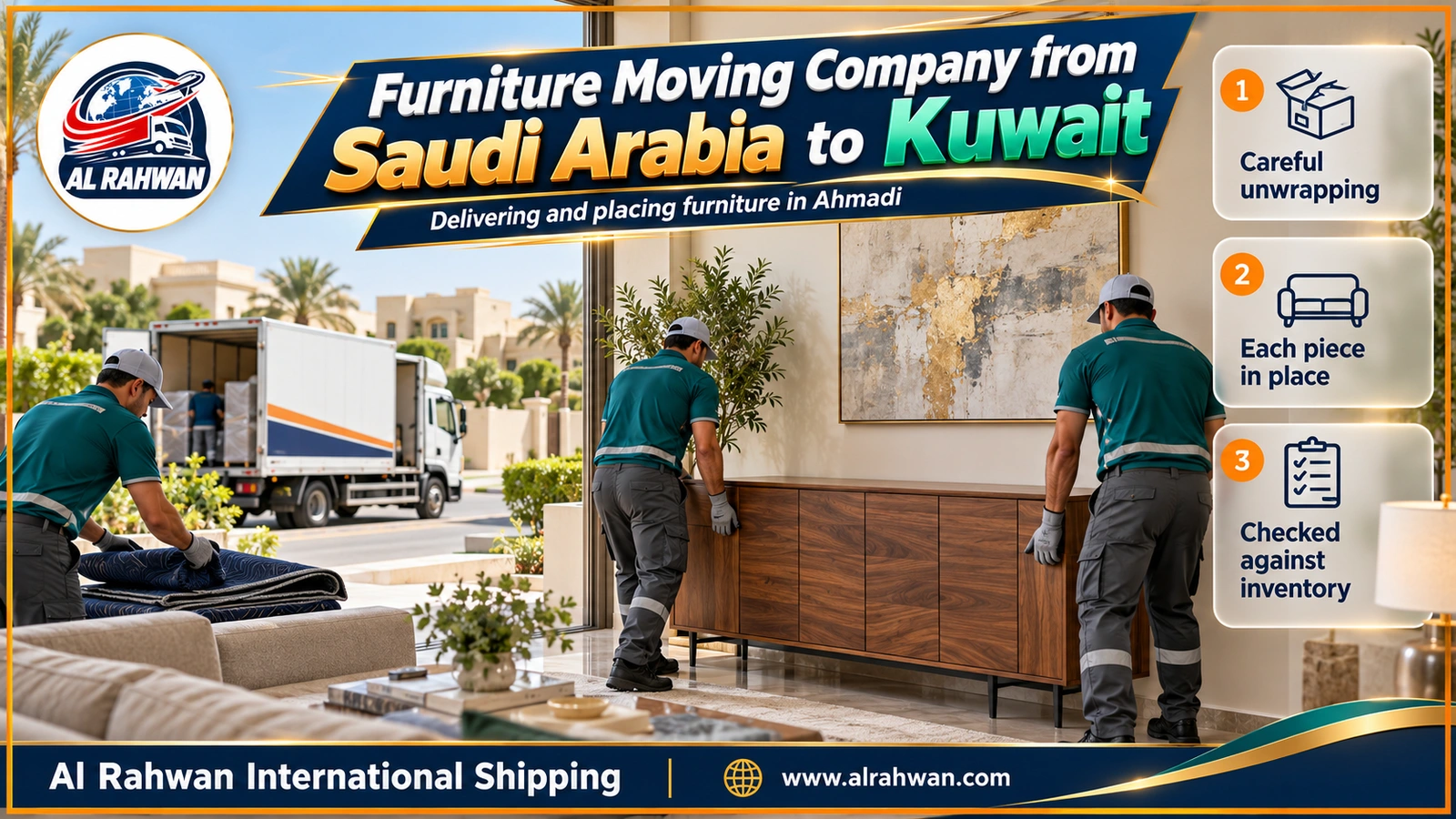
The Al Rahwan crew delivers furniture to all six governorates, unpacks in the home itself, puts each piece in its place, reassembles the chandelier and hangs mirrors on the walls if you ask, and then takes the packing materials away.
| Governorate | Areas | Note for valuable furniture |
|---|---|---|
| Capital | Kuwait City, Shuwaikh, Dasma, Kaifan, Shamiya | Towers with service lifts that need booking |
| Hawalli | Hawalli, Salmiya, Jabriya, Rumaithiya, Mishref, Bayan | Dense blocks with lift doors of varying size |
| Farwaniya | Farwaniya, Khaitan, Jleeb Al Shuyoukh, Rabiya, Ardiya | Early unloading to avoid traffic |
| Mubarak Al Kabeer | Sabah Al Salem, Adan, Qurain, Messila | Houses that usually have wide entrances |
| Ahmadi | Fahaheel, Mangaf, Fintas, Mahboula, Wafra, Sabah Al Ahmad | The governorate trucks from the Eastern Province reach first |
| Jahra | Jahra, Saad Al Abdullah, Abdali | The first area reached after entering at Al Salmi |
Delivery day: opening the crates and checking the pieces
In Kuwait, wooden crates are opened inside the home, not on the street, because a piece out of its crate is at its most vulnerable. The mover undoes the screws, lifts the lid and takes the piece out the same way it went in. Then each valuable piece is checked with you against its photo on the inventory.
If you notice anything, record it on the delivery note before signing and photograph it in place. That is not an accusation; it is the only way insurance works. After the check, the crew reassembles the chandelier and hangs mirrors and paintings if you wish, and takes the empty crates and packing away, unless you want to keep some crates for a future move.
Steps to move your furniture with Al Rahwan
- Start with a call to 0568829975, or complete the online Request a shipping quote form at any time.
- Book the survey and point out the valuable pieces to the supervisor by name.
- Receive the itemised quote, with crates, special packing and insurance each on its own line.
- Send the dimensions of the Kuwaiti building’s lift and its management’s conditions.
- Send the documents and the FASAH authorisation.
- On packing day, review the photos and condition notes on the inventory and sign.
- Follow the notifications, take delivery in Kuwait and check every piece before signing.
Mistakes that damage valuable furniture
- Tight plastic directly on leather and fabric: it traps moisture and leaves stains.
- Carrying marble flat: the most common way stone tops snap in the middle.
- Leaving glass on its base: a table top must be separated and wrapped on its own.
- Not measuring the Kuwaiti lift: the crew finds out at the door.
- Insuring with one total value: it does not protect the expensive piece at its value.
- Not photographing existing defects: it opens an unnecessary dispute at delivery.
- Polish and varnish inside the cartons: flammable materials that cannot travel.
Why Al Rahwan for your valuable furniture?
- Packing by material: not one roll of plastic for everything.
- Made-to-measure wooden crates: for marble, mirrors, paintings and antiques.
- Carpenters and chandelier and air-conditioning technicians: who dismantle and reassemble in Kuwait.
- A dedicated closed truck when needed: with no transfers at consolidation points.
- Hoists for upper floors: when the lift is too small and the stairs will not do.
- A photo inventory recording each piece’s condition: protecting you at delivery.
- Routing that fits your city: the coastal pair of border posts or the Hafar Al Batin pair, whichever is shorter for you.
- Global coverage: whether by truck, ship or plane, Al Rahwan can deliver to any country, with Kuwait near the top of the list.
If you are moving a full home with all its everyday contents and only a few valuable pieces, the Home removals company from Saudi Arabia to Kuwait page explains the whole move stage by stage, and for goods and parcels see Shipping company from Saudi Arabia to Kuwait. A survey can be booked on 0568829975.
Related articles and pages
- Shipping to Kuwait: the destination page with crossings and services
- Shipping company from Saudi Arabia to Kuwait
- Home removals company from Saudi Arabia to Kuwait
- Best furniture moving company from Riyadh to Kuwait
- Best furniture moving company from Jeddah to Kuwait
- Best home removals company from Saudi Arabia to Kuwait
- Request a shipping quote: send your list of pieces and receive an itemised quote
Frequently Asked Questions
How much does it cost to move furniture from Saudi Arabia to Kuwait?
SAR 1,350 at minimum for a room’s contents, SAR 2,300 when the flat has three bedrooms, SAR 3,700 for a villa, while wooden crates and special packing are priced after the free survey.
How long does a furniture move from Saudi Arabia to Kuwait take?
1 to 2 days from the east and Al Ahsa via Al Khafji and Al Nuwaiseeb, two or three from Riyadh or Qassim via Al Ruqai and Al Salmi, and up to five from Jeddah, Makkah, Madinah or Taif, counted from loading.
When does furniture need a wooden crate?
For marble, granite, large mirrors, paintings, antiques and dismantled chandeliers, meaning any piece that cannot bend or take weight on top; the crate is built to its size.
How do you pack a crystal chandelier for Kuwait?
It is photographed, its drops and arms are removed into numbered bags, the frame goes into a padded crate and the drops into padded boxes, and it is reassembled in Kuwait.
Do you move pianos from Saudi Arabia to Kuwait?
Yes, an upright piano travels upright on a dedicated dolly, strapped inside the truck, and the survey decides whether it needs the stairs or an external hoist.
How is a leather sofa packed without damage?
Soft paper against the leather first, then a moving blanket, then an outer cover, with no tight plastic directly on the leather so it does not sweat and stain.
Is valuable furniture insured during the move?
Yes, choose it at booking and set the value of each valuable piece yourself; cover is built on those values and the inventory photos, priced on a separate line.
What documents are needed to move furniture to Kuwait?
4 documents cover an individual: an iqama or ID copy, an itemised inventory, the agent’s FASAH authorisation, and the Kuwaiti receiver’s name, number and address, sometimes with a copy of their civil ID.
What is the price of shipping a luxury car with the furniture to Kuwait?
SAR 4,150 is the lowest price for a prestige car in a closed transporter, a sedan sharing an open carrier starts from SAR 920, and either arrives in two to four days.
Do you move office and embassy furniture to Kuwait?
Yes, Al Rahwan moves the furniture of offices, organisations, public bodies and embassies, keeping the organisation’s property separate from staff belongings, with pallets from SAR 550.
What if the lift in my Kuwait building is small?
Send the lift dimensions before loading, and the Al Rahwan team decides from the start whether to dismantle the piece, carry it up the stairs or use an external hoist where the building allows.
Can a painting or small antique be flown to Kuwait?
Yes, a painting or antique can arrive by air in a day or two, priced from SAR 28 a kilo on whichever is higher, its weight or its size.
Is Al Rahwan available around the clock?
Online requests are open 24 hours, and phone 0568829975 is answered every day from 7 am to 11 pm.
Which materials cannot travel with fine furniture?
Varnish, polish, wax, air fresheners, gas cylinders and fuel cannot travel because they are flammable, and medicines in quantity need declaration or approval.