 United Arab Emirates
 Qatar
 Kuwait
 Bahrain
 Oman
 Iraq
 Turkey
 Lebanon
 Syria
 Jordan
 Egypt
 Morocco
 Tunisia
 Algeria
 Libya
 Sudan

Al Rahwan, as a Furniture Moving Company from Saudi Arabia to Jordan, puts the focus on the furniture itself whenever it is the centre of your move rather than the whole house: a hand-woven-rug majlis, a marble table, chandeliers and glass, paintings and pieces gathered over the years. For each such piece Al Rahwan builds a made-to-measure crate or a material-specific wrap, shipping it afterward in a closed truck through the Al-Haditha crossing on to Zarqa, Amman and the rest of Jordan’s governorates. Transit takes 3–4 days from Riyadh and 3–5 days from Jeddah, with pricing starting from SAR 1,300 for one room of furniture, while anything without a fixed price, such as a made-to-measure wooden crate, waits for a free survey first. Call 0568829975 and describe the pieces you are moving along with how delicate they are.
🧭 In this guide59 sectionsShowHide
This page treats furniture as a physical product with real material properties: wood that expands and cracks, glass that shatters with a single impact, leather that stiffens in heat, and metal that rusts with moisture. Every material needs to be understood before it is wrapped and shipped, not given one generic wrap the way many providers treat “household goods” as a single uniform mass.
- some 36–38 km from Al Qurayyat city, a further 135 km reaches Zarqa, the first big stop before Amman.
- Transit: 3–4 days from Riyadh and Qassim, 3–5 days from Jeddah, Makkah and Madinah.
- Protection: made-to-measure wooden crates for glass, chandeliers and antiques, not one generic wrap for everything.
- Pricing: one room of furniture from SAR 1,300, a commercial pallet from SAR 600.
- Insurance: optional, on a declared value with a photographed inventory.
- Delivery: placement in Zarqa, Amman and the rest of Jordan’s governorates.
The difference between “home removals” and “furniture moving”
A home removal covers the whole house with everything inside it, dismantling and wrapping through to reassembly, detailed on Home Removals Company from Saudi Arabia to Jordan , or it can simply be trucked without dismantling and reassembly as covered on Furniture Shipping from Saudi Arabia to Jordan . Furniture here is a different, deeper angle, zooming in on the pieces themselves, their sensitivity, material and value, whether part of a whole house or shipped on their own, such as a single marble table or a set of paintings. Both services together are needed by anyone moving a whole house that includes valuable pieces: the full home removal, plus the special protection this page details for those particular pieces.
Quick comparison: the two services
| Element | Home removal (whole house) | Furniture moving (valuable pieces) |
|---|---|---|
| Scope | Everything in the house, kitchen to bedrooms | Specific pieces, whether part of a house or an independent shipment |
| Packing | General, by the broad furniture type | Specific to each piece’s material: wood, glass, leather, marble |
| Wooden crates | For glass and chandeliers only when present | Essential for most valuable pieces, built to exact measure |
| Insurance | Optional on the value of the whole house | Strongly recommended on each valuable piece individually |
Material categories and what each one needs
The most common mistake with fine furniture is treating it as a single material: wrapping everything in the same paper and blankets with no distinction between wood, glass, leather and metal. Each material behaves differently under heat, vibration and moisture, and that behaviour needs to be understood before anything is even touched.
Solid and finished wood
Wood expands and contracts with the temperature change between the Kingdom’s south and north, so painted or gilded surfaces are first wrapped in acid-free paper so nothing sticks to the finish, then blankets, then reinforced cardboard corners on the edges. Untreated natural wood on a long journey needs small ventilation gaps in its crate, because sealing it completely without airflow can trap internal moisture that affects it weeks later.
Glass, mirrors and crystal
Every glass piece is wrapped in several layers of bubble wrap and loaded standing, never flat, because a flat position exposes it to even pressure across its surface that can crack it without any direct impact. Finely manufactured crystal, such as chandelier pieces, is wrapped individually piece by piece, since it is thinner than ordinary glass and more sensitive to lateral pressure.
Leather
Leather stiffens and cracks in dry heat, so it is wrapped in clean cloth or paper that allows light ventilation, with no tape ever touching its surface directly, since adhesive leaves a permanent mark on natural leather that is not easily removed.
Metal and marble
Marble and granite travel in a wooden crate when they form one large piece, given their weight and tendency to crack under lateral impact despite their apparent solidity. Polished metals such as bronze and copper are wrapped in soft cloth to prevent scratching their shiny surface, since a single scratch on a polished surface shows clearly in a way it would not on an unpolished one.
Hand-woven rugs and textiles
A hand-woven rug is rolled, never folded, since folding breaks its threads over time, then wrapped in clean cloth before an outer plastic cover that protects it from road moisture. Valuable textiles such as embroidered curtains or rare fabrics are kept in breathable cloth bags, not sealed plastic bags that trap moisture.
Does your piece need a wooden crate or just wrapping?
Not every valuable piece necessarily needs a wooden crate; the decision comes down to three questions: is the piece glass, crystal or an easily breakable material? Is it irreplaceable or rare? And is its journey relatively long, such as one coming from Jeddah or Khamis Mushait? If the answer is yes to two or more of these, a wooden crate is the safer option over wrapping alone. Solid wooden pieces such as an ordinary wooden cabinet usually do fine with blanket and paper wrapping without an extra crate, unless they carry fine finish or inlay work that calls for greater protection.
In every case, the final decision rests with the technician after actually seeing the piece or clear photos of it, since they are best placed to judge its real sensitivity, not just a description of it.
How to prepare your valuable pieces before the survey
- Gather the valuable pieces in one place if possible, to make accurate measuring easier.
- Photograph them from multiple angles before any wrapping, since these photos are the basis of insurance and any later claim.
- Note any existing scratch or old damage, since recording it before loading removes any doubt about when it happened.
- Don’t wait until loading day to measure large pieces, since their wooden crates need time to be built after the survey.
- Mention if a piece is part of a set, such as a crystal set or a group of paintings, so they are wrapped and numbered together.
How is a survey of valuable pieces done?
A survey is a step that cannot be skipped when moving valuable furniture, and it happens in three ways: a technician visiting your home to see the pieces and take precise measurements, a video call where you describe the pieces and measure their basic dimensions yourself with an ordinary tape measure, or clear photos from multiple angles with the dimensions written next to each piece. All three methods are free and place no obligation on you to book.
In an in-person survey, the technician looks at the piece’s current condition (scratches, old breaks, previously loosened parts), measures its three dimensions to determine the wooden crate size if it needs one, and asks how it is dismantled if it can be taken apart, such as a display cabinet or a chandelier. From this information the itemized quote is built: wrapping, the wooden crate if needed, transport, and insurance if requested. Crate manufacturing usually begins after booking is confirmed and the deposit is paid, so anyone needing crates for several pieces should book the survey with enough lead time before their preferred shipping date.
Made-to-measure wooden crates
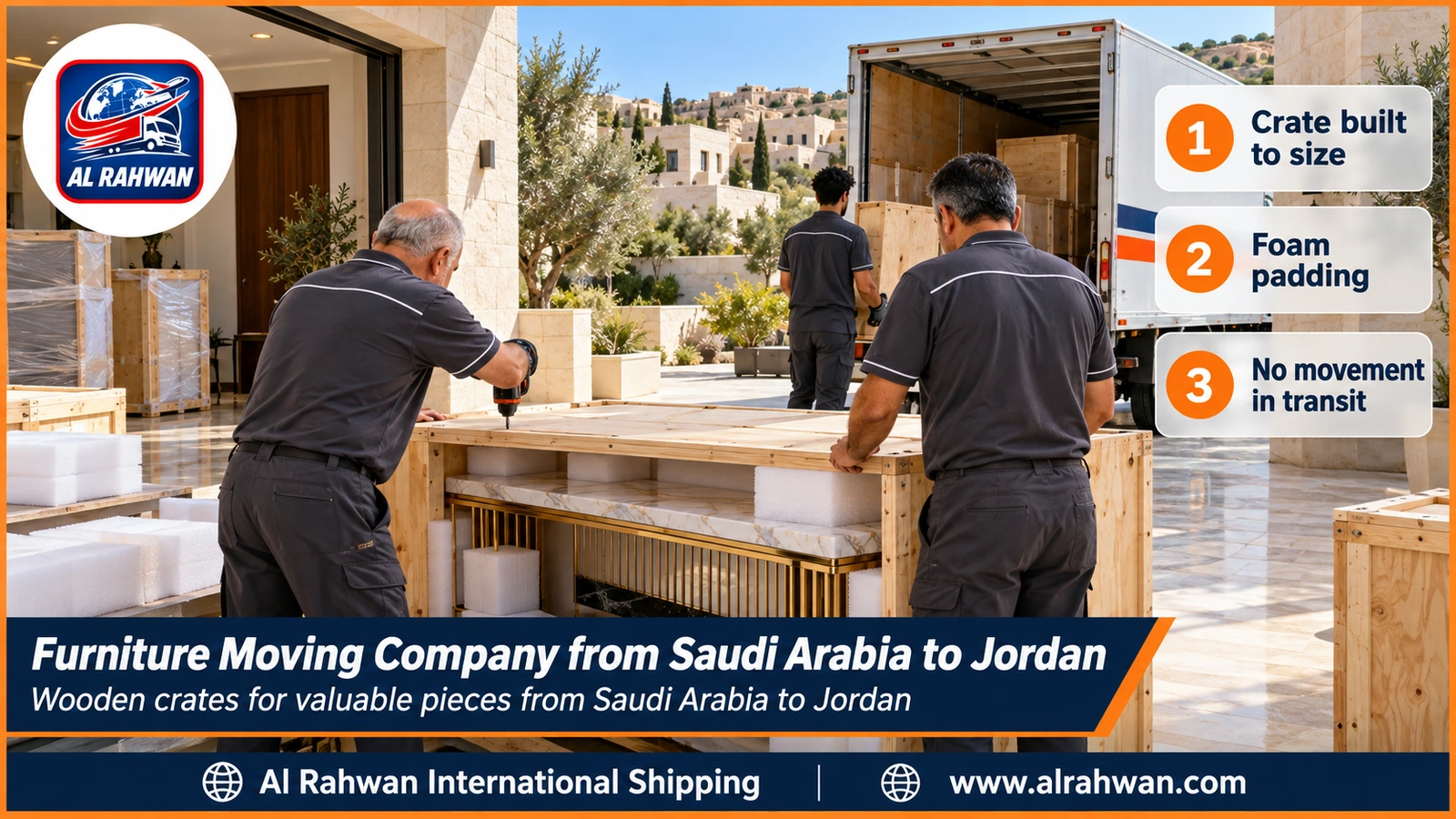
A piece that ordinary wrapping cannot protect gets a wooden crate built exactly to its measurements: walls of pressed or solid wood, internal padding with foam or sponge that stops the piece moving at all inside the crate, and small ventilation openings for the pieces that need them, such as some natural woods. The crate is built after the technician sees the piece or its precise dimensions, since no single size fits everything, and its price is set after a free survey or an itemized quote based on each piece’s dimensions.
How the crate is built also differs by the piece’s own shape: a round table needs a cylindrical or square crate padded evenly on every side, while a long piece such as a glass display cabinet needs internal supports that prevent its long sides bowing under its own weight over days on the road. Every crate is marked on the outside with the piece’s name and a clear “fragile” warning, so everyone who handles it at each stage of transport treats it with the appropriate care.
Glass, mirrors and chandeliers
A chandelier needs careful disassembly before any wrapping: its arms and crystal pieces are removed one by one and each piece is wrapped separately in bubble wrap, then the main frame goes into a padded wooden crate marked with the room it will be hung in again. Large mirrors and glass-top tables are loaded standing between soft pieces, not directly against the truck’s metal wall, which transfers the full vibration of the road straight into them.
One piece that is frequently mishandled is a glass display cabinet with sliding doors: the doors are removed first and wrapped separately, then the wooden or metal frame is wrapped, since moving the whole cabinet with its doors closed puts pressure on its hinges that they cannot withstand over a journey lasting days.

Antiques and paintings
A painting first faces acid-free paper on its front, then corner protectors on its frame, then a crate built exactly to its size that gives it no room to move inside. Antiques and vases are secured inside their crate with packing material that prevents them striking its sides on any bump in the road. Any antique or especially valuable piece is best photographed from its different angles before wrapping, since these photos are the basis of any insurance claim.
Large sets of paintings travelling together, such as a full collection by one artist or a set gathered over years, are numbered and kept in a single crate divided by internal dividers that prevent their surfaces touching each other, rather than each painting in its own separate crate, which raises cost with no real need.
Office and showroom furniture
Dismantling luxury desks and large meeting tables into their main parts comes first, with each part numbered on a simple diagram for reassembly in the same order. Glass display shelves, lighting and facades in showrooms and display halls are each wrapped piece by piece, with glass going into wooden crates as described earlier. Once the goods on those shelves are travelling too, they shift from the furniture category into commercial goods, needing the trader’s papers instead: register, invoice, packing list, and a certificate of origin if customs requests one.
Clinic and medical office furniture needs similar care: delicate equipment is separated from its furniture and wrapped individually, and examination tables and glass cabinets are treated like display cabinets, with their doors removed first. A full office relocation, including upholstered meeting chairs and filing cabinets, needs precise numbering by the room it will return to.
Showroom and warehouse furniture
Metal warehouse shelving is dismantled and strapped in bundles, and goods on pallets are shrink-wrapped tightly. Commercial pallets are priced from SAR 600 per pallet, while large quantities and heavy equipment need an itemized quote after a survey, and a 20-foot container starts from SAR 4,800 and a 40-foot container from SAR 8,100 for traders choosing sea freight as a limited secondary option.
This sea option is never suitable for personal fine furniture in any case, since it is meant only for large, pre-coordinated commercial quantities; your personal fine furniture, however large, always travels by closed truck through the Al-Haditha crossing.
Comparing road, air and sea for moving furniture
| Mode | Best suited for | Approximate duration |
|---|---|---|
| Road (closed truck) | All personal fine furniture of any size, and the main and only recommended mode here | 3–5 days from most cities |
| Air | Very small, highly valuable pieces that need speed, such as a jewellery box or a small art piece | 24–48 hours |
| Sea (containers) | Large, pre-coordinated commercial quantities, not personal furniture | Much longer than road, and unsuited to the sensitivity of valuable pieces |
This table sums up an important idea: road is naturally the right choice for your personal fine furniture every time, air is an exceptional choice for a single small piece, and sea is a purely commercial choice unsuited to delicate pieces that need individual care in wrapping and handling.
From other cities not listed above
From Hail, Al Jouf, Arar, Hafr Al-Batin, Najran, Jazan, Yanbu and AlUla, your valuable pieces are loaded into a closed truck from your door, or joined to the nearest run heading to the Al-Haditha crossing after wrapping and crate-building. The team confirms the nearest run heading north from your city at booking, so you get a clear estimated duration.
The stages of moving your furniture, from the call to placement
| Stage | What happens |
|---|---|
| Survey | A technician sees the pieces or their photos and takes precise measurements for free |
| Quote | Itemized: wrapping, wooden crates if needed, transport, insurance if requested |
| Crate building | After the deposit, to each piece’s actual dimensions |
| Wrapping and loading | Each material its own way, then stacking and strapping inside the closed truck |
| Crossing | The Al-Haditha crossing on the Saudi side, the Al-Omari centre on the Jordanian side, with WhatsApp updates |
| Delivery and placement | Crates opened in front of you, pieces placed, then sign-off on delivery |
This order does not change with shipment size, whether it is one valuable piece or a full showroom collection; what changes is how long each stage alone takes, since building several wooden crates needs more time than one, and that is what the technician determines right after the survey.
Furniture moving time from every Saudi city
| Your city | Transit time to Jordan |
|---|---|
| Tabuk | 1–2 days |
| Riyadh and Qassim | 3–4 days |
| Dammam and Al Ahsa | 4–5 days |
| Jeddah, Makkah, Madinah and Taif | 3–5 days |
| Khamis Mushait | 5–7 days |
These durations include clearance on both sides, and they don’t change because of how delicate the pieces are; what changes is the wrapping time before loading, since a large number of valuable pieces may need an extra day or two for careful wrapping and crate building before the truck actually starts its road. As in the rest of the batch, Tabuk is the closest city to the Al-Haditha crossing on this table, while Khamis Mushait needs to cross the whole Kingdom northward first.
Furniture moving prices from Saudi Arabia to Jordan
| Item | Starts from |
|---|---|
| Partial load in a shared truck | SAR 1,100 |
| One room of furniture | SAR 1,300 |
| Three-bedroom flat with appliances | SAR 2,400 |
| Villa or whole house | SAR 3,900 |
| Dedicated closed truck (move only) | SAR 2,450 |
| Car on a dedicated carrier | SAR 1,450 |
| Luxury car inside a closed carrier | SAR 4,300 |
| Commercial pallet | SAR 600 |
Worked examples
A family moving a majlis set, a marble table and two chandeliers from Riyadh, with their car on a dedicated carrier: SAR 1,300 for the majlis furniture (one room) plus SAR 1,450 for the dedicated carrier, for a starting total of SAR 2,750, plus the wooden crate cost for the marble and the two chandeliers once the technician sees their exact dimensions.
A painting collector moving five paintings and one antique vase from Jeddah with no other furniture: a partial load in a shared truck from SAR 1,100, plus a shared crate for the five paintings and a separate crate for the vase, priced after a survey.
A showroom trader moving two glass display cabinets and two pallets of goods to their showroom in Amman: 2 × SAR 600 = SAR 1,200 for the pallets, plus crates for the two glass display cabinets after a survey, and full commercial papers since the goods on the shelves will be sold.
Anything without a fixed price, like a made-to-measure wooden crate, is always set after a free survey or an itemized quote, never guessed over the phone.
Why does a wooden crate’s price differ from piece to piece?
A wooden crate’s price is never one fixed number, because three factors control it: the piece’s size and the area of wood its walls need, the type of internal padding, and how complex the piece’s own shape is. A simple square crate for a rectangular table is cheaper than a tailored crate for a display cabinet with corners and internal drawers, since the latter needs longer carpentry time and extra internal supports. That is why the team won’t quote a crate price without a survey or clear photos with dimensions.
Shipping your car with the furniture
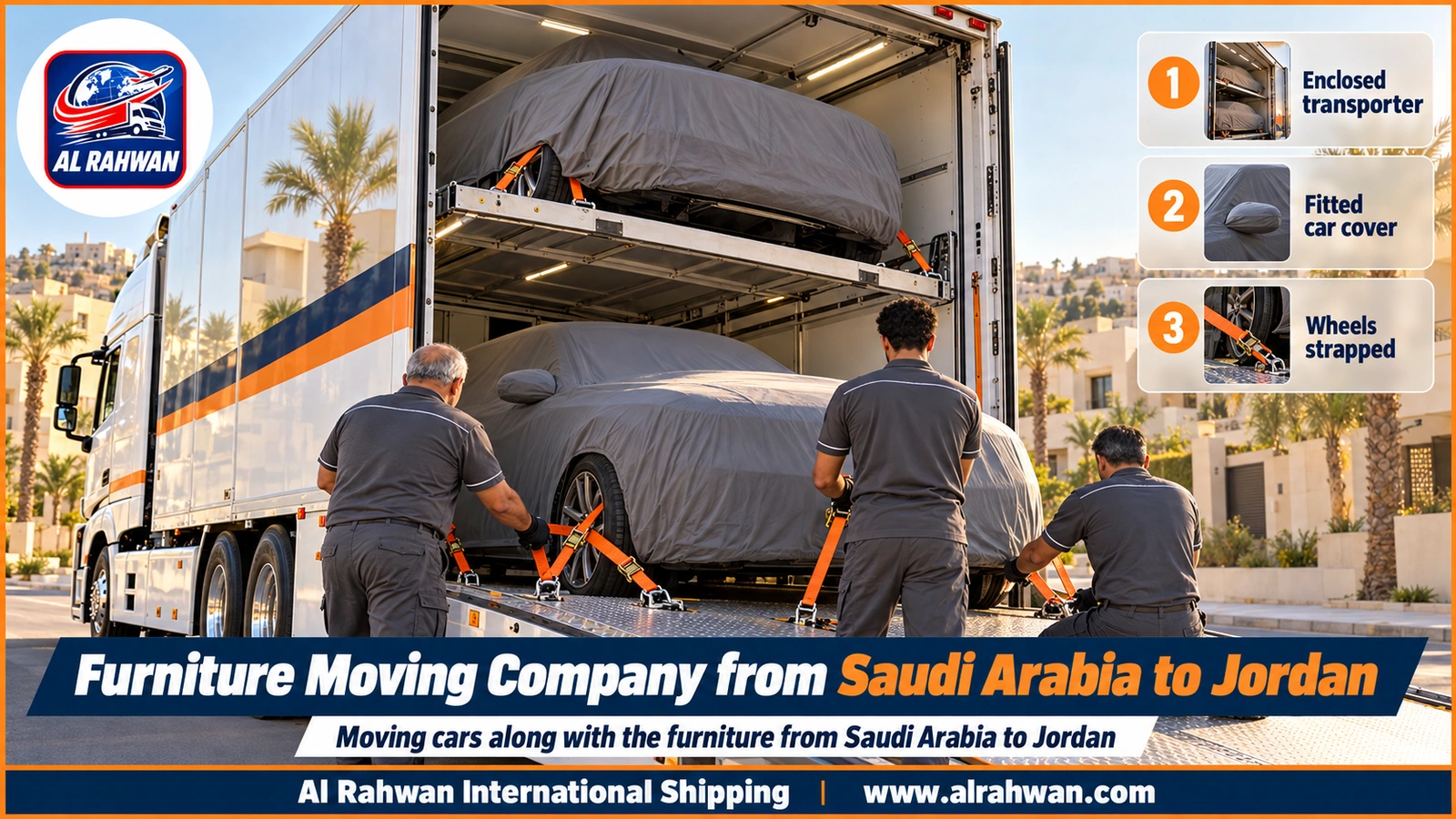
Your car is shipped the same week on a multi-level carrier, covered and secured with straps at the wheels and body:
| Car shipping method | Starts from |
|---|---|
| Sedan on a shared carrier | SAR 980 |
| SUV on a shared carrier | SAR 1,180 |
| Car on a dedicated carrier | SAR 1,450 |
| Luxury car inside a closed carrier | SAR 4,300 |
diesel, tinted glass, and over-five cars are refused, permanent entry into Jordan, registration wraps up at the Zarqa free zone, the owner pays for it, the temporary option runs three months, one renewal, with a bank guarantee needed in some cases.
Local transport before loading
In homes on narrow lanes or in older neighbourhoods a large truck cannot enter, a small pickup is used to move the valuable pieces from the house to the closed truck on the nearest wide street. That small pickup is for local transport only; what crosses the border into Jordan is the closed truck alone.
In buildings with upper floors and no lift suitable for the pieces’ size, such as a heavy marble table or a large display cabinet, a specialist carrying crew brings it down carefully through the stairwell with calculated turning angles, and a very large piece may need a door frame temporarily removed — something decided at the survey, not at the moment of loading.
Loading and securing
Inside the truck, wooden crates and wrapped pieces are stacked with the heaviest items at the base near the front, glass kept upright between soft items, with mattresses and soft pieces forming a wall that shields whatever sits behind them. Strapping happens in stages, leaving no gaps that would let crates shift during the long journey, and before the door closes the supervisor goes through the inventory list together with the owner.
Crossing and customs, briefly
the sender authorises the clearing agent on Fasah, owned by the Zakat, Tax, Customs Authority, and lodge the export declaration electronically, before the truck heads out of the Kingdom, some cartons may be opened there to confirm, Jordanian customs takes the file on at Al-Omari.
Required papers
| Shipment type | Papers |
|---|---|
| Fine furniture and personal valuables | Passport and ID copy, a bilingual inventory list with every piece and its size, a clearance authorization (“Fasah”) for the broker |
| Recipient details in Jordan | Full name, the governorate, city and neighbourhood, a Jordanian phone number, the floor and whether a lift serves it |
| Showroom and warehouse commercial furniture | Commercial invoice, commercial register, packing list, the importer’s details in Jordan, certificate of origin on request |
| The car | Valid registration, plates, owner ID, bank letter if financed, settled traffic fines |
the agent gets authorisation through the Fasah platform, the Zakat, Tax and Customs Authority’s platform, to submit the export declaration digitally, before the truck rolls out of the Kingdom, the inspector might open two or three cartons there, at Al-Omari, Jordanian customs takes charge of the file.
Prohibited items
drugs, weapons and ammunition are banned outright, and counterfeit goods or censored publications are turned away, a CB-type wireless device needs prior clearance, alcohol is kept to a simple personal amount, fresh meat, dairy and vegetables need an agri permit, the deciding voice stays with customs on both sides.
Antiques, heritage pieces and provenance papers
A genuinely antique or heritage piece may need extra papers proving ownership or provenance, especially if it will later be displayed or faces a detailed customs inspection. Anyone holding an old purchase invoice or a certificate from a known seller for that piece should keep a copy of it within the shipment file, since it eases any potential customs query and never hurts to have on hand. Ordinary antiques collected over the years without formal documentation are covered sufficiently by the inventory list and the photos described earlier.
Any piece suspected of being antique in the sense of protected national heritage subject to antiquities-protection regulations should be referred to the relevant official authority before shipping, since that falls outside the scope of this ordinary commercial service for personal belongings.
Air freight for small valuable pieces
A piece that is small, valuable and cannot wait for the truck, such as a jewellery box or a miniature art piece, may travel by air instead, landing at Queen Alia International Airport near Amman inside 24 to 48 hours after leaving King Khalid Airport in Riyadh, King Abdulaziz Airport in Jeddah, or King Fahd Airport in Dammam. Air pricing starts from SAR 30 per kilogram, billed on whichever is greater between the scale’s actual reading and the dimensional weight found from the piece’s length, width and height in centimetres divided by 6000.
Delivery and placement in Zarqa, Amman and the rest of the governorates
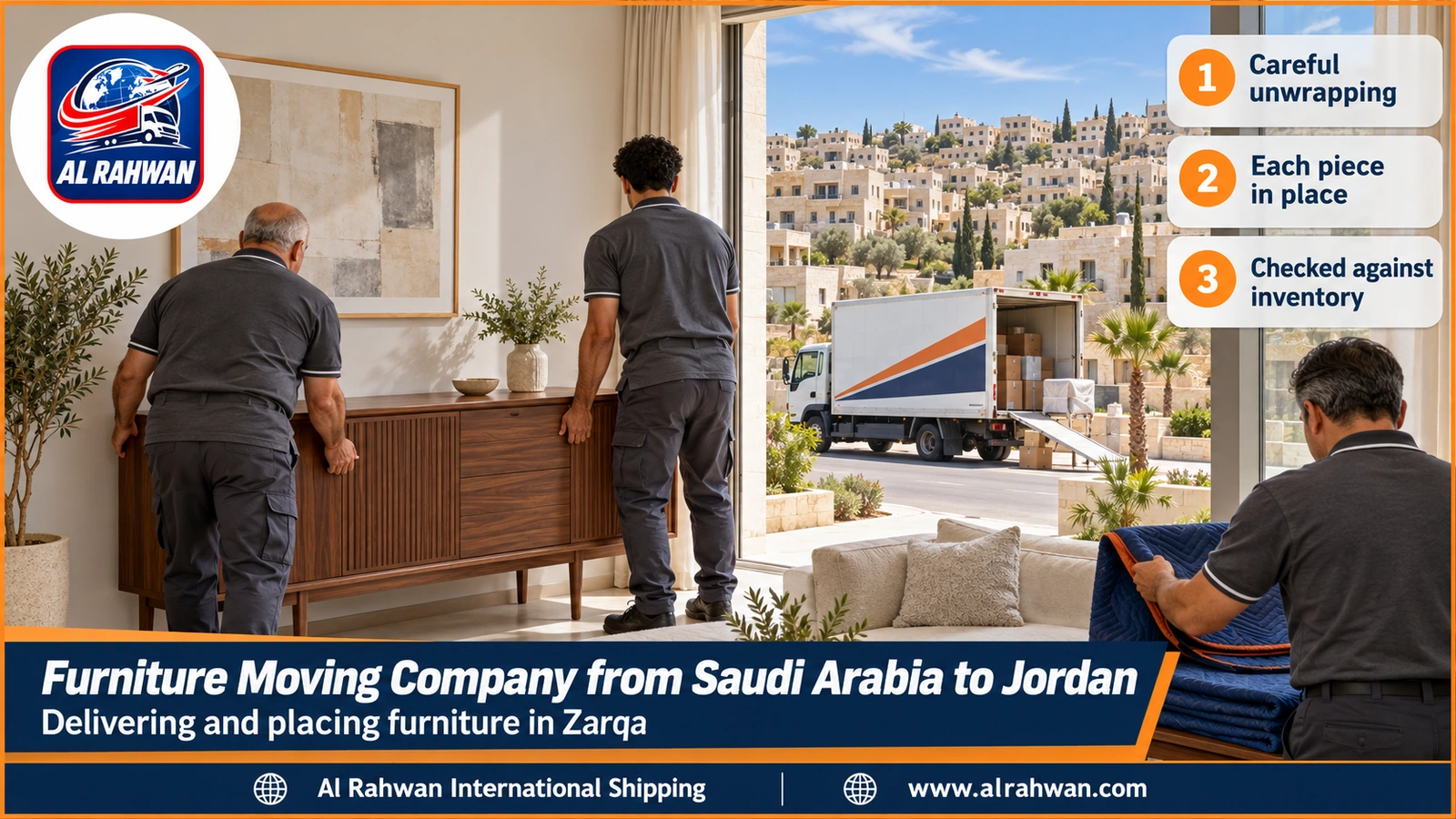
Past the Al-Omari centre, Zarqa is the first major city on the road, with Amman following it, and Al Rahwan also delivers in full to all twelve Jordanian governorates: Irbid, Balqa, Madaba, Karak, Tafilah, Ma’an, Aqaba, Mafraq, Jerash and Ajloun. According to its numbering, the team brings every piece to its place, opens the wooden crates in front of you, hangs the chandeliers and sets the glass and paintings where they belong, then reviews the inventory list with you once more before delivery is signed for.
Insurance and tracking
Insurance matters here more than on any other shipment, since the pieces you are moving are usually not easily replaceable. It is calculated on a value you declare yourself for each piece, along with a photographed inventory from multiple angles proving its condition before loading. Anyone moving antiques, paintings or heritage pieces should request insurance every time, without hesitation.
Tracking arrives as WhatsApp updates at loading, on reaching the Al-Haditha crossing, on crossing into Jordan, and at delivery.
Storing valuable pieces before shipping or after arrival
Anyone moving between two dates, such as selling their current home before their new one in Jordan is ready, usually needs an interim storage period for their valuable pieces. Pieces are stored inside the same wooden crates or wrapping they travelled in, in an enclosed place away from direct moisture, whether in Saudi Arabia before shipping or in Jordan after arrival and before final delivery.
Storage pricing is set after the supervisor sees the pieces’ actual size and the number of weeks needed, since no fixed figure suits every case. Anyone who already knows they’ll need storage should mention it in the first quote so the correct duration and location are factored in from the start, instead of a later surprise in price.
What if a valuable piece is damaged on the way?
Your first reference in any dispute is the signed inventory list together with the photos taken before loading. Should a scratch or break appear when the crate is opened in Jordan, keep the crate itself and its padding material rather than discarding them, photograph the piece and the crate side by side in front of the supervisor, and sign your note on the delivery copy at once. Compensation for anyone who requested insurance at booking rests on the photos sent before loading plus the signed list, assessed against the value declared for that specific piece rather than the whole shipment’s value.
Collection from more than one address
If your valuable pieces are spread between your home and a storage warehouse or a relative’s house, the team visits all the addresses in the same city and combines them, once wrapped, into a single truck, and every address and the pieces expected from it are listed in the quote from the start.
Payment and being present
A deposit books the appointment and starts wooden-crate building if you need it, with the rest due at loading against the signed inventory, with no instalments. Being there on loading day matters, especially with valuable pieces, so you can check every crate before it’s sealed and confirm it matches the list. If you cannot attend in person, someone you authorize can attend in your place to sign the inventory list and review the wrapping on your behalf.
Moving furniture from Jordan to Saudi Arabia
The same steps also work in the opposite direction, starting with a survey in Jordan and running through crate building to placement in your Kingdom home. The reverse path applies exactly for anyone with valuable pieces in Jordan heading to Riyadh, Jeddah or any Saudi city: a survey in Amman or Zarqa, wrapping and wooden crates as needed, crossing the Al-Haditha crossing toward Saudi Arabia, then delivery and placement at the new address.
Steps to book your furniture move
- Call 0568829975 or describe your pieces and their dimensions on WhatsApp, or fill in Request a shipping quote.
- The team sets a survey appointment for the valuable pieces to take their precise measurements.
- Receive the itemized quote, including the wooden crates, and pay the deposit.
- Send photos of your papers and the recipient’s details in Jordan, and issue the “Fasah” authorization.
- The team builds the crates and wraps the pieces, then loads and secures them in the truck.
- Follow the crossing updates until the truck enters Jordan.
- Receive the team at your address to open the crates, place the pieces and sign for delivery.
Real protection criteria before any “best” claim
Many advertisers describe their service as “the best for furniture moving” with no real standard behind it. The questions actually worth asking: are wooden crates built to measure, or is one generic wrap used for everything? Is real insurance offered on a declared value, or an absolute promise with no conditions? Are pieces photographed before loading to document their condition, or not? And is there genuine shipment tracking with notifications at clear stages? These four questions separate a real service for protecting fine furniture from an empty marketing promise.
A fifth question worth asking too: who builds the wooden crate, and does the technician see the piece themselves or rely on a phone description alone? A crate built to the wrong measurement can be more dangerous than no crate at all, because the piece moves inside it with extra room without anyone noticing until arrival.
Common mistakes when moving fine furniture
- Relying on generic wrapping for a valuable glass or wooden piece instead of a crate built to its own measure.
- Not photographing the pieces before loading, making it hard to prove their original condition in any later dispute.
- Delaying measurement of large pieces until loading day, delaying the right crate’s construction.
- Skipping insurance for pieces that can’t easily be replaced, assuming good wrapping alone is enough.
- Mixing up personal-baggage papers with commercial-goods papers when moving showroom furniture that will be sold in Jordan.
- Moving a chandelier with its arms still assembled instead of dismantling it first, so its arms take lateral pressure they were never designed for.
- Folding a hand-woven rug instead of rolling it, which breaks its threads along the fold line with repeated handling.
- Sealing a natural-wood crate completely with no ventilation on a long journey, trapping moisture that can affect it later.
Why Al Rahwan for moving your fine furniture to Jordan?
- Made-to-measure wooden crates for each piece, not one generic wrap for everything.
- Knowledge of every material’s properties: wood, glass, leather, metal and hand-woven rugs.
- Real insurance on a declared value with a photographed inventory, not absolute promises with no conditions.
- Car shipping alongside the furniture in the same week on a suitable carrier.
- Delivery and placement in Zarqa, Amman and the rest of Jordan’s governorates.
- Tracking with clear notifications at every stage of the road.
If the centre of your move is the whole house, not just the fine furniture alone, read Home Removals Company from Saudi Arabia to Jordan. And if your belongings are ready to ship without dismantling and reassembly, Furniture Shipping from Saudi Arabia to Jordan suits you better.
Contact Al Rahwan
Reach Al Rahwan’s team on 0568829975 by call or WhatsApp between roughly 7 a.m. and late evening, and for anyone who prefers typing over calling, the Request a shipping quote form stays open at any hour of the day or night.
Related articles and pages
- Shipping to Jordan: The destination page with every service and route
- Shipping Company from Saudi Arabia to Jordan
- Home Removals Company from Saudi Arabia to Jordan
- Furniture Shipping from Saudi Arabia to Jordan
- Cheapest Home Removals Company from Saudi Arabia to Jordan
- Best Furniture Moving Company from Jeddah to Jordan
- Best Furniture Moving Company from Riyadh to Jordan
- Request a shipping quote: Send photos of your pieces and their dimensions for an itemized quote
Frequently Asked Questions
What is the cost of moving furniture from Saudi Arabia to Jordan??
Prices start from SAR 1,300 for one room of furniture, SAR 3,900 for a villa, and SAR 2,400 for a three-bedroom flat, with the wooden crate price set only after a survey.
How long does moving furniture to Jordan take?
From Tabuk just one to two days, stretching to 3–4 days from Riyadh and Qassim, 4–5 days from Dammam and Al Ahsa, 3–5 days from Jeddah, Makkah, Madinah and Taif, and up to 5–7 days from Khamis Mushait.
What is the difference between home removals and furniture moving?
Home removals covers the whole house, including dismantling and reassembly, while furniture moving is a narrower angle focused on the valuable pieces themselves and their special protection with crates and materials suited to each one.
Do you build made-to-measure wooden crates?
Yes, for every valuable piece such as a marble table, a chandelier or a painting, after surveying its exact dimensions.
Can the car be shipped along with the furniture?
Yes, on a shared carrier a sedan starts from SAR 980 and an SUV from SAR 1,180, while a luxury car in a closed carrier starts from SAR 4,300.
Which crossing does the furniture cross through into Jordan?
The Al-Haditha crossing on the Saudi side, and the Al-Omari centre on the Jordanian side, about 135 km from there to Zarqa.
Is commercial furniture offered for sale treated differently?
Yes, Jordan Customs handles it under the rules in force at the time of shipment, and it needs full commercial papers, not personal-baggage papers.
Is there air freight for small valuable pieces?
Yes, it reaches Queen Alia International Airport within 24–48 hours, and chargeable weight starts from SAR 30 per kilogram.
Do you offer insurance on fine furniture?
Yes, strongly recommended in fact for pieces like these, based on a value you declare and a photographed inventory taken from multiple angles.
Can furniture be stored before or after the move?
Yes, whether before shipping or after arrival, with the price set after a survey of size and the number of weeks needed.
How do I pay?
A deposit starts crate building if you need it, with the rest due at loading, with no instalments.
Do I need to be there on loading day?
Being there is best, especially with valuable pieces, to check every crate before it is sealed.
Which Jordanian cities do you deliver and place furniture in?
Mainly Zarqa and Amman, and in the rest of Jordan’s twelve governorates in full as well.
Do you move furniture from Jordan to Saudi Arabia?
Yes, the service runs in both directions with the same steps.